By February 1944, the air war over Germany had become something very different from the fighter combat of 1940. German pilots were facing heavily armed bomber formations, increasingly protected by long-range escort fighters. Among those whose careers spanned this transformation was Wilhelm Schilling. He had fought in the West, served on the Eastern Front near Leningrad and eventually returned to defend Germany against Allied bombing. [1][2][3]
At a glance
| Field | Information |
|---|---|
| Born | 30 January 1915 |
| Died | 14 March 2000 |
| Country / service | Nazi Germany / Luftwaffe |
| Duties | Fighter pilot, squadron leader, instructor |
| Principal wing | Jagdgeschwader 54 (JG 54) |
| Squadrons | 9./JG 54; later 5./JG 54 |
| Theatres | Western Europe, Eastern Front, Defence of the Reich |
| Aircraft family | Messerschmitt Bf 109 |
| Best-known aircraft | Bf 109 G-6 “Yellow 1” |
| Victory claims | Commonly 50; 13 additional claims disputed |
| Combat missions | Reported as 538 |
| Wartime award | Knight’s Cross, 10 October 1942 |
His name survives especially through a Messerschmitt Bf 109 G-6 marked “Yellow 1”. The aircraft appears in scale-model painting guides, historical photographs and accounts of February 1944. Yet a closer look reveals a complication: the same marking may have belonged to more than one airframe, with dates, factory numbers and accounts of what happened to the pilot sometimes combined into a single familiar story. [2][4][5][6]
The first campaigns: France and Britain, 1940
Wilhelm Schilling was born on 30 January 1915. After completing flying training, he joined 3./JG 21 as a non-commissioned pilot early in 1940. During the German offensive in Western Europe, he received credit for his first air victory claim: a Hawker Hurricane over Brussels on 12 May 1940. This was the beginning of a long service record rather than evidence that every later wartime claim would be independently confirmed. [1][2]
The fighter unit was reorganised that summer and became part of III./JG 54. During the Battle of Britain, three more claims followed: Spitfires on 12 August and 5 September 1940, then a Bristol Blenheim over the North Sea on 8 November. These dates appear consistently in the biographical summaries, but victory claims should not automatically be equated with verified losses recorded by the opposing air force. [1][2]
The Eastern Front and the siege of Leningrad
The unit subsequently moved east. On 22 June 1941, Nazi Germany invaded the Soviet Union. Schilling’s first recorded claim in that campaign came the next day, 23 June, against a Soviet Tupolev SB bomber. JG 54 supported the advance of Army Group North and later operated around Leningrad, which German forces besieged. Such accounts need more than a tally of aircraft: the invasion and siege inflicted catastrophic suffering on civilians as well as military personnel. [1][2]
By the end of 1941, biographies attribute 17 victory claims to Schilling. He was severely wounded by ground fire on 14 February 1942, recovered and returned to operational flying. He was injured again on 16 September 1942, reportedly while flying a Bf 109 G-2 usually identified as “Yellow 3”, WNr 10436. Some accounts describe anti-aircraft fire; others note Soviet pilots’ claims from the same action. Without matching primary combat reports, it would be misleading to declare one explanation proven beyond doubt. [1][2][3]
He received the Ehrenpokal on 1 July 1942, the German Cross in Gold on 4 August and the Knight’s Cross on 10 October 1942. Accounts differ between approximately 46 and 48 credited claims at the time of the last award. These decorations belonged to Nazi Germany’s military system; their historical significance is not an endorsement of the regime or its war. [1][2][3]

Returning west: a different kind of air war
In February 1943, III./JG 54 was transferred from the Eastern Front to duties defending Germany. The change was abrupt. Pilots accustomed to smaller engagements and lower-altitude operations had to confront American heavy-bomber formations at height, with concentrated defensive fire and increasingly effective fighter escorts. Historical accounts describe particularly costly early operations as the unit adapted. [1][2]
Schilling was promoted to Oberleutnant in August 1943 and took command of 9./JG 54 later that year. Several of his additional victory claims were attributed to four-engined bombers. The new assignment, however, also exposed him to repeated losses and injuries. [1][2][3]
February 1944: the problem of “Yellow 1”
From 20 to 25 February 1944, Allied air forces launched the offensive remembered as Big Week, or Operation Argument. The US Eighth and Fifteenth Air Forces struck aircraft and engine production by day while the RAF conducted night attacks. Long-range escort fighters increasingly forced the Luftwaffe into costly engagements. The operation was intended to weaken German fighter aviation as well as aircraft production. [7]
A February 1944 incident involving Schilling and his Bf 109 G-6 “Yellow 1” is frequently dated 20 February, with the aircraft described as Werknummer 440141. That identification appears in familiar model-kit references. The difficulty is that the surviving secondary accounts are not fully consistent. A specialised photographic interpretation distinguishes a “Yellow 1” WNr 27068 lost on 10 February from WNr 440141 on 20 February. Other compiled career and modelling records give conflicting date and aircraft-number combinations. [2][3][4][5][6]
Accounts also differ over how Schilling survived the later loss: some say he made a forced landing, while another specialist interpretation describes bailing out. The responsible conclusion is not to select whichever version makes the most dramatic narrative. Schilling was involved in dangerous air combats and suffered further injury, but the exact pairing of date, airframe and escape method remains disputed in the sources consulted. [2][3][4][5]
Claim versus documentation
| Common assertion | What the sources actually establish |
|---|---|
| “63 fully confirmed victories in 538 missions” | The mission figure is widely repeated; most accounts distinguish around 50 recorded claims from 13 additional, unconfirmed claims. |
| “Schilling had only one Yellow 1” | Some specialist research distinguishes two February 1944 aircraft; the identification needs careful qualification. |
| “WNr 440141 definitely force-landed on 20 February” | Descriptions of a forced landing and a parachute escape conflict. |
| “Every period photo marked Yellow 1 shows his aircraft” | Tactical numbers were reused; an image cannot be identified from the marking alone. |
The final year: Estonia, Finland and training units
After recovering, Schilling returned east in spring 1944 and took command of 5./JG 54. His unit operated in Estonia and, during the Soviet summer offensives, supported operations in Finland and the Karelian region. These campaigns unfolded as Germany’s and Finland’s strategic circumstances became increasingly desperate. [1][2][3]
On 22 August 1944, he moved to a fighter-training assignment. He continued serving with training formations in the final months of the war. Some personnel compilations record a Hauptmann appointment by 1945, whereas shorter biographies commonly identify him as Oberleutnant; this is another reason to avoid overstating a single final rank. Wilhelm Schilling died on 14 March 2000. Reliable material about his private post-war life is limited, and no anecdotes or quotations have been invented to fill that gap. [1][2][3]
Fifty or sixty-three? Reading wartime victory totals
The figure most often associated with Schilling is 50 aerial victory claims across 538 combat missions. Some compilations mention 13 additional, unconfirmed claims, producing the larger total of 63; another personnel index simply gives 63 without the same distinction. Neither presentation is proof that 63 individual enemy losses were independently established. Accounts also attribute 41 of the recorded claims to the Eastern Front. Wartime claims, opponents’ loss documents and later propaganda were not identical sets of records. [1][2][3]
Schilling’s career is more revealing when viewed in full. The fighter tactics of 1940, the attritional warfare near Leningrad and the bomber battles of 1944 demanded different skills and carried different risks. A meaningful historical portrait need not turn every uncertainty into a heroic certainty. It should explain what the available evidence can—and cannot—tell us.
Related ModofWar stories
- Messerschmitt Bf 109 G-6 — Tamiya 1/48 “Yellow 1” scale model, the site’s own build inspired by Schilling’s aircraft markings. This is a scale model, not an archival aircraft photograph.
- Final Checks diorama, ModofWar’s own Bf 109 G-6 scene built with Tamiya and ICM kits.
References
- Steffen Arndt, “Wilhelm Schilling — Messerschmitt Bf 109 G-6,” IPMS Deutschland, May–June 2014. Detailed chronology; some numbers and dates differ from other works. ipmsdeutschland.de
- Wilhelm Schilling, English Wikipedia overview, with references to specialist bibliographies. Secondary orientation only; not independent proof. en.wikipedia.org
- Henry L. deZeng IV and Douglas G. Stankey, Luftwaffe Officer Career Summaries 1935–1945, S–Z, 1 April 2016; entry “SCHILLING, Wilhelm”. Compiled personnel-history source, not a contemporary operational report. doczz.net
- IPMS Deutschland, “Messerschmitt Bf 109 G-6 ProfiPACK — marking B,” 2014: WNr 440141, Yellow 1, February 1944. ipmsdeutschland.de
- G. R. Morrison, HyperScale Forum, 5 December 2025, post #3: distinction between WNr 27068 / 10 February and WNr 440141 / 20 February. Expert forum opinion, not a primary aircraft-loss document. www.tapatalk.com
- Marc-André Haldimann, annotated 1944 period photograph labelled Bf 109 G-6 WNr 27068 “Gelbe 1,” uploaded 2024, citing Prien & Rodeike (1995), p.126. Cited only to cross-check the aircraft attribution. www.flickr.com
- National Museum of the United States Air Force, “Big Week: February 20–25, 1944.” www.nationalmuseum.af.mil
- ModofWar, original Messerschmitt Bf 109 G-6 1/48 scale build. modofwar.com
- ModofWar, original Son Kontroller diorama. modofwar.com
Image credits
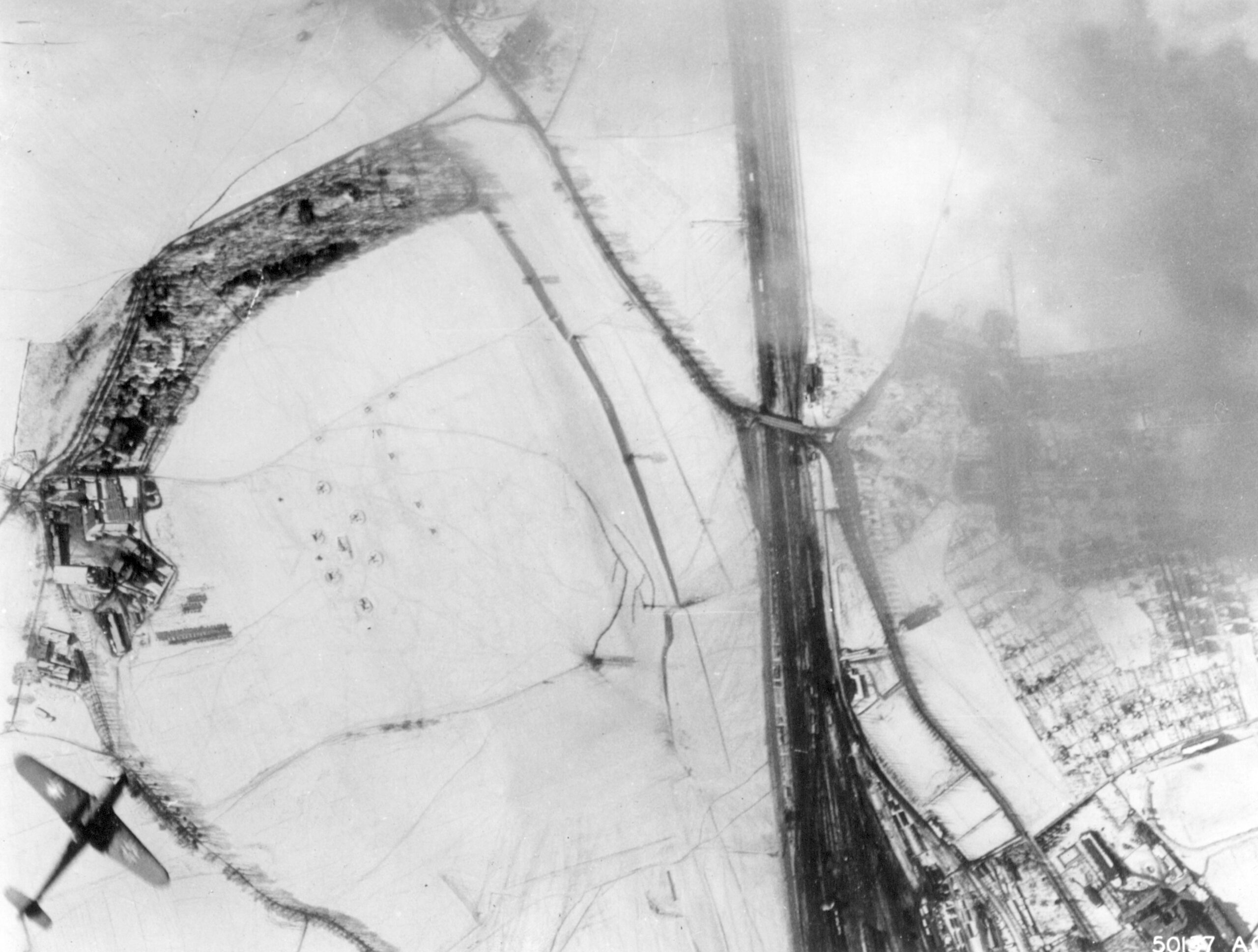
- Cover: A German Bf 109G in flight over Regensburg on 25 February 1944, photographed during the American bombing operation. U.S. Army Air Forces photo 342-FH-3A20348-50137AC, NARA NAID 204899818; U.S. government work, public domain. Representative period image; it is not identified as an aircraft flown by Wilhelm Schilling. Wikimedia Commons file record.
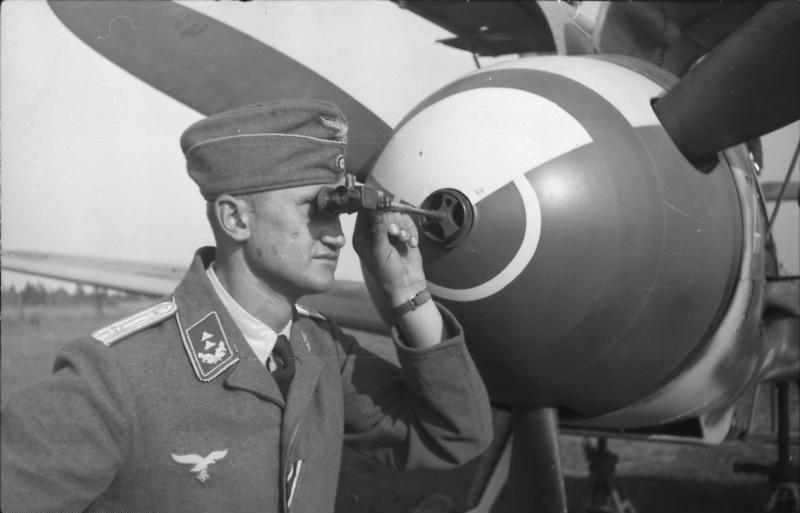
- Article image: Bundesarchiv, Bild 101I-390-1220-20 / Reiners, August 1941; maintenance on a II./JG 54 Bf 109F near Leningrad. Licence CC BY-SA 3.0 DE; Wikimedia Commons file record. Not Schilling or his aircraft.
