On 1 September 1942, a German fighter pilot operating over North Africa filed claims for 17 Allied aircraft destroyed in three combat sorties. The figure entered Luftwaffe records and helped transform the young airman into one of Germany’s most publicised fighter pilots. His name was Hans-Joachim Marseille. The nickname Der Stern von Afrika — the Star of Africa — spoke both to the flying skills attributed to him and to the wartime myth built around those skills. [1][2][3]
At a glance
| Label | Value |
|---|---|
| Full name | Hans-Joachim Walter Rudolf Siegfried Marseille |
| Born | 13 December 1919, Berlin |
| Died | 30 September 1942, near Sidi Abdel Rahman, Egypt |
| Age at death | 22 |
| Conflict | Second World War |
| Air force | Luftwaffe, Nazi Germany |
| Unit | Jagdgeschwader 27 (JG 27); earlier service elsewhere |
| Rank | Hauptmann (captain) |
| Nickname | “Star of Africa” (Der Stern von Afrika) |
| Aircraft | Messerschmitt Bf 109 E / F / G; final aircraft G-2/trop |
| Official victory credit | 158 (Luftwaffe credit; not all independently matched to Allied losses) |
| Cause of death | Fatal accident while bailing out of a smoke-filled Bf 109, involving the tail |
Understanding Marseille requires separating three things: what he did as an operational fighter pilot; the victories officially credited by Germany; and the way the Nazi state and later popular accounts turned those figures into a heroic narrative. Those categories do not always overlap. Establishing an Allied aircraft loss from squadron records is a different task from reading a German claim or a celebratory newspaper caption. [3][4]
From Berlin to the Battle of Britain
Hans-Joachim Walter Rudolf Siegfried Marseille was born in Berlin on 13 December 1919. Biographies describe an early enthusiasm for the piano and American jazz, as well as a temperament poorly suited to rigid military discipline. Some of the colourful episodes told about him rest on later recollections rather than contemporary documents; the difference matters when a life has become a legend. [1][2][5]
Marseille entered Luftwaffe training in 1938. He flew the Messerschmitt Bf 109 in the Battle of Britain in 1940, recording his first victory claims but also suffering a troubled introduction to combat. Damaged fighters, forced landings and complaints about his willingness to cooperate with wingmen featured in accounts of those months. He eventually joined Jagdgeschwader 27 (JG 27). [1][2][5]
Fighter flying was never merely a competition in marksmanship. Protecting one’s wingman, managing fuel, keeping sight of other threats and surviving a mission were essential. The very independence later used to romanticise Marseille could be seen by his commanders as a tactical liability.
North Africa and a distinctive fighting style
JG 27 deployed to North Africa in 1941, where its Bf 109s fought aircraft of the Royal Air Force, South African Air Force and other Allied formations. Its opponents included Hawker Hurricanes, Curtiss P-40s and, later, Supermarine Spitfires. Marseille developed a reputation for rapid judgment and exceptionally accurate deflection shooting — aiming ahead of a turning target rather than where the aircraft was at that instant. [1][2][3][5]
Such shooting depended on far more than the fighter’s speed. A pilot had to estimate the opponent’s turn, the closing angle and the time the bullets would take to arrive, often while making a sharp maneuver of his own. Accounts from JG 27 describe Marseille attacking formations at speed, firing brief bursts and breaking away before trying again. These descriptions help explain his reputation, although veterans’ memories must still be distinguished from precise combat evidence. [1][2]
The approach also raised questions about formation discipline and the safety of supporting pilots. More broadly, the outcome of the North African campaign was determined by much more than aerial duels. Supply routes, fuel, ground operations and Allied bombing played vital roles, however compelling the story of an individual fighter ace might be. [3][4]

What did 158 victories actually mean?
The Luftwaffe credited Marseille with 158 aerial victories. That is an important historical fact about Germany’s accounting of fighter claims. It does not, by itself, establish that 158 specific Allied aircraft can all be matched independently to losses in surviving Allied records. A claimed crash, an aircraft that survived with damage, two pilots claiming the same target, and errors in recorded time or location all complicate reconstruction. [1][3][4]
The best-known controversy concerns 1 September 1942, when Marseille claimed 17 victories. Robert Tate’s research stressed that Allied forces did suffer substantial losses in the area, challenging simplistic claims that none occurred. Other specialists, including Russell Brown and Christopher Shores, have highlighted the difficulties of matching German claims to individual Allied squadron records. Claims made on 15 September have also been scrutinised. The evidence therefore supports neither an easy dismissal of every claim nor an unqualified declaration that all 17 were individually verified. [1][3][4]
| Familiar assertion | A more defensible reading |
|---|---|
| “Marseille definitely destroyed 158 enemy aircraft.” | He received 158 official Luftwaffe victory credits; independent loss matching varies in certainty. |
| “All 17 aircraft on 1 September are verified.” | He claimed 17 that day; attribution against Allied records remains a matter of historical debate. |
| “Every claim describes an identical kind of encounter.” | His claims span different dates and aircraft types; individual engagements require separate examination. |
| “The score alone changed the campaign.” | Fighters operated inside a much larger contest of bombing, logistics and ground operations. |
Celebrity, the Luftwaffe and Nazi propaganda
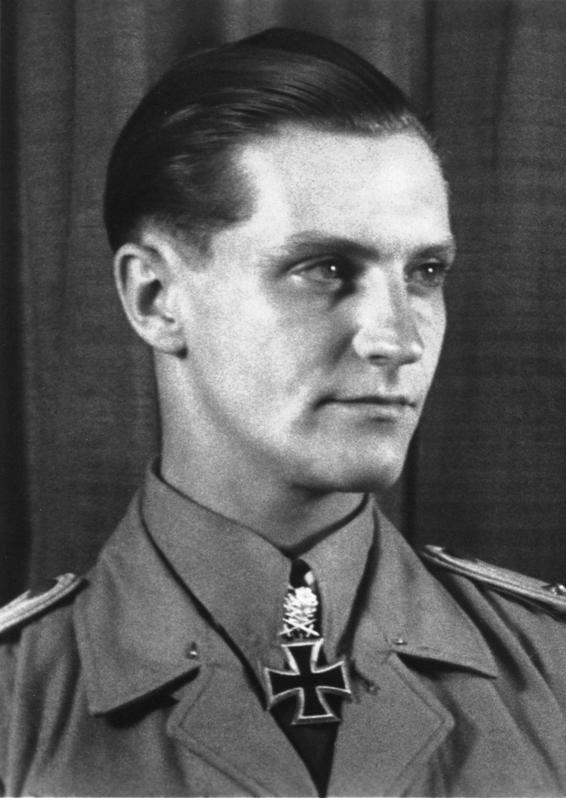
By the summer of 1942, Marseille’s public image had grown well beyond his unit. Military decorations, postcards, news photographs and features in publications such as Der Adler made him a prominent Luftwaffe celebrity. The regime had obvious reasons to showcase striking individual success as the wider war became increasingly costly. Many of the portraits that now circulate as neutral historical images were made as wartime propaganda photographs. [1][2][6]
Marseille’s interest in jazz, confrontations with authority and reluctance to conform became central to the stories told about him. Some popular biographies have portrayed him as openly anti-Nazi. Yet personal irreverence is not the same as documented political resistance. German military historians have questioned whether the later heroic image, partly grounded in wartime propaganda, provides reliable evidence of ideological opposition or moral exemplarity. The responsible conclusion is to acknowledge the uncertainty rather than turn personality anecdotes into an acquittal of the regime he served. [6][7]
A frequently repeated story concerns a Black South African prisoner of war whose name appears in later accounts as Mathew Letulu or Letuku, known as “Mathias.” Marseille reportedly kept him close and sought protection for him within the unit. This account is relevant to the complexity of personal relations under a racist state, but much of its detail comes through later biographical testimony. It is not, on its own, proof of a coherent anti-Nazi political position. [1][7]
30 September 1942: the final flight
Marseille was just 22 when his career ended. On 30 September 1942, returning from an escort mission, the cockpit of his new Messerschmitt Bf 109 G-2/trop began to fill with smoke. Accounts describe his attempt to return to friendly territory while receiving guidance from pilots nearby. Visibility and the aircraft’s condition deteriorated. [1][2][5]
Marseille eventually attempted to bail out. During the escape he struck part of his own aircraft, usually identified as the tail assembly, and failed to open his parachute. He died near Sidi Abdel Rahman, Egypt. Witness accounts and technical discussions offer additional details, but the precise attitude of the aircraft, exact final radio words and injury sequence should not be reconstructed with false certainty. The essential distinction is clear: Marseille did not die after being shot down by an Allied fighter; his death followed an accident while attempting to abandon a smoke-filled aircraft. [1][2][5]
His last aircraft was a Bf 109 G-2/trop, not an F-series fighter. The familiar “Yellow 14” markings also appear on his earlier aircraft and on later reconstructions; when interpreting photographs, models or replicas, the variant, serial number and date should always be checked.
Behind the Star of Africa legend
His life was retold in the 1957 feature film Der Stern von Afrika. Film, military press and veterans’ memoirs all help explain how Marseille was remembered — but they are different kinds of sources, with different incentives and limitations. None is a substitute for comparing operational and loss records. [6][8]
Hans-Joachim Marseille should neither be transformed into an invincible legend beyond criticism nor stripped of his documented technical reputation. The more revealing story is that of a gifted young fighter pilot serving Nazi Germany, celebrated through official victory claims and a powerful propaganda apparatus, who died in an aircraft accident before his twenty-third birthday. The distance between this life and the story constructed around it remains as interesting as the combat record itself.
Sources
- Robert Tate, Hans-Joachim Marseille: An Illustrated Tribute to the Luftwaffe’s “Star of Africa” (Schiffer, 2008), ISBN 9780764329401 — bibliographic record. Access note: Publisher/bibliographic information verified; the complete book was not read online. Consult directly for fine-grained operational claims.
- John Weal, Jagdgeschwader 27 ‘Afrika’ (Osprey, 2003), ISBN 9781841765389 — bibliographic search. Full text not represented as consulted.
- Russell Brown, Desert Warriors: Australian P-40 Pilots at War in the Middle East and North Africa, 1941–1943 (Banner Books, 2000), ISBN 9781875593229 — bibliographic search. An important study of Desert Air Force records; full pages not independently accessed in this preparation.
- Christopher Shores, Giovanni Massimello & Russell Guest, A History of the Mediterranean Air War, 1940–1945, Vol. 2: North African Desert, February 1942–March 1943 (Grub Street, 2012) — bibliographic search. Listed as a research reference, not falsely cited as fully read.
- Stephen Wilkinson, “Hans-Joachim Marseille: The Star Pilot of Africa in World War II”, HistoryNet. Secondary narrative; dramatic reported conversations are not reproduced as verbatim fact.
- Markus Benner, “Ist das noch Tradition — oder muss das weg? Der Jagdflieger Hans-Joachim Marseille — Namensgeber der ‘Marseille-Kaserne’ in Appen”, in Eberhard Birk & Heiner Möllers (eds), Die Luftwaffe und ihre Traditionen (2019), pp. 110–121 — German National Library contents record. Bibliographic existence verified, chapter text not directly examined; relevant to German military memory and tradition debates.
- Colin D. Heaton & Anne-Marie Lewis, The Star of Africa: The Story of Hans-Joachim Marseille — publisher’s overview. The publisher’s characterisation is more sympathetic and politically categorical; this article does not treat promotional copy as proof.
- Der Stern von Afrika (1957), directed by Alfred Weidenmann — film and reception background. A work of popular historical memory, not combat documentation.
Photo credits
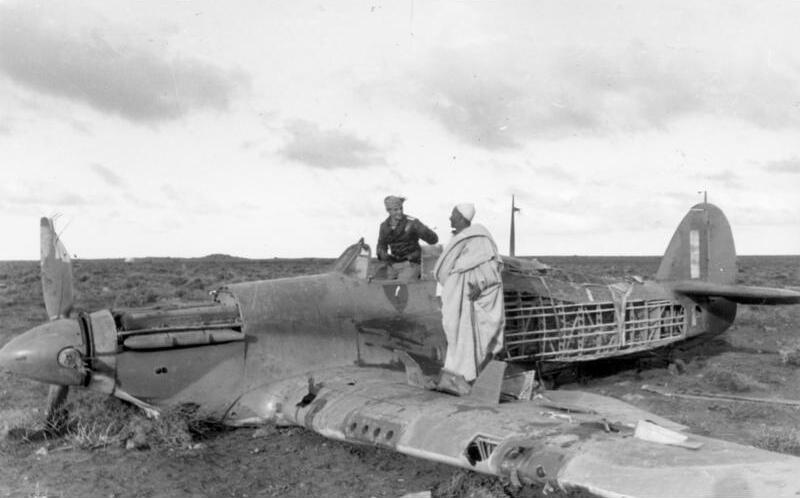
- Cover: Hans-Joachim Marseille beside the wreck of a Hawker Hurricane in North Africa, March 1942. A German wartime propaganda-unit photograph; its original caption does not independently verify the combat claim. Bundesarchiv, Bild 101I-440-1313-09 / Oppitz / CC BY-SA 3.0 DE; file record.
- Portrait: A 1942 publicity portrait of Marseille, produced in the context of Nazi Germany’s wartime propaganda. Bundesarchiv, Bild 146-2006-0122 / Heinrich Hoffmann / CC BY-SA 3.0 DE; file record.

Related reading: Saburō Sakai: The Zero Pilot Beyond the Legend — a second source-conscious case study in the interpretation of fighter victory totals.