When a damaged Japanese Zero landed on Niʻihau after the attack on Pearl Harbor, the island’s residents found themselves facing a crisis they could never have anticipated. What followed between 7 and 13 December 1941 brought the Pacific War to an isolated Hawaiian community.
Key facts
| Dates | 7–13 December 1941 |
| Location | Niʻihau, Territory of Hawaii, United States |
| Aircraft | Mitsubishi A6M2 Zero Model 21, BII-120 (Hiryū) |
| People | Shigenori Nishikaichi; Hawila (Howard) Kaleohano; Ishimatsu Shintani; Yoshio and Irene Harada; Ben and Ella Kanahele |
From Pearl Harbor to Niʻihau
On the morning of 7 December 1941, Japanese aircraft attacked Pearl Harbor and other military targets on Oʻahu in two waves. Among the pilots in the second wave was Japanese naval airman Shigenori Nishikaichi. He flew Mitsubishi A6M2 Zero Model 21 BII-120, assigned to the fighter group aboard the carrier Hiryū. The U.S. Naval History and Heritage Command identifies the same aircraft in its photographic record 80-G-22162, showing its damaged tail after the incident. [1][2]
Nishikaichi’s aircraft was damaged and began losing fuel. Unable to make the return flight to his carrier, he diverted toward Niʻihau, a small island west of Kauaʻi. Japanese planning had designated the island as a possible landing and rendezvous point for disabled aircraft. But the assumption that Niʻihau was uninhabited proved disastrously wrong. A Hawaiian community lived there. [1]
A stranger on the island
The Zero crash-landed in a field on 7 December. One of the first residents on the scene was Hawila (Howard) Kaleohano. He did not yet know that Pearl Harbor had been attacked. Seeing the Japanese markings, however, he took precautions: he removed the pilot’s weapon and collected the papers he found with the aircraft. Those documents would become the centre of a dangerous struggle. [1][3]
Niʻihau was isolated and had limited means of communicating with the outside world. Its residents did not initially know war had begun. To speak with the pilot, they called on Japanese-speaking resident Ishimatsu Shintani and later Yoshio and Irene Harada. Nishikaichi disclosed the attack on Pearl Harbor and demanded the return of his papers and pistol. Sources do not agree on every detail of when the islanders learned of the attack; what is clear is that the first encounter took place amid uncertainty. [1][3]
12 December: the crisis turns violent
Nishikaichi’s attempts to recover his documents grew increasingly dangerous. A memorandum from 1942 records that by 10 December the pilot was under loose guard at Yoshio Harada’s home. On 12 December Nishikaichi and Harada overpowered a guard, secured weapons and began searching for Kaleohano and the missing papers. Islanders were threatened and some fled. The pilot’s aircraft and Kaleohano’s house were set alight. [3]
Shintani’s role should not be conflated with Harada’s. Contemporary and later accounts describe Shintani approaching Kaleohano about the papers and offering money for them; that is not equivalent to attributing every subsequent armed act to him. Nor should the actions of a few individuals be generalized to the Japanese American community of Hawaii or the United States. [1][3]
13 December: Ben and Ella Kanahele
The crisis reached its end when Nishikaichi and Harada detained Ben (Benehakaka) Kanahele and his wife Ella Kanahele. Threatened by the armed pilot, Ben confronted Nishikaichi. The pilot shot Ben three times, but Ben and Ella fought back. Nishikaichi was killed in the struggle; Harada then took his own life. [1][3]
Ben survived his injuries and was later officially honoured for his courage. Islanders who had set out for Kauaʻi to seek assistance alerted the authorities. Personnel arrived on 14 December, after the crisis itself had ended on the 13th. [1][3]
What remained of BII-120
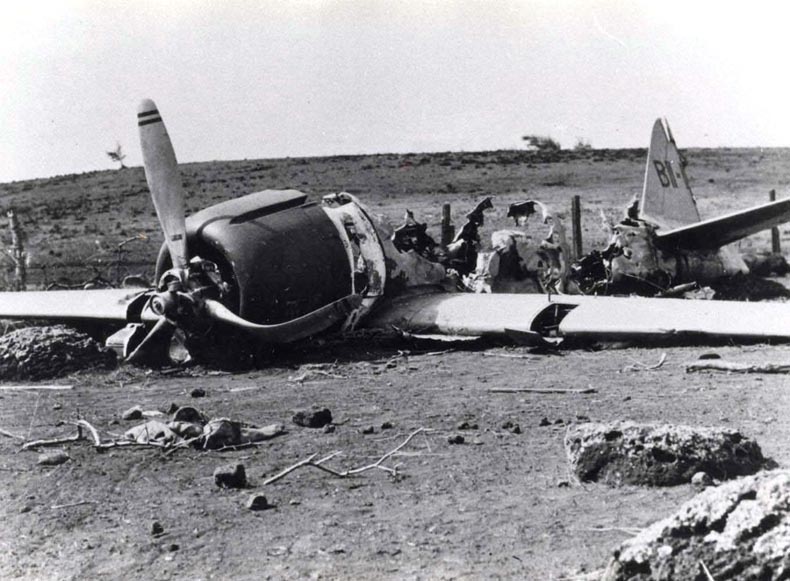

The remains of Zero BII-120 remind us that the Pearl Harbor attack did not end at the naval base or the airfields. It brought war directly to a community far from the main battlefield. The U.S. Navy’s archival photograph of the aircraft’s tail explicitly records the BII-120 marking and its origin aboard Hiryū. It is among the most tangible pieces of evidence linking this episode to a specific aircraft. [2]
The incident was later cited in wartime security debates and in accounts of suspicion directed at Americans of Japanese ancestry. It should not, however, be presented as the single or proven direct cause of the mass forced removal and incarceration of Japanese Americans. Those policies had a much broader political, military and discriminatory context. [1][4]
The aircraft in the ModofWar model archive
BII-120 is one of the two 1/48 A6M2 Zero Type 21 models I built from Eduard’s 11155 TORA TORA TORA! Dual Combo. The other depicts AI-102, associated with Saburō Shindō of Akagi. Their construction, painting and photographs belong in the separate model dossier rather than being repeated in this historical account.
Eduard 1/48 A6M2 Zero Type 21 — Two Aircraft from One Box
Sources
- U.S. National Archives — Remembering Pearl Harbor: the Niʻihau Incident (2018). Narrative and participants.
- U.S. Naval History and Heritage Command — 80-G-22162, Crashed Japanese Navy Zero. Identification, aircraft marking and photo.
- 1942 Niʻihau memorandum, reproduced by the U.S. National Archives (PDF). Contemporary record, particularly 12–14 December.
- Hawaii State Aviation History — December 7, 1941 / An Enemy on Niihau. Local context.
Photograph credit: Nishikaichi’s Zero BII-120 on Niʻihau, 17 December 1941. Photo: US Army, via Wikimedia Commons (public domain). It has not been confirmed whether this is the same frame as NHHC record 80-G-22162 [2].