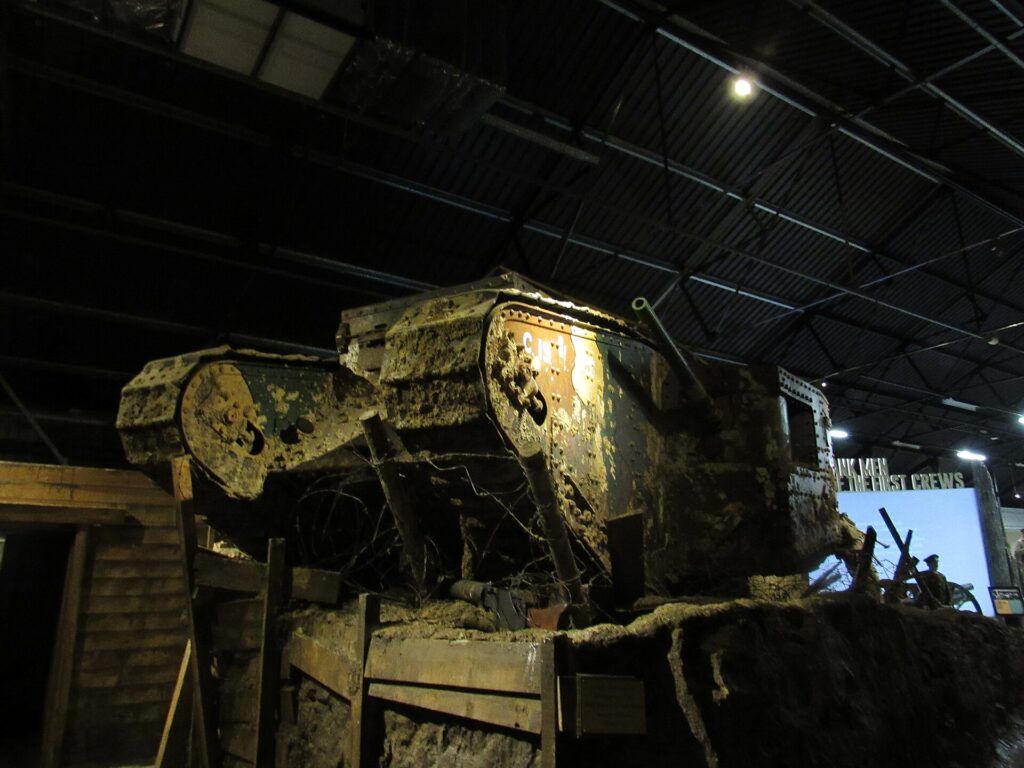
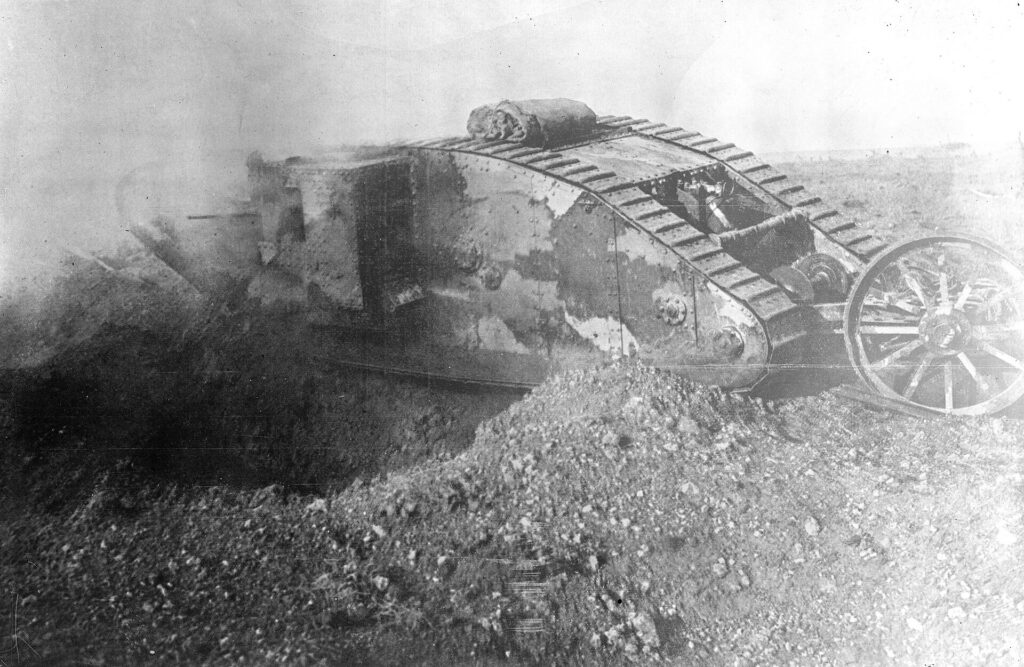
On the morning of 15 September 1916, a new weapon appeared on the battlefields of the Somme. Slow, noisy, cumbersome and painfully unreliable, it was hardly a perfect fighting machine. Yet its arrival marked the beginning of a new era in armoured warfare. Its name was the Mark I.
A Solution to the Deadlock
When the First World War began, armies still expected to fight a war of movement. Instead, the Western Front became a vast network of trenches, barbed wire and machine-gun positions. Artillery could devastate the landscape without destroying every defensive strongpoint, while infantry crossing open ground suffered terrible casualties.
British officers and officials, including Ernest Swinton and Maurice Hankey, began exploring the possibility of a tracked vehicle that could protect its crew and force a way across trench systems. With support from Winston Churchill, the Landships Committee was established in 1915 to examine such ideas.
The ambition went beyond building an armoured car. It was to give a land vehicle something of a warship’s protection and firepower—and make it move across a battlefield torn apart by shellfire.
Little Willie: The First Practical Experiment
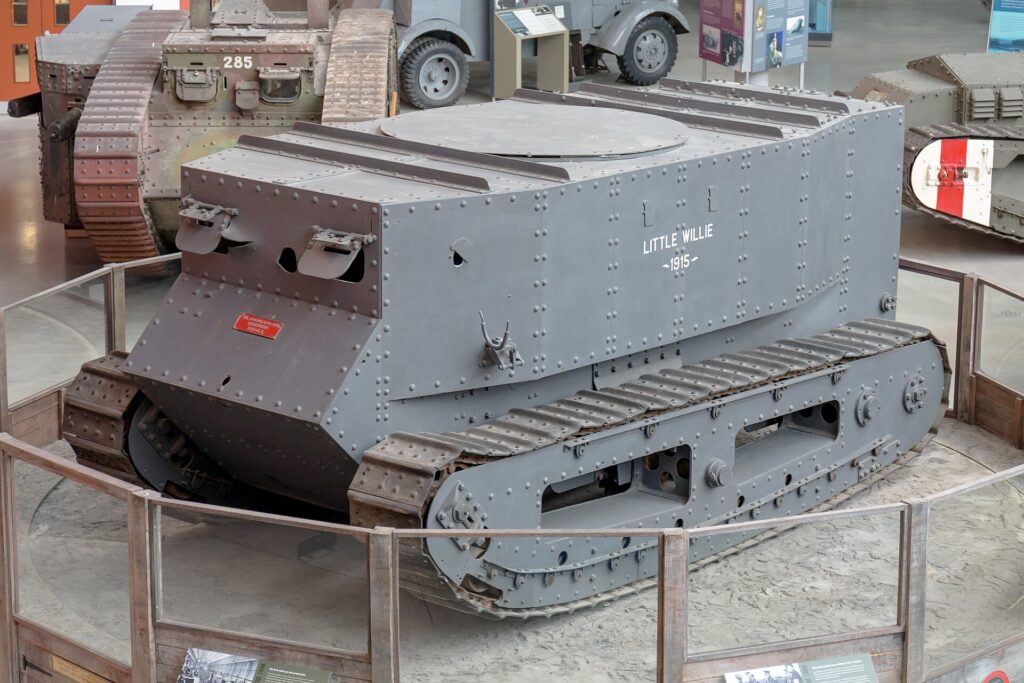
In 1915, engineers at William Foster & Co. in Lincoln produced Little Willie, the first practical prototype in the programme. William Tritton and Walter Gordon Wilson played central roles in turning the concept into a working tracked machine.
Little Willie demonstrated that the mechanical idea was sound, but its tall, box-like hull presented a serious problem. It could not cross the wide trenches that defined the Western Front. The prototype never entered combat.
That did not make it a failure. Its development provided valuable lessons about tracks, transmission and hull design. Little Willie survives today in the collection of The Tank Museum in Britain.
From Mother to the Mark I
The next design took a radically different shape. Tracks ran around almost the entire hull, creating the long, distinctive rhomboid silhouette that became synonymous with early British tanks. The raised ends made it easier to climb obstacles and bridge trenches.
Completed in December 1915, the prototype became known as Mother, or Big Willie. Trials in January and February 1916 demonstrated enough promise to persuade the authorities to commit to production. A total of 150 Mark I tanks were ordered.
The project remained highly secret. The word tank, associated with water containers, served as a convenient cover for the machines’ real purpose. What began as a disguise eventually became the permanent name for an entirely new class of fighting vehicle.
Two Versions: Male and Female
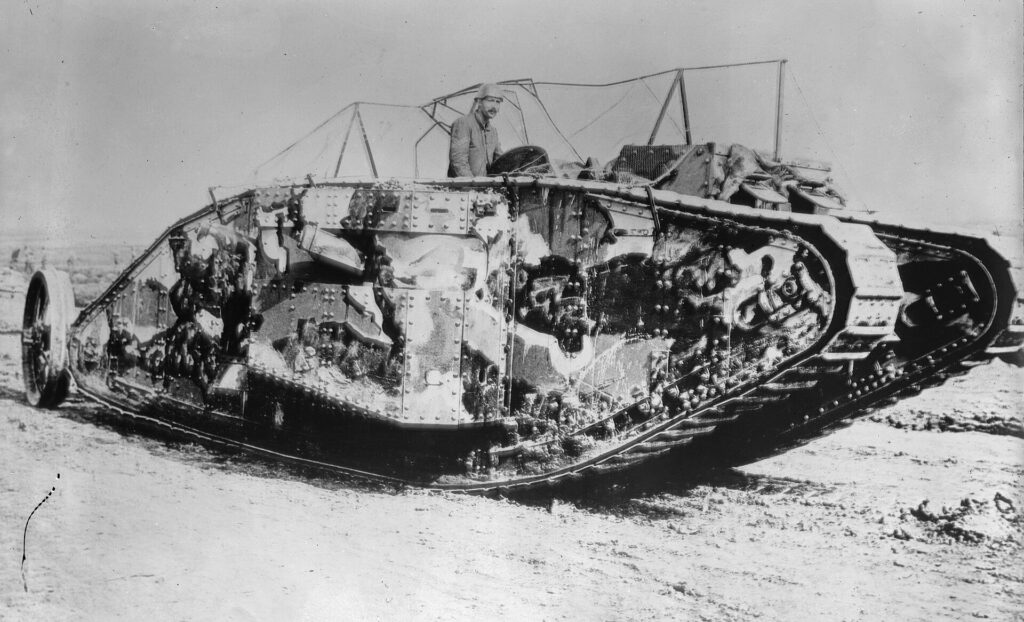
The Mark I looked little like a modern turreted tank. Its weapons sat in large side-mounted structures known as sponsons. The vehicle required a crew of eight, weighed roughly 28 tonnes and could reach only about 6 km/h (3.7 mph) on a road. Across the churned-up battlefield, progress was slower still.
The Male version carried two 57 mm (six-pounder) guns alongside Hotchkiss machine guns. Its primary role was to attack fortified positions and hostile machine-gun nests. The Female version carried four Vickers machine guns, supported by additional Hotchkiss armament, to deliver concentrated fire against enemy infantry. Seventy-five of each type were produced.
Armour of approximately 6–12 mm offered protection against much small-arms fire but left the tank vulnerable to artillery. At the rear, a two-wheeled steering tail was intended to assist manoeuvring and balance. In practice it proved of limited value and was later abandoned.
15 September 1916: Into Battle
The Mark I made its combat debut during the Battle of Flers-Courcelette, part of the Somme Offensive. British commanders hoped the tanks would advance ahead of the infantry, crush barbed wire, cross trenches and silence German strongpoints.
Forty-nine tanks were assigned to the operation. Reaching the front line was itself a formidable challenge. According to The Tank Museum, only 32 reached the starting line, and 18 eventually saw action. The National Army Museum records that 15 crossed into no man’s land as the assault began. These figures describe different stages of the operation rather than a single count.
One of the day’s earliest tank actions involved Daredevil, commanded by Harold Mortimore. For German troops facing the unfamiliar vehicles, the sight was astonishing: armoured machines pushed through wire and continued forward under rifle and machine-gun fire.
The British and their allies captured Flers and Courcelette, but the decisive breakthrough did not come. Engine failures, shell holes, trenches and artillery fire stopped many tanks. Poor coordination with the infantry limited what the survivors could achieve. The first tank attack was less a triumphant victory than an expensive, instructive experiment.
Inside an Armoured Furnace
From the outside, the Mark I seemed formidable. Inside, serving in one could be miserable. The engine occupied the same enclosed hull as the crew. Heat, fumes and deafening noise made the fighting compartment exhausting, while the absence of effective suspension turned every obstacle into a violent jolt.
Driving demanded unusual teamwork. The commander, driver and two secondary gearsmen were all involved in controlling the vehicle. With spoken orders difficult to hear, crews often relied on hand signals.
Communicating beyond the tank was another problem. Carrier pigeons were among the methods used to send messages from early vehicles. Later, some surviving Mark Is were adapted for supply duties or converted into wireless tanks. Reliable communication, like dependable mobility, would take time to achieve.
From the Front Line to the Home Front
The Mark I did not decide the battle on its first day, but it showed that tracked armour could have a future. British engineers continued to improve the design, and later Marks reflected the lessons learned on the Somme.
Tanks also acquired a second role: symbols of technological power and public determination. From late 1917, Tank Week campaigns displayed tanks in British towns and cities to encourage purchases of war bonds. The Imperial War Museums records that one campaign in Glasgow raised approximately £14 million.
The tanks used for these fundraising exhibitions were later Mark IV machines, not the original Mark Is. The once-secret invention had become a public spectacle—and a powerful emblem of Britain’s war effort.
The Legacy of the Mark I
The Mark I was slow, mechanically fragile and extraordinarily demanding on its crews. It did not break the deadlock on 15 September 1916. Nevertheless, it demonstrated that an armoured, tracked vehicle could cross obstacles that had stopped infantry for years.
Engines improved, armour thickened, weapons changed and tactics evolved. None of those later developments can make the first tanks seem sophisticated. Their importance lies in the possibilities they opened.
The history of modern tank warfare began with these awkward machines struggling across the Somme.


.jpg)