Keeping a tank in the fight meant keeping it repairable
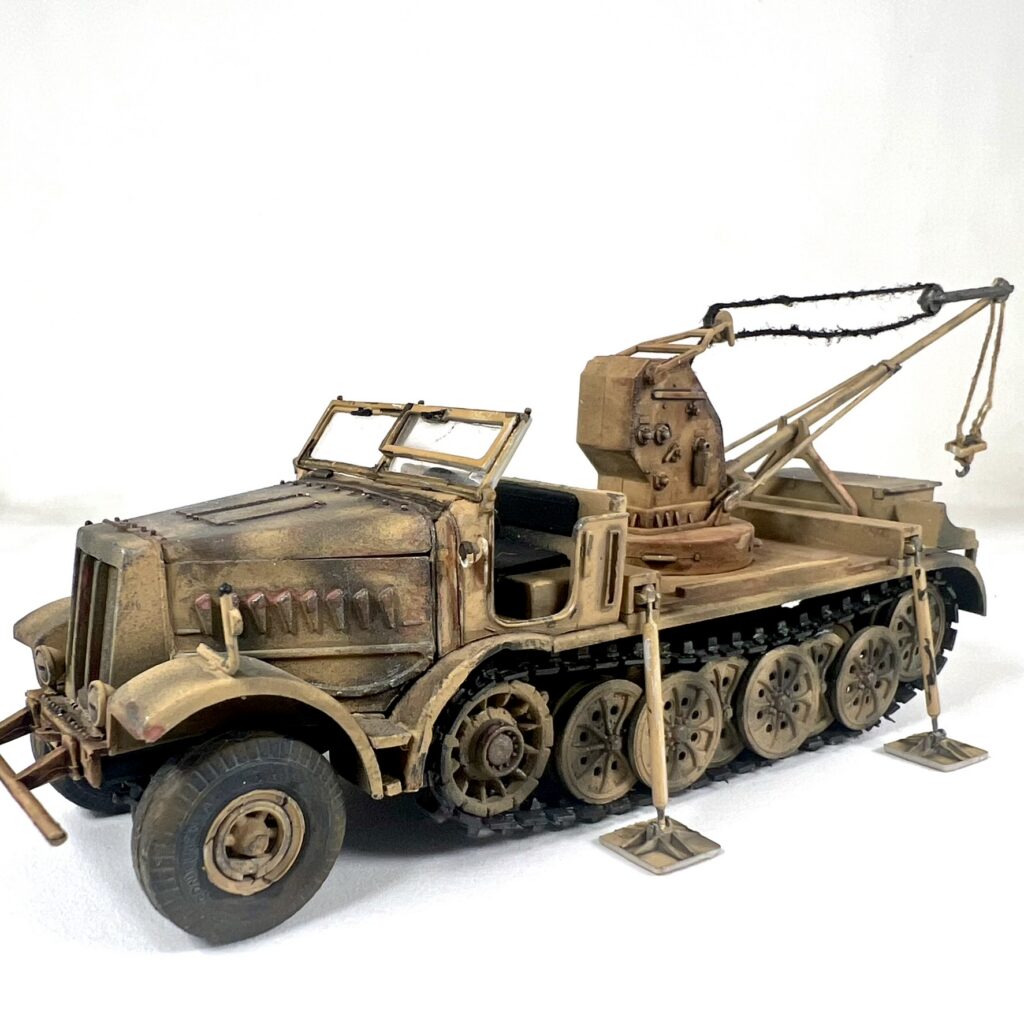
When a tank broke down, towing it away was only part of the problem. A damaged powertrain could require an engine or gearbox to be lifted before a field workshop could make repairs. The German Army’s heavy Sd.Kfz. 9 half-track family helped with towing and recovery; the Sd.Kfz. 9/1 added a six-tonne Bilstein slewing crane to the rear of its chassis. It made heavy lifting possible much closer to the front than a conventional fixed workshop could manage. [1][2]
The vehicle tells a part of military history easily overlooked in photographs of armoured warfare. Tanks depended not just on crews, ammunition and fuel, but on mechanics, recovery teams and vehicles capable of handling extraordinarily heavy components.
From heavy tractor to crane carrier
The Sd.Kfz. 9 was among the largest German half-tracked tractors of the Second World War. Developed by FAMO and manufactured within a wider industrial programme, it was intended to tow heavy artillery and recover disabled armoured vehicles. The F3 version, in series production from 1939, used the Maybach HL 108 TUKRM, a petrol V12 rated at approximately 250 hp. The combination of steerable front wheels and tracked propulsion allowed large loads to be moved beyond ordinary roads. [3][4]
The designation 18-ton tractor refers to its towing class, not a literal statement of the vehicle’s empty weight. Frequently quoted production of roughly 2,500 relates to the Sd.Kfz. 9 family as a whole, not 2,500 crane-equipped 9/1s. The specialised crane variant was considerably rarer. [3][5]
What the six-tonne Bilstein crane could do
Development of a rotating crane installation began around 1940. German modelling and vehicle-history references place the first issue of the Sd.Kfz. 9/1 to armoured workshop companies in September 1941. Both early and later Sd.Kfz. 9 chassis were used. [2]
The vehicle was not designed to lift an entire tank clear of the ground. Its six-tonne capacity was meant for major components: engines, gearboxes and other heavy assemblies. Working in the field could shorten the time needed to return a repairable armoured vehicle to service, especially when transporting it to a distant workshop was impractical. [1][2]
Do not confuse the 9/1 with the Sd.Kfz. 9/2. The latter used a separate, more powerful ten-tonne crane arrangement. The Bilstein six-tonner and the larger crane are distinct variants, not interchangeable specifications. [2][6]
A Panzer III under repair in Russia
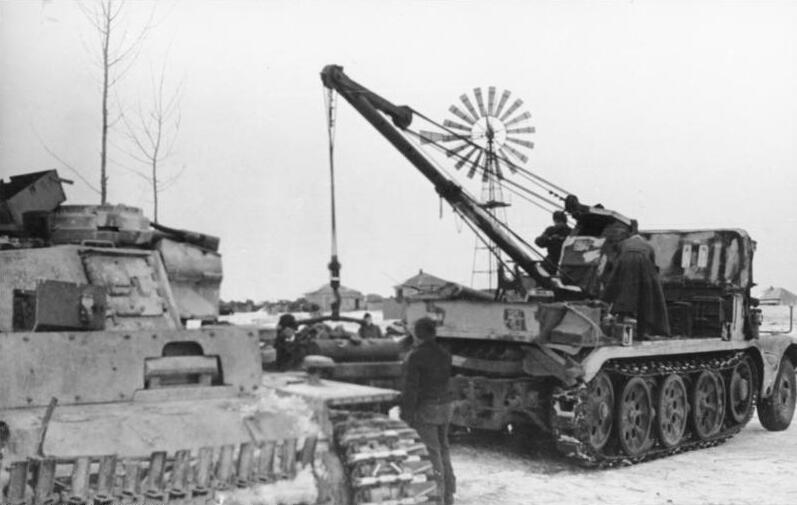
An archival photograph from Russia gives the crane’s task a human scale. Bundesarchiv Bild 101I-235-0996-02A, attributed to photographer Falk, shows a Panzer III being worked on with the assistance of an Sd.Kfz. 9/1. It is easy to read this as simply another wartime scene of German vehicles. In fact, it documents the less visible infrastructure that kept combat vehicles operational: mechanics, workshop equipment and a mobile crane. [7]
The vehicle’s stabilising equipment and rigging were part of this work, but a particular load or lifting procedure should not be generalised to every crane operation. Terrain, configuration and the component being lifted all mattered.
Why this unusual half-track still matters
The Sd.Kfz. 9/1 illustrates the transition from heavy tow tractors to specialised armoured-vehicle support equipment. In one machine it combined tracks, a large petrol engine, an open working platform and a purpose-built rotating crane. Surviving examples are very rare: Oorlogsmuseum Overloon describes a restored, running Sd.Kfz. 9/1 with its six-tonne Bilstein crane. [1]
The companion Trumpeter 1/72 Sd.Kfz. 9/1 FAMO build in the ModofWar archive shows the crane, tracks and outriggers in miniature. See the model build →