
A fighter left behind at Gaziemir
In September 1922, as Turkish forces advanced towards İzmir, aircraft and aviation supplies were left behind by the retreating Greek forces. Among the aircraft recovered at Seydiköy–Gaziemir airfield were French-built Nieuport fighters. The Nieuport 27 became part of a story that would continue into the early years of the Turkish Republic. [1][2]
Its capture after the Great Offensive should not be mistaken for evidence that it had flown Turkish combat missions earlier in the War of Independence. Its historical significance rests chiefly in what followed: an ageing fighter was brought into Turkish service and subsequently used for flying training. [3][4]
A French fighter from the First World War
Introduced in 1917, the Nieuport 27 was a development of the Nieuport 24 family. Its characteristic V-shaped interplane struts supported a sesquiplane layout, with a substantially smaller lower wing. Powered by a rotary engine and fitted with a single-seat cockpit, it belonged to the final generation of Nieuport fighters employed during the First World War.
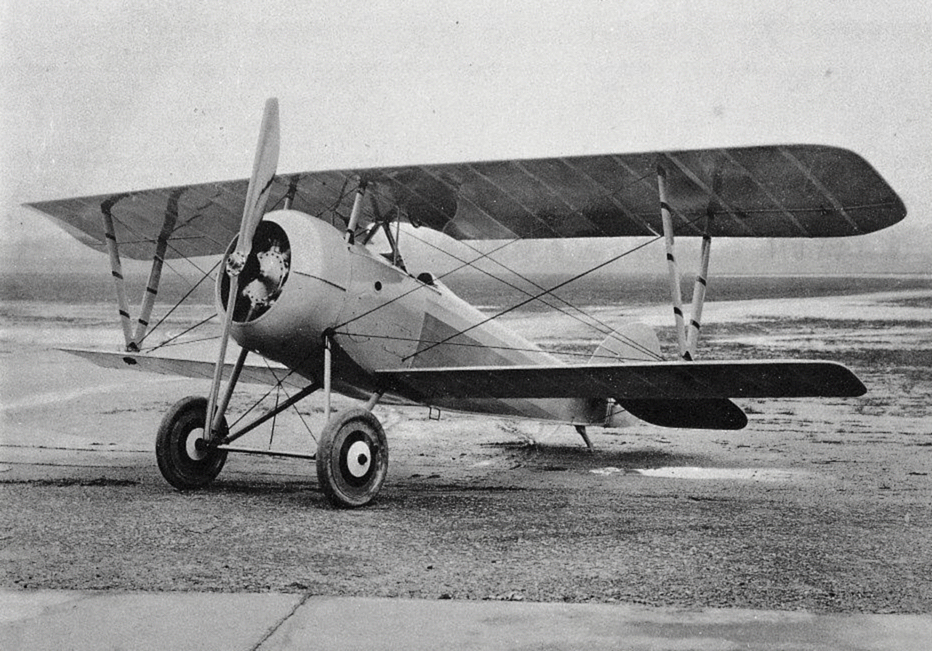
By 1922 the design was no longer a cutting-edge fighter. Yet for an air arm working with limited aircraft, spares and repair capacity, an airworthy captured machine could still be valuable.
Turkish service, 1922–1927
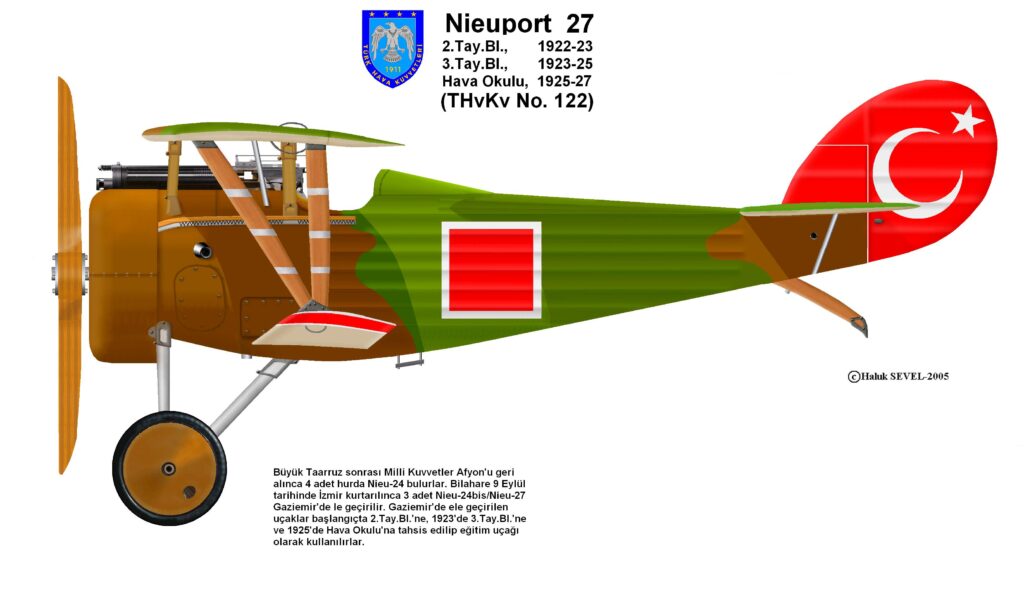
The Turkish Air Force’s Aircraft Album (1911–2009) records that the type entered Turkish inventory in 1922. It describes service with the 2nd and 3rd Aircraft Companies as a fighter, followed by use for fighter training until 1927. [3]
A more detailed illustrated Turkish Air Force inventory gives the sequence as the 2nd Aircraft Company (1922–1923), 3rd Aircraft Company (1923–1925) and Flight School (1925–1927). [4] The aircraft’s importance therefore extends well beyond its capture in September 1922. It became part of the practical work of maintaining and rebuilding Turkish military aviation, including the training of pilots during the Republic’s early years.
The Ganimet serial-number confusion
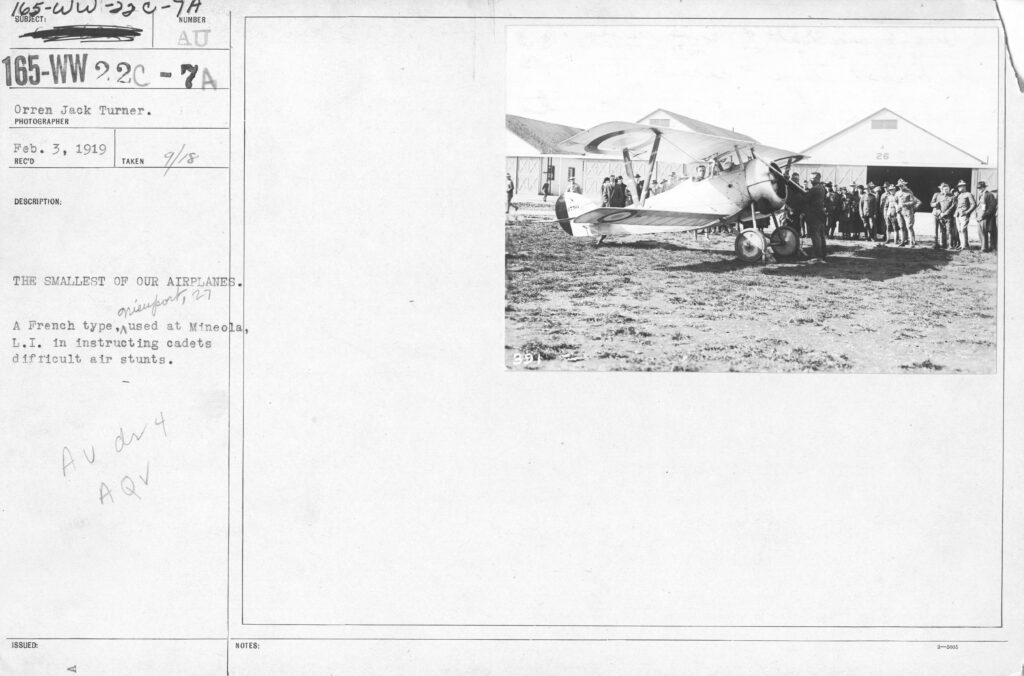
The names applied to captured Nieuports are not always reported consistently. In the illustrated inventory, the two Nieuport 27 aircraft were Ganimet-3 and Ganimet-4, later assigned serials 122 and 123. Ganimet-5, by contrast, is identified as a Nieuport 24bis, a closely related but different aircraft. [4]
There is also a disagreement over quantity. The 2009 Aircraft Album lists one Nieuport 27 in Turkish inventory, while the illustrated inventory records two. Rather than presenting either total as universally accepted, this dossier identifies both figures and their sources. [3][4]
Technical character
The Aircraft Album gives the Nieuport 27 a 130 hp Le Rhône 9JB rotary engine, an 8.21 m wingspan, 5.87 m length and a maximum speed of approximately 176 km/h. It lists one crew member and two Vickers machine guns. These are source-attributed type figures, not a guarantee that every individual airframe was fitted identically. [3]

Why it matters
The Nieuport 27 was neither the most powerful nor the most numerous fighter in Turkish history. What makes it memorable is its second life: a captured aircraft that passed from a wartime airfield into squadron service and eventually pilot training. It illustrates how the early Turkish air arm relied not only on new acquisitions but also on repair, maintenance and making the most of the machines available.