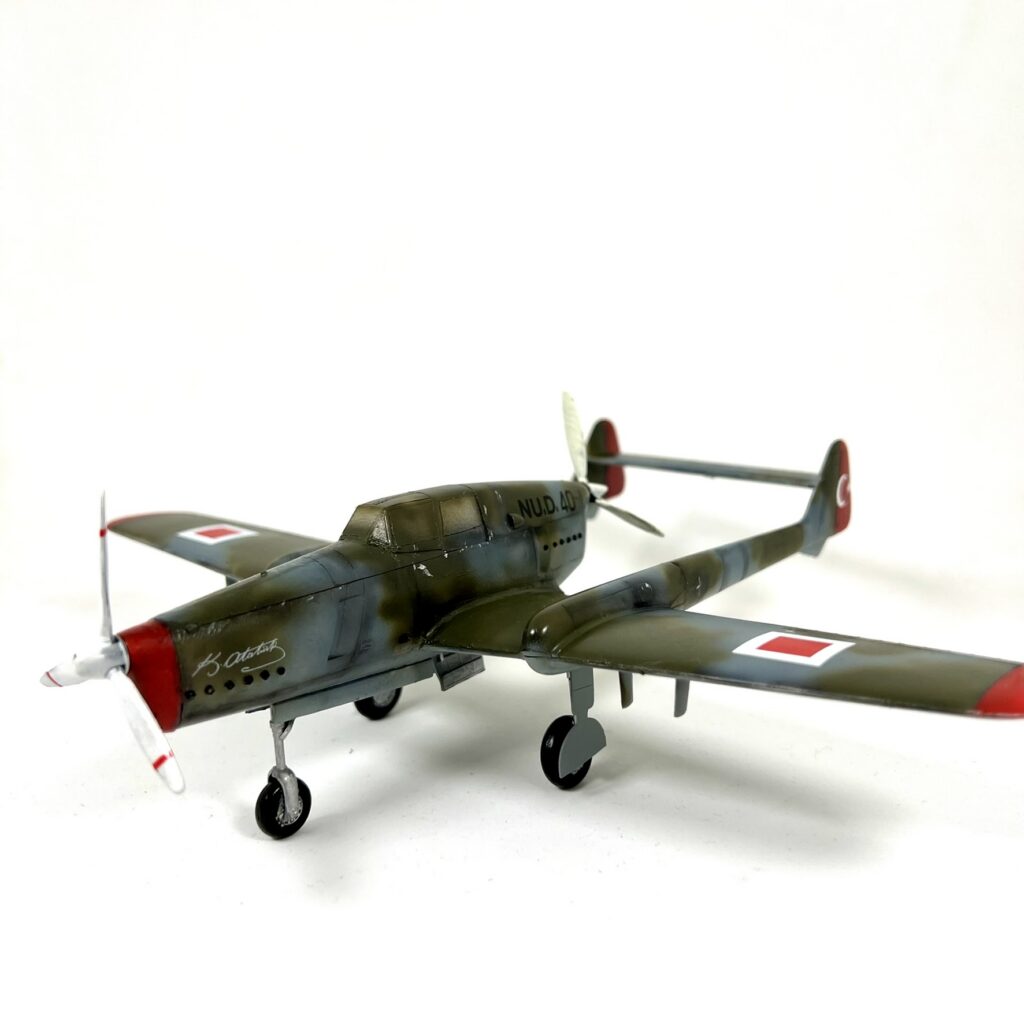
Sometimes I start a scale model not because of the aircraft itself, but because of the story behind it. The Nu.D.40 was one of those projects. There is no verified record of it becoming a flying aircraft, yet its surviving drawings and wind-tunnel documentation suggested a fascinating subject to recreate on my workbench.
A fighter project almost lost to history
In the second half of the 1930s, Turkish aviation ambitions went well beyond purchasing aircraft from abroad. There were also entrepreneurs determined to design and manufacture aircraft at home. One of the most remarkable was Nuri Demirağ, who established an aircraft workshop in Beşiktaş, Istanbul.
During an interview with journalist Abidin Daver in the summer of 1938, Demirağ spoke of his intention to develop a fighter aircraft. His ambition was not simply to manufacture a foreign design under licence. He wanted to help establish an original Turkish aircraft-design capability. The Nu.D.40, later traced through archival records by researcher Dr. Emir Öngüner, was one little-known expression of that ambition. [1][2]
Its unusual configuration makes the project especially intriguing. The proposed aircraft featured an engine-and-propeller arrangement at either end of the central fuselage—a tractor–pusher configuration—and two tail booms supporting a connecting horizontal tail surface. It resembled some of the more unconventional fighter concepts of its era.
But an important distinction must be made: evidence of an aircraft design does not establish that a flight-ready prototype was completed or flown. What can be discussed with confidence is the documentary record: technical drawings, aerodynamic models, test material and correspondence associated with the project.
The trail leads to Göttingen
Some of the most significant evidence concerning the Nu.D.40 emerged from records associated with the Aerodynamische Versuchsanstalt (AVA), the German aeronautical research institution in Göttingen.
By examining correspondence between Demirağ’s workshop and German institutions, alongside drawings and wind-tunnel documentation relating to the Nu.D.38 and Nu.D.40, Dr. Emir Öngüner helped bring this little-known part of Turkish aviation history back into view. [1][2]
The records indicate that the Nu.D.40 wind-tunnel tests were completed in 1939. Correspondence concerning the preparation and cost of the test reports shows that this was more than an idea on paper: it had entered a real programme of engineering assessment. However, the precise consequences of disputes over costs and subsequent events are not fully resolved by the surviving material.
Öngüner later explored this history in his book Bir Avcı Tayyaresi Yapmaya Karar Verdim—roughly, I Decided to Build a Fighter Aircraft—published in TÜBİTAK’s popular-science book series. The book places the Nu.D.40 within the industrial ambitions and international relationships of its time, rather than presenting it as an isolated aircraft sketch. [2][3]
For me, what made the book special was the way it recovered a largely forgotten design through tangible historical evidence. As I read, a different question began to form:
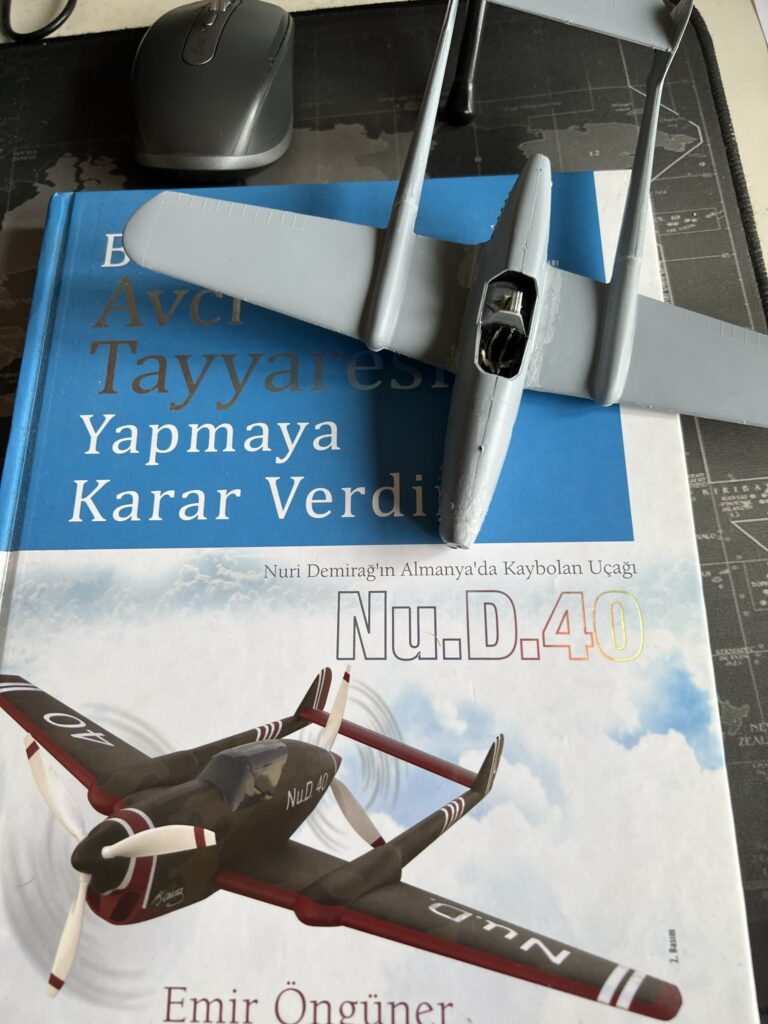
What might this aircraft have looked like if it had actually been built?
Why I chose the Fokker D.XXIII
There was no readily available Nu.D.40 plastic kit on my shelf. But the Dutch Fokker D.XXIII offered a strikingly similar overall layout: a forward tractor propeller, a rear pusher propeller and twin booms joined by a horizontal tail.
Unlike the Nu.D.40, the Fokker D.XXIII did reach the prototype flight stage. It made its first flight on 30 May 1939, before the development programme was brought to an end following the German invasion of the Netherlands in 1940. That is the Fokker’s own history, not the history of the Nu.D.40. Nor does the visual resemblance, on its own, demonstrate that one design was copied from the other. [4]
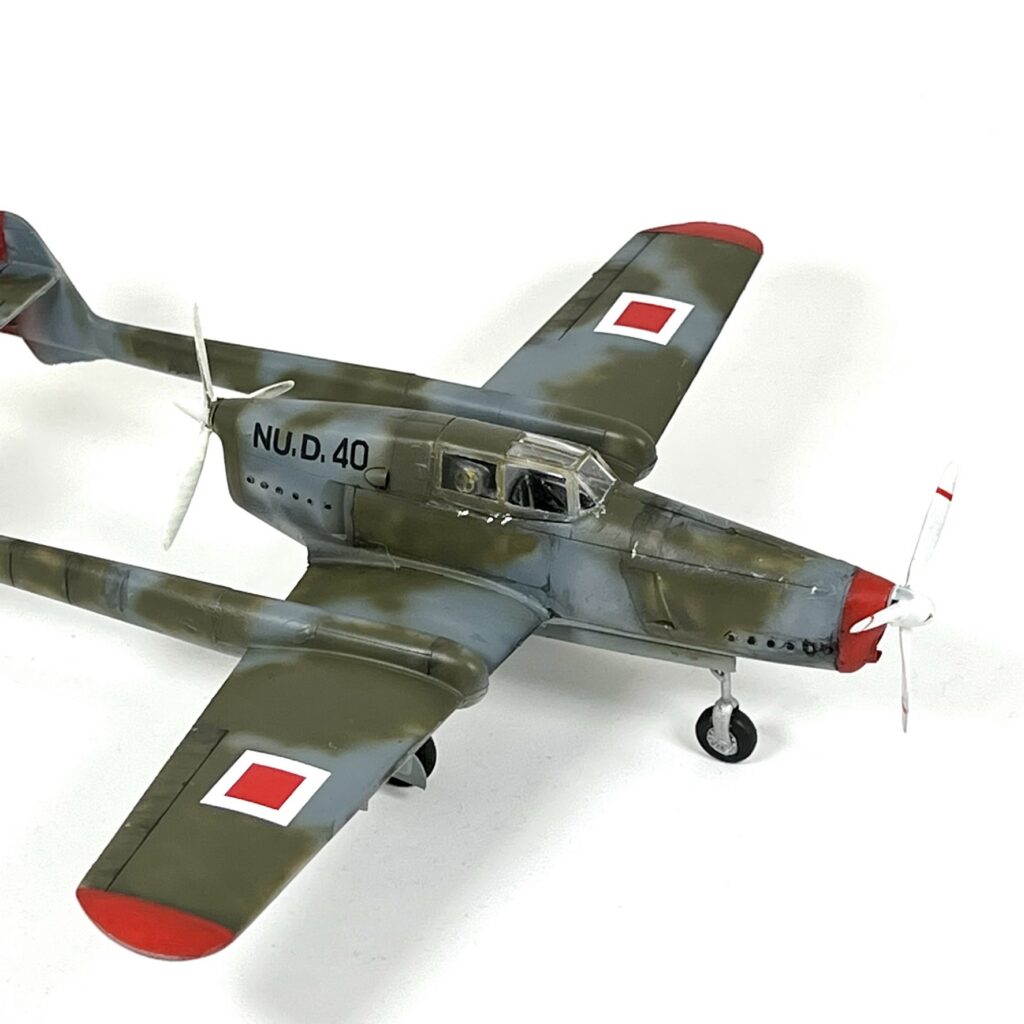
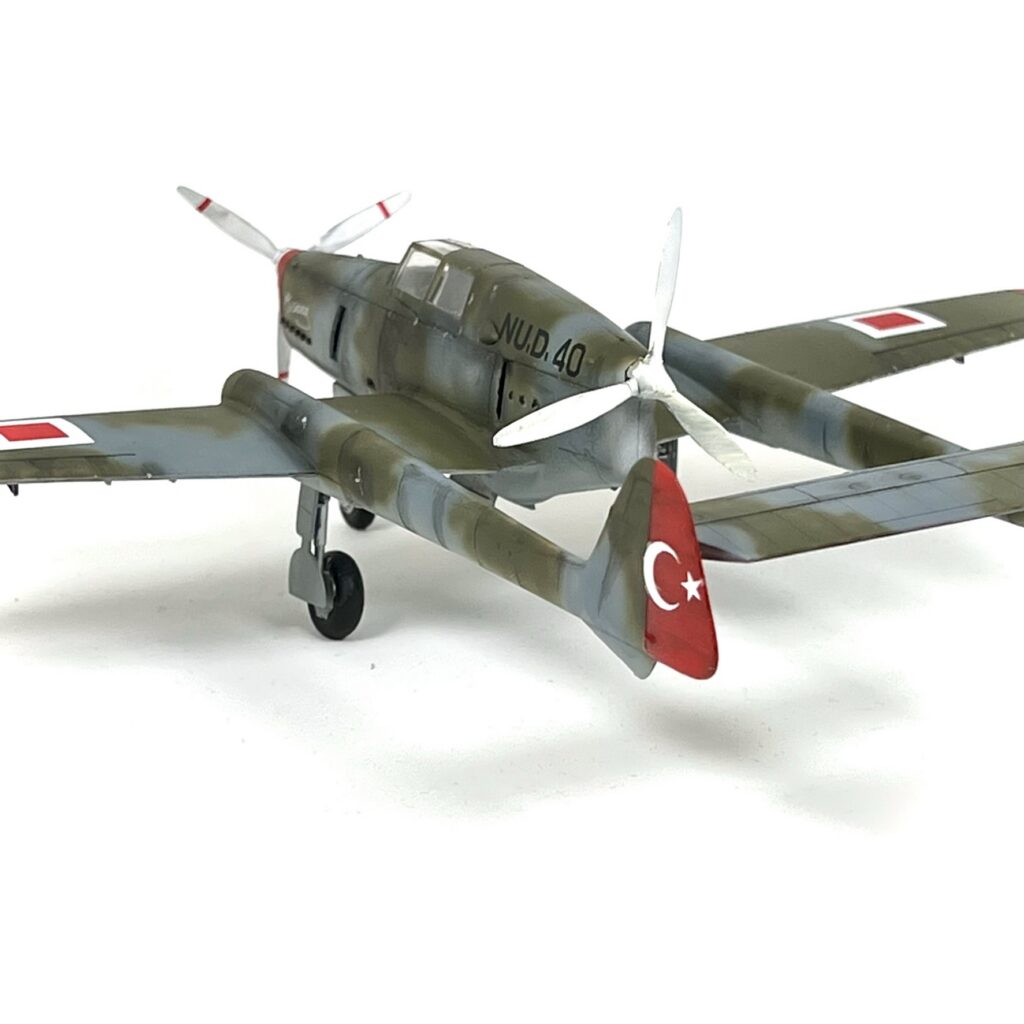
Still, the similarity gave me an excellent starting point. I selected RS Models kit no. 48001, the 1/48-scale Fokker D.XXIII, to create my own interpretation of a Nu.D.40 that might have existed. [5]
There is a crucial point here: I did not physically convert or redesign the aircraft’s plastic structure to match a verified Nu.D.40 airframe. I retained the kit’s Fokker fuselage, wings, booms and tail arrangement. The transformation came through the colour scheme and markings.
This is therefore not a historically exact Nu.D.40 replica or reconstruction. It is a what-if representation created using a visually related aircraft kit.
Building the RS Models 48001: more work than expected
Finding a suitable donor kit was the easy part. Building it proved considerably more demanding.
I would not call the RS Models kit a bad model, but it needed substantial attention at several major joins. Gaps appeared along the fuselage seam, where the wings joined the fuselage, and at the connections between the tail booms and tail surfaces.
These areas required repeated filling, levelling and sanding. The unusual twin-boom structure made even minor alignment problems noticeable, so I spent time getting the silhouette right before painting.
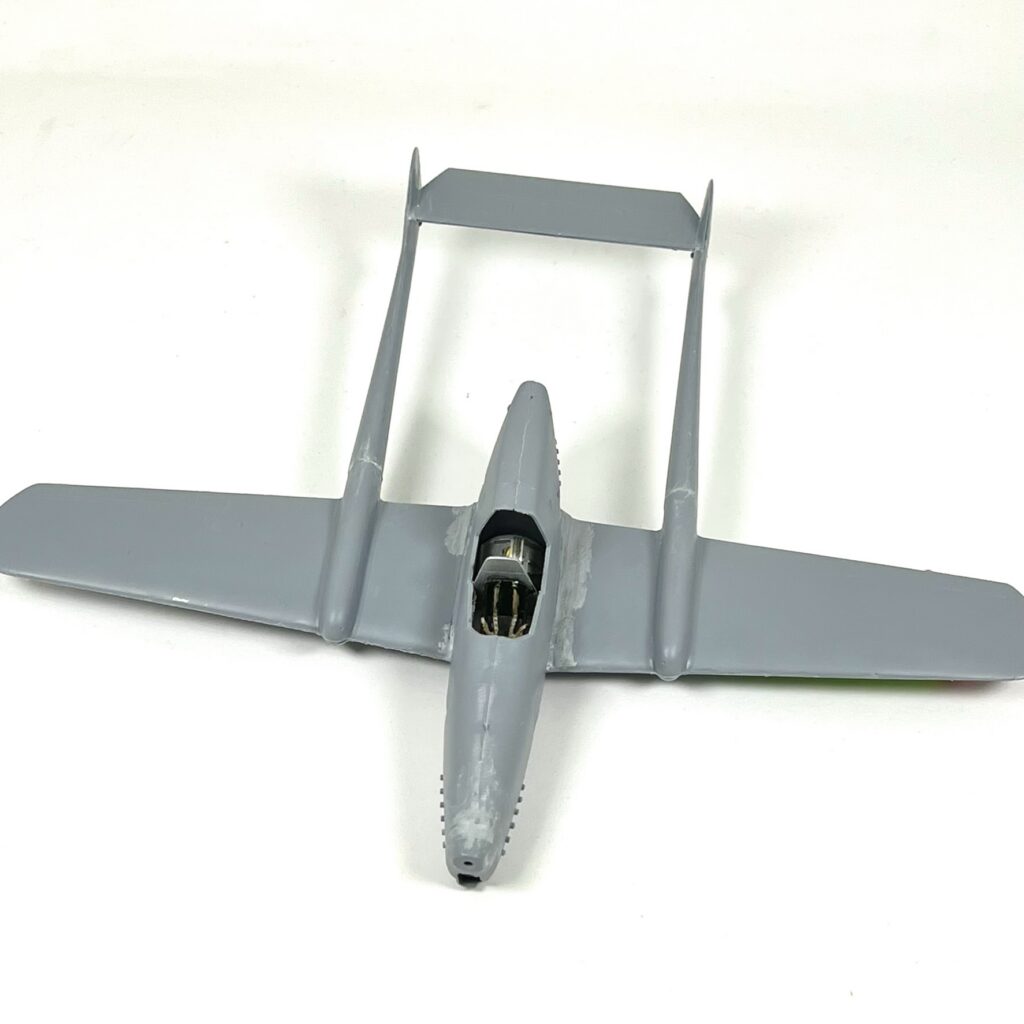
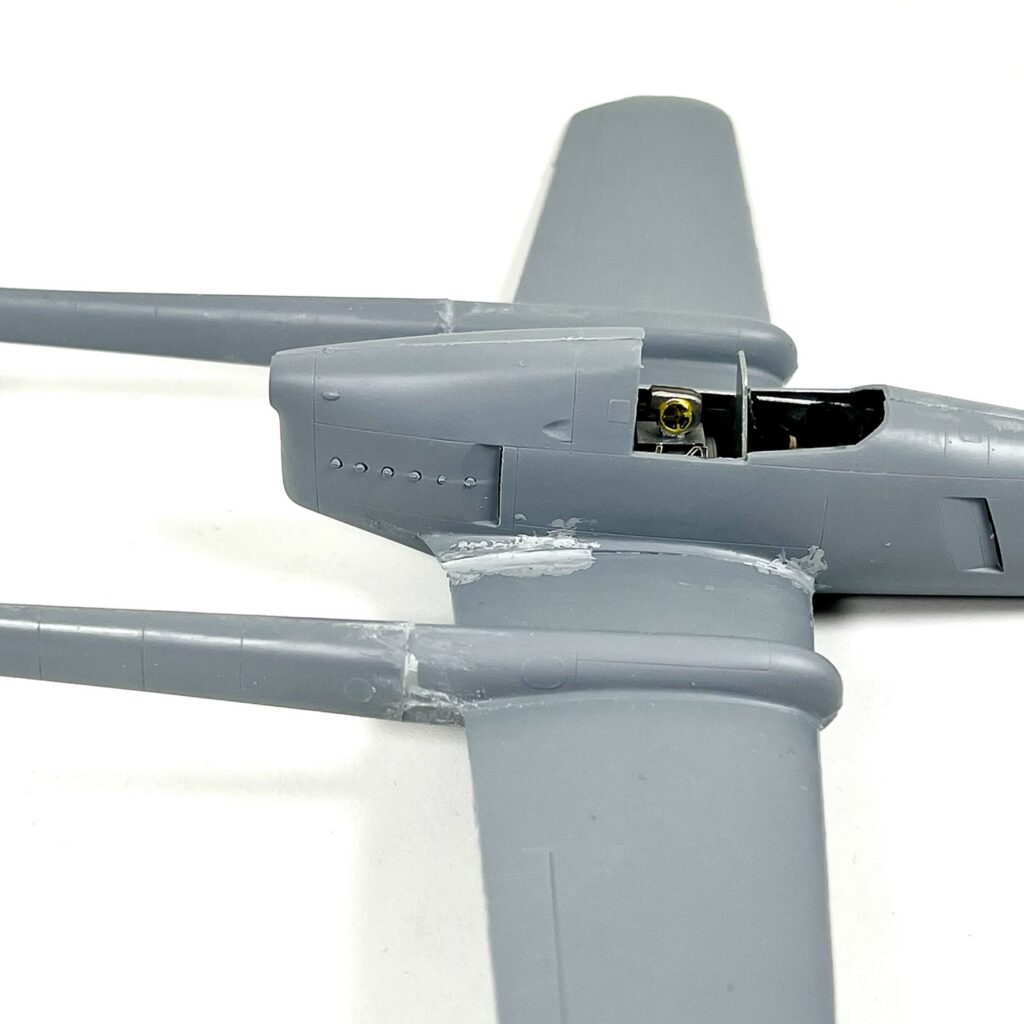
The cockpit was relatively basic, too. In my experience it was not one of the kit’s strongest features, although the aircraft’s distinctive shape was always going to be the main attraction.
A small but essential detail: nose ballast
Another practical challenge was the aircraft’s balance. With a rear propeller and a tail structure extending behind the main fuselage, I did not want the finished model to sit on its tail.
I placed small spherical lead weights, similar to fishing sinkers, inside the nose. To prevent them from moving around inside the fuselage, I secured them with a soft, putty-like adhesive. This helped the finished model stand properly on its nose landing gear.
Those weights are invisible in the completed photographs, but they were every bit as important as the more obvious filling and sanding. To me, that is part of what makes an honest build story interesting: not just the finished paintwork, but the less glamorous problems solved along the way.
Choosing a camouflage scheme for an aircraft that never entered service
Because there is no verified operational paint scheme or set of service markings for the Nu.D.40, I did not attempt to present my colours as an authentic historical specification.
Instead, I used a colour-and-marking reference illustration for Spitfires and Fw 190s in Turkish service as inspiration. I then chose the corresponding Tamiya acrylic colours for the RAF colour names shown in that reference.
The darker green and grey areas gave definition to the unusual twin-tail silhouette, while a lighter grey was used on the undersides. Black and white were used for smaller details.
| Model area | Reference colour | Tamiya acrylic actually used |
|---|---|---|
| Upper-surface green camouflage | RAF Dark Green | XF-81 Dark Green 2 (RAF) |
| Upper-surface grey camouflage | RAF Ocean Grey | XF-82 Ocean Gray 2 (RAF) |
| Undersides | RAF Medium Sea Grey | XF-83 Medium Sea Gray 2 (RAF) |
| Black details | Flat Black | XF-1 Flat Black |
| White details | Flat White | XF-2 Flat White |
This table records the paints I used on my model; it is not a historical Nu.D.40 paint specification. I did not record the exact paint code used for the red nose and tip markings, so I will not assign one retrospectively. The camouflage pattern itself should likewise be understood as an artistic interpretation, not a verified Nu.D.40 scheme.
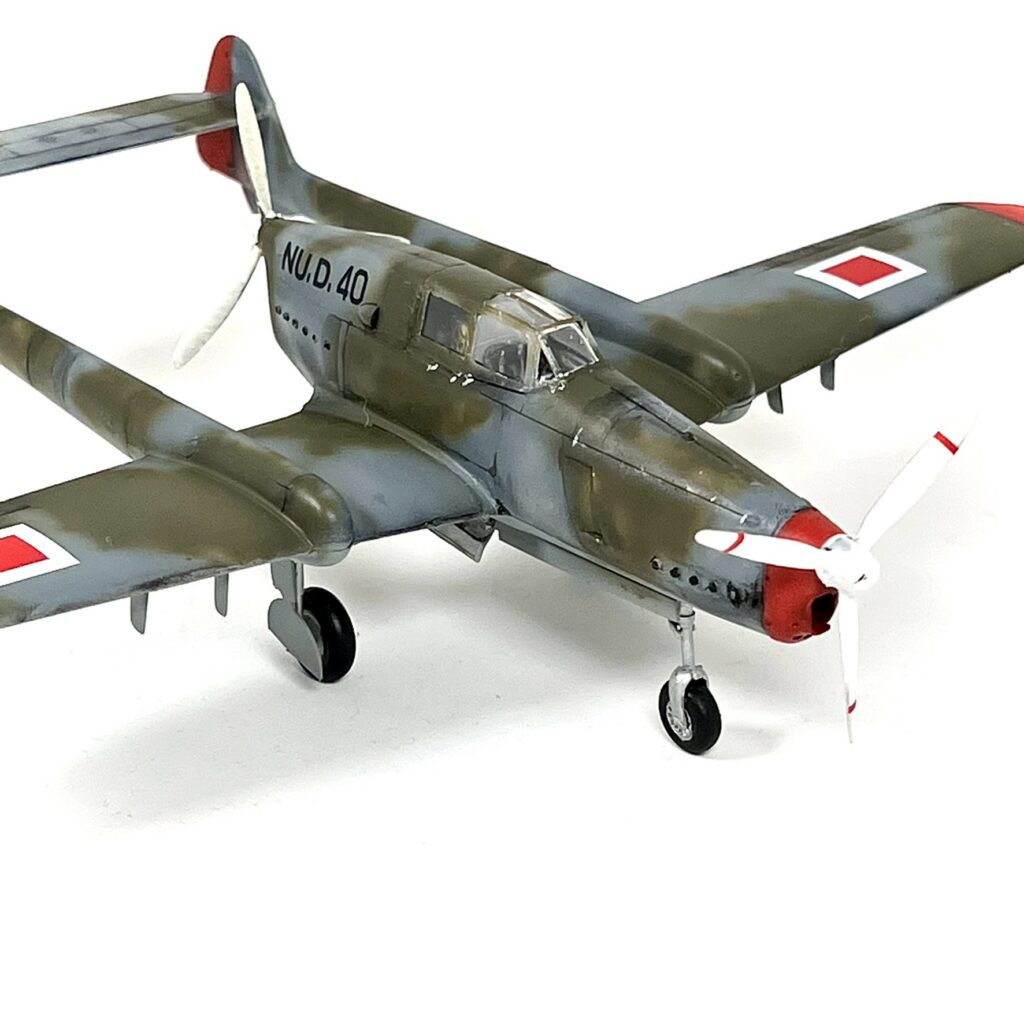
A Turkish identity assembled from spare decals
The final transformation came from the markings.
I went through leftover decals from several earlier kits, bringing together letters, symbols and other elements. I also made use of decals from Babibi Models. With these I created the Nu.D.40 lettering, Turkish markings and the Atatürk signature seen on the finished model.
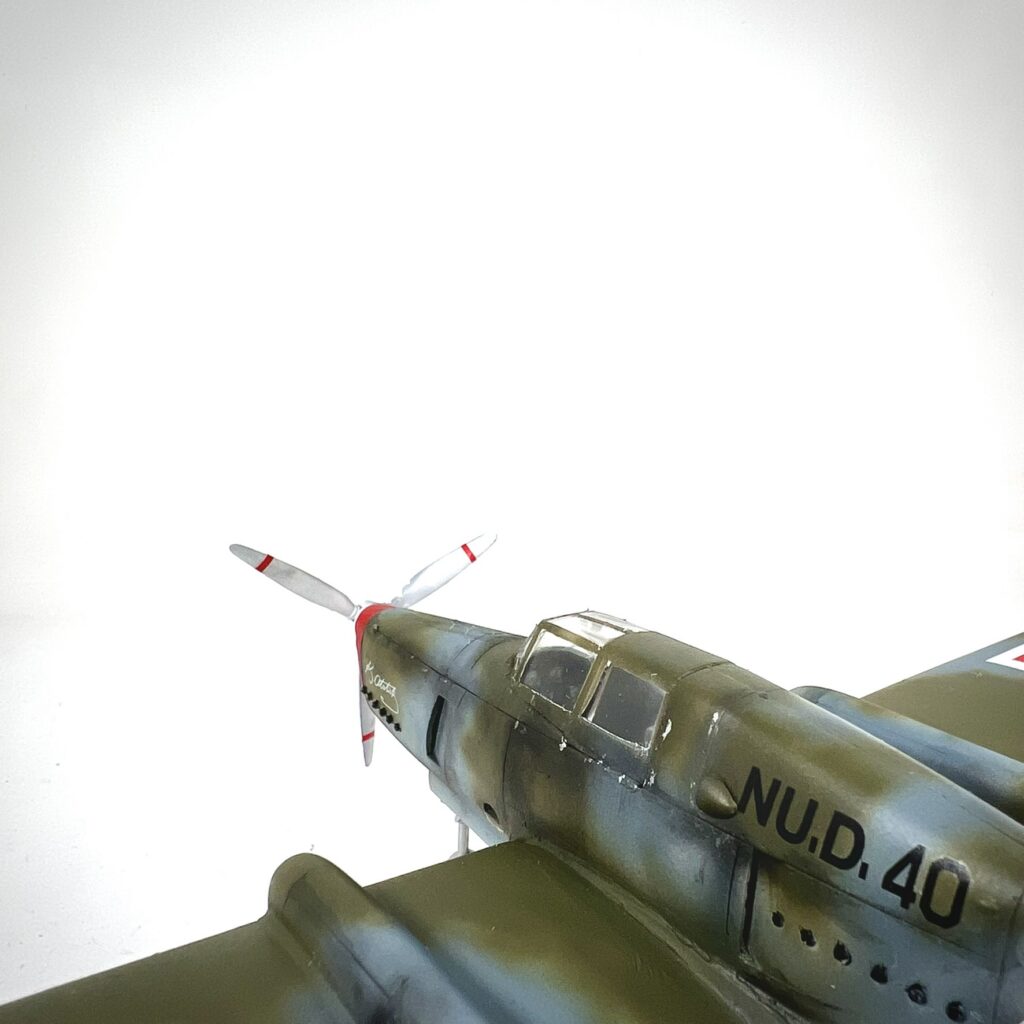
None of these markings came from an official Nu.D.40 decal sheet, and they should not be mistaken for documented markings worn by a real aircraft. They were my way of imagining what a Turkish identity for this fighter might have looked like.
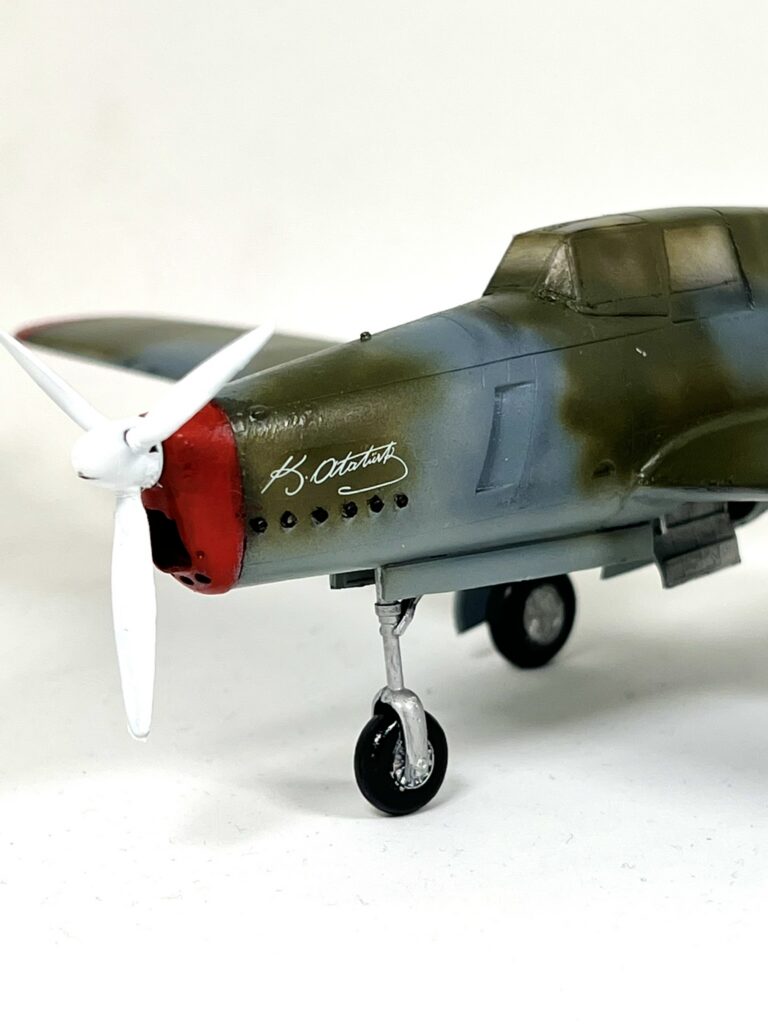
The Nu.D.40 lettering and the signature near the nose are especially important to the finished appearance. Without changing the fundamental aircraft structure, they turn a recognisable Fokker-shaped model into something with a very different story.
When the author found my Instagram post
I completed the project in March–April 2022.
When I shared the finished model on Instagram, a few international scale modellers immediately recognised the Fokker D.XXIII silhouette. Some congratulated me on the Fokker build but wondered where the Nu.D.40 designation had come from.
In a sense, that was exactly the reaction I had hoped for: the shape was familiar, but the identity was unexpected.
The most memorable response came from Emir Öngüner, the author whose research had inspired the project. He commented on my post:
“Thank you for your work. I hope we will soon see the real one in the skies as well.”
English translation of his original Turkish Instagram comment.
Seeing the researcher who had helped recover this forgotten design respond to my scale model made the project especially meaningful to me.
What this model represents—and what it does not
This is not a model of a Nu.D.40 known to have flown with the Turkish Air Force in the 1930s. There is no verified operational aircraft behind those markings.
It is my alternative-history interpretation of a genuine but unrealised Turkish fighter project, built from the 1/48-scale Fokker D.XXIII by RS Models.
The Nu.D.40’s documented research and engineering history belongs in one category; my choices of camouflage, markings and kit belong in another. Using a Fokker kit does not establish that the two aircraft were structurally identical. It simply gives me a way to explore a historical possibility without pretending the unanswered questions have been settled.
For me, scale modelling is not always just about reproducing machines that existed. Sometimes it is also about making forgotten ideas visible.
The Nu.D.40 began for me with a book, took shape on my workbench, and ended with a small but unforgettable connection to the author who had brought its story back to light.
At ModofWar, this is where real machines meet scale stories.