
Introduction: A small vehicle with an enormous job
One of the most recognisable vehicles of the Second World War was neither a tank nor a heavy lorry. It was a small, open-bodied, four-wheel-drive machine with a folding windscreen: the jeep. It carried soldiers and officers, made reconnaissance patrols possible, hauled equipment and served as a platform for radios, light weapons and improvised stretcher frames. Its jobs varied, but the same qualities kept it useful: mobility, mechanical simplicity and a design suited to production on a huge scale.
The name Willys jeep is familiar, yet its origins are best understood as a collaboration shaped by competition. American Bantam supplied the first functioning prototype in 1940. Willys-Overland developed the design selected for standard production as the MB. Ford manufactured the closely related GPW to help meet military demand. None of these roles should be erased from the story.

1940: A specification and a punishing deadline
As war spread across Europe, the US Army asked American vehicle manufacturers for a compact four-wheel-drive reconnaissance car. It had to move men and equipment over poor terrain while remaining small enough to be readily transported and maintained. The early specification included an extraordinarily low weight target of around 1,300 pounds (590 kilograms). A request went to 135 manufacturers, but the effective competitors were American Bantam, Willys-Overland and Ford.
Based in Butler, Pennsylvania, American Bantam answered the challenge first. Its prototype reached the Army on 23 September 1940. It was a crucial achievement: the concept had become a functioning military vehicle. Bantam, however, was not equipped to manufacture the enormous numbers the Army would soon require.
Willys and Ford produced their own trial vehicles. Testing exposed the difficulty of the original weight limit and helped the Army draw useful features from several competing solutions. The Bantam BRC, Willys MA and Ford GP were steps along the road to the standard wartime jeep, not different names for the finished MB.
1941: From trials to the Willys MB
In the summer of 1941, the Army selected the Willys design as the basis for high-volume production. Important factors included the performance of its four-cylinder Go Devil engine, price and manufacturing suitability. The standard Willys MB developed from the MA while incorporating useful details established during the trials.
Willys alone could not supply enough vehicles for the growing war effort. Ford therefore began building the GPW to the same military requirements. Parts between the two types were substantially interchangeable, an important advantage in the field and throughout the supply system. The GPW model letters are sometimes inaccurately expanded as ‘General Purpose Willys’; Ford’s designation system was more specific than that popular explanation suggests.
The vehicle was still evolving as production increased. Early Willys MBs featured a welded ‘slat’ grille, while the familiar stamped-steel grille with vertical slots was a more economical design adopted during production. It became part of the jeep silhouette recognised around the world.
More than 637,000 — but not all built by Willys
Between 1941 and 1945, Willys and Ford together produced more than 637,000 standard wartime jeeps. The combined total is also commonly rounded to about 640,000, depending on the categories included in a particular account. This is not a figure for Willys MB production alone: it includes Ford GPWs.
Producing a common vehicle through two major companies made it easier to equip forces operating across very different theatres. Its success was not based on heavy armour or exceptional carrying capacity. Rather, it offered a quick and practical solution for hundreds of duties that did not demand a larger vehicle.
Service: Reconnaissance, communications and improvisation
The jeep served as a reconnaissance and liaison vehicle, a means of carrying officers and small teams, a radio platform, a light towing vehicle and a military-police transport. Units adapted jeeps to move wounded soldiers on stretchers or to carry mounted machine guns. These roles illustrate why the design’s compact size and simplicity mattered so much.
In parts of the European theatre, soldiers fitted tall wire cutters ahead of the windscreen to deal with wires stretched across roads. These were field adaptations rather than standard equipment fitted to every jeep at the factory. The Tamiya model featured in the companion ModofWar build represents a jeep carrying such a cutter.
Its short wheelbase and four-wheel-drive layout made the jeep useful on narrow tracks, broken roads and rough ground. The open body and lack of armour also set clear limits: its crew could not expect the protection of an armoured car. What the jeep offered was mobility, flexibility and availability—three qualities essential to an army in constant movement.
Where did the name ‘jeep’ come from?
The origin of the word is still debated. Explanations include Eugene the Jeep, the extraordinary creature from the Popeye comic strip, earlier military slang and the pronunciation of ‘GP’. It is too simple, however, to state that GP always stood for ‘general purpose’, or that the name can be traced securely to a single moment. Even official US Army historical accounts discuss competing explanations. The uncertainty is part of the vehicle’s history.
The legacy
The wartime jeep helped establish the light, multipurpose 4×4 as a category in its own right. Its influence reached post-war civilian and military vehicles. More importantly, it demonstrated how a straightforward design, produced and supported in very large numbers, could transform everyday military mobility.
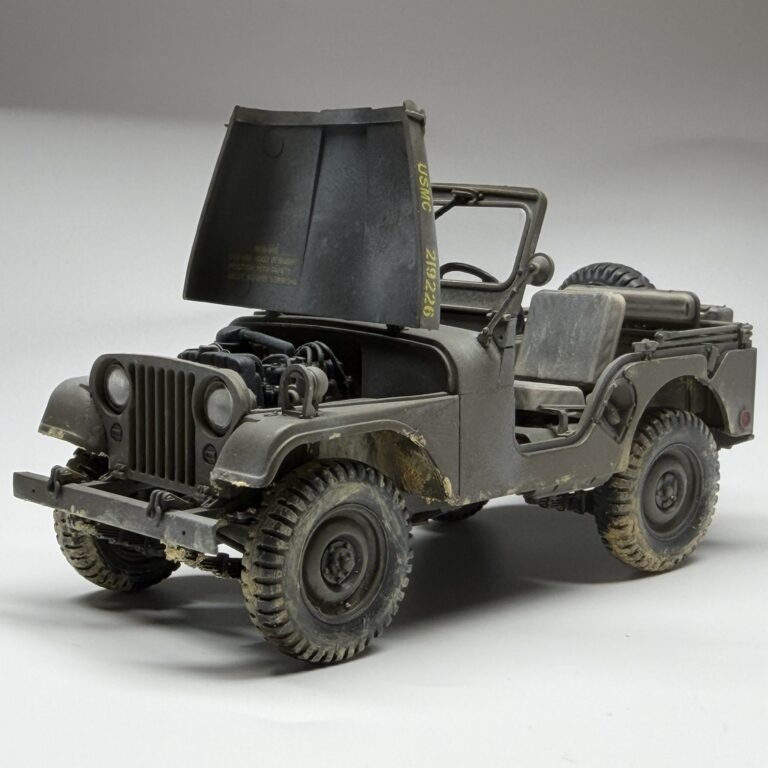
The companion Tamiya 1/35 Willys MB model dossier shows a vehicle in US 7th Armored Division markings, representing Belgium in early 1945, together with my modelling and weathering notes.
Related scale model
The Tamiya 1/35 Willys MB build, with painting and weathering notes and photographs: View the model →
Sources
- U.S. Army Center of Military History — The Ordnance Department: Procurement and Supply, ‘The Versatile Jeep’: https://history.army.mil/portals/143/Images/Publications/catalog/10-10.pdf
- Smithsonian, National Museum of American History — Bantam Jeep Prototype, 1940: https://americanhistory.si.edu/collections/object/nmah_841492
- Smithsonian Folklife — Military Equipment Display, Willys MB and Ford GPW: https://folklife.si.edu/national-wwii-reunion/military-equipment-display/smithsonian
- American Society of Mechanical Engineers — Jeep Model MB, Engineering Landmark: https://www.asme.org/about-asme/engineering-history/landmarks/152-jeep-model-mb
- Jeep — 1940s Heritage: https://www.jeep.com/history/1940s.html
- Tamiya — U.S. Jeep Willys MB, 1/35 kit 35219 instruction sheet and historical introduction: https://cdn.simba-dickie-group.de/downloads/300035219/300035219_Jeep_Willys_MB.pdf