Overview
Two small military utility vehicles became familiar sights on opposite sides of the Second World War: the Allied Willys Jeep and Germany’s Volkswagen Kübelwagen Type 82. Both carried soldiers, orders, messages and small loads where the front line demanded quick transport. Yet they solved the problem in different ways. Instead of four-wheel drive, the Kübelwagen relied on low weight, simple mechanical components and an air-cooled engine mounted at the rear.
From people’s car to military vehicle
The Kübelwagen grew from Volkswagen development under Ferdinand Porsche. Work on turning the civilian design into a light military utility vehicle began before the war; military prototypes appeared by late 1938. The Type 82 entered mass production in 1940, and manufacturing continued until 1945. Roughly 50,000 vehicles were built, though reported totals vary slightly depending on which versions are counted.
Its flat, angular body was inexpensive to manufacture. The layout seated four, while an air-cooled, rear-mounted flat-four engine provided the power. Early engines displaced around 985 cc and produced approximately 23.5 hp; later wartime vehicles received a larger, more powerful engine. Independent suspension on all four wheels and the low weight made up for some of the limitations of rear-wheel drive on rough ground.
Why it worked in North Africa
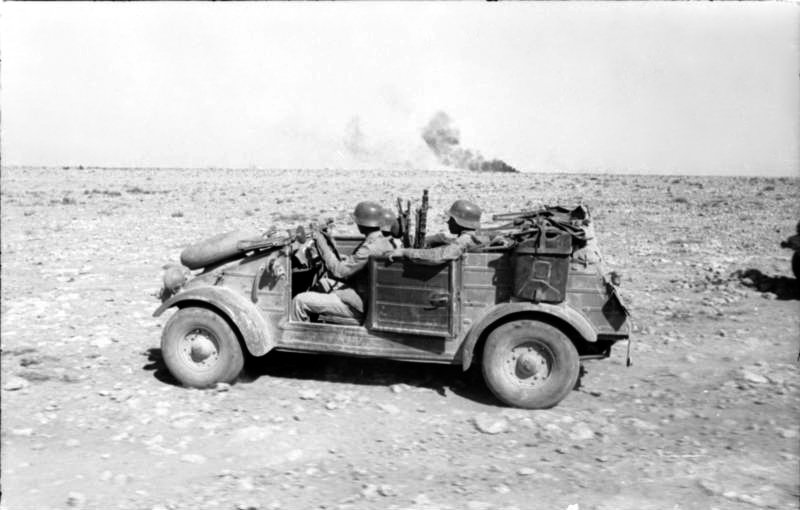
Desert conditions highlighted the Kübelwagen’s practical strengths. Without a liquid-cooled radiator, crews did not have to worry about boiling coolant or radiator leaks. Ease of maintenance also mattered when supplies and workshop equipment were limited.
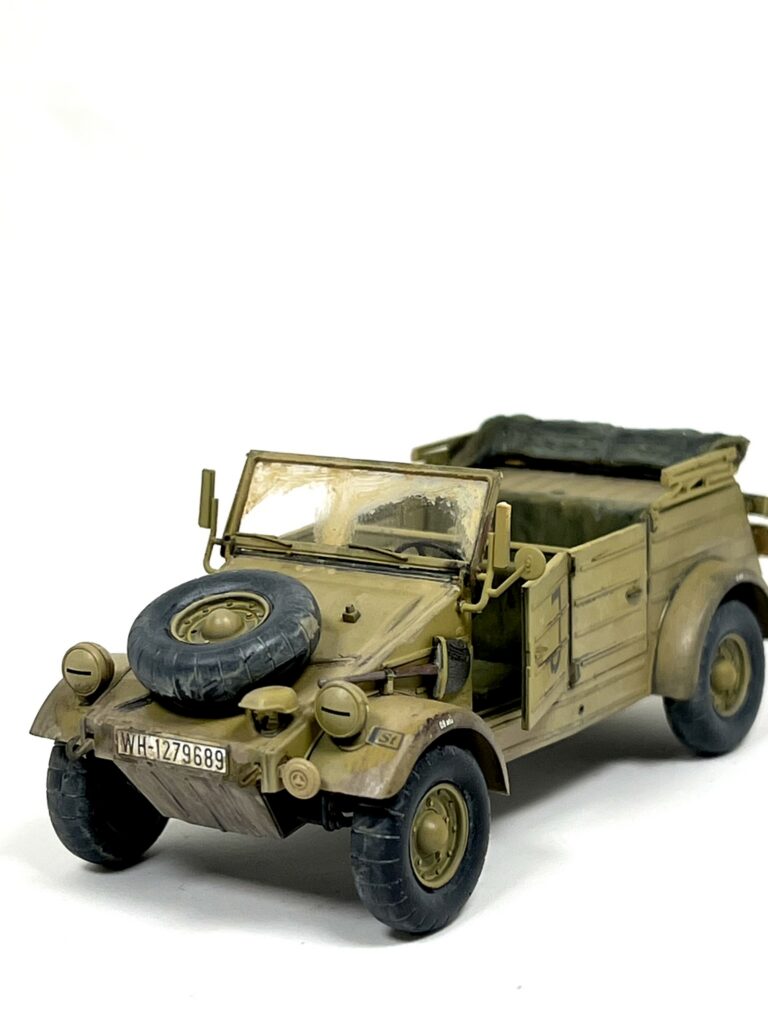
From 1942, vehicles fitted with wide balloon tyres appeared for desert service. A broader contact patch helped on soft sand. Tamiya’s Africa-Corps kit recreates this arrangement. The equipment was not exclusive to a single formation or one particular paint scheme.
Was it really the German Jeep?
Calling the Kübelwagen the “German Jeep” is reasonable as shorthand: both vehicles handled liaison, reconnaissance and light transport duties. But similar roles do not imply identical engineering.
The Willys MB had a front-mounted engine and four-wheel drive. The Kübelwagen had its engine at the rear and drove only the rear wheels; it was also considerably lighter. The Jeep prioritised traction, while the Kübelwagen achieved useful off-road performance through modest weight and simplicity. Since its development began before the Jeep became widespread, it should not be described as a copy or direct response to the Willys MB.
That contrast makes them particularly interesting model subjects: two different engineering answers to broadly similar needs. A separate Willys MB scale-model dossier is available on ModofWar.
A useful vehicle to the end
The Type 82 continued serving on German fronts until 1945. Its modest appearance concealed an efficient design. While the Willys Jeep went on to become an international icon, the Kübelwagen remains an equally revealing example of how military utility vehicles were designed under very different constraints.
The scale model
My Tamiya 1/35 kit 35238 represents the North African version with balloon tyres. The separate Scale Model dossier documents its desert finish, original gallery and the actual Tamiya XF paints I used.
Tamiya 1/35 Kübelwagen Type 82 Africa-Corps — view the model build →