A fighter shaped by its engine
Few Second World War aircraft are as recognisable as the Vought F4U Corsair. The downward-angled inner wing sections and upward-sweeping outer panels gave it the characteristic inverted gull wing silhouette. This striking shape was not merely an aesthetic choice. The Pratt & Whitney R-2800 Double Wasp drove an enormous propeller exceeding four metres in diameter. By lowering the inner wing, Vought could provide ground clearance for the propeller while keeping the main undercarriage comparatively short and robust. [1][2]
The prototype XF4U-1 first flew on 29 May 1940. Later that year it exceeded 400 mph (about 644 km/h), placing it among the fastest American single-engine fighter designs of its time. Speed, however, was only one requirement. A naval fighter also had to take off from, and safely recover aboard, a moving aircraft carrier. The early Corsair would prove that these demands were not always easy to reconcile. [1][2]
Why the early Corsairs went ashore
The first production F4U-1 arrived during 1942. Its long nose and the cockpit’s aft position obstructed the pilot’s view of the landing deck. Low-speed approach behaviour, bounce on landing and a tendency for one wing to stall early were additional problems during carrier trials. The US Navy therefore initially favoured the Grumman F6F Hellcat for fleet carrier service. Early Corsairs instead became strongly associated with shore-based US Marine Corps fighter squadrons, particularly in the Solomons and the fighting around Rabaul. [2]
Vought continued to refine the design. Later aircraft, commonly identified as F4U-1A, gained improved visibility from a raised seat and revised canopy, together with changes that helped manage the aircraft during low-speed approaches. The Corsair’s qualities in the air had not disappeared; its naval handling was gradually becoming better suited to those same high-performance demands. [1][2]
The F4U-1D: a fighter that could strike back
Introduced in the spring of 1944, the F4U-1D represented a particularly useful combination of fleet fighter and fighter-bomber. With six 0.50-calibre (12.7 mm) machine guns, underwing stations for bombs or drop tanks and provision for up to eight rockets, it could defend the fleet or attack targets ashore. Versions of the R-2800 with water injection helped provide additional power for short periods, while other refinements included broader propeller blades and the improved pilot position. [1][3]
This versatility matched the changing Pacific War. As US carrier task forces advanced towards the Japanese home islands in 1944–45, they increasingly needed aircraft able to escort strikes, intercept threats and attack airfields, shipping and other ground targets. The Corsair flew from aircraft carriers as well as Marine bases ashore. Its folding wings were essential to the space-constrained world of the carrier hangar and flight deck. [1][2][3]
The dark blue Corsair
Many late-war US Navy Corsairs are remembered in overall Glossy Sea Blue, designated ANA 623. The change from earlier multicolour camouflage schemes was implemented during 1944 and did not instantly replace every aircraft in the Pacific. Earlier finishes, different production dates and unit-level repainting could overlap during the transition. The familiar dark blue silhouette therefore belongs to a particular period rather than to every Corsair ever flown. [4]
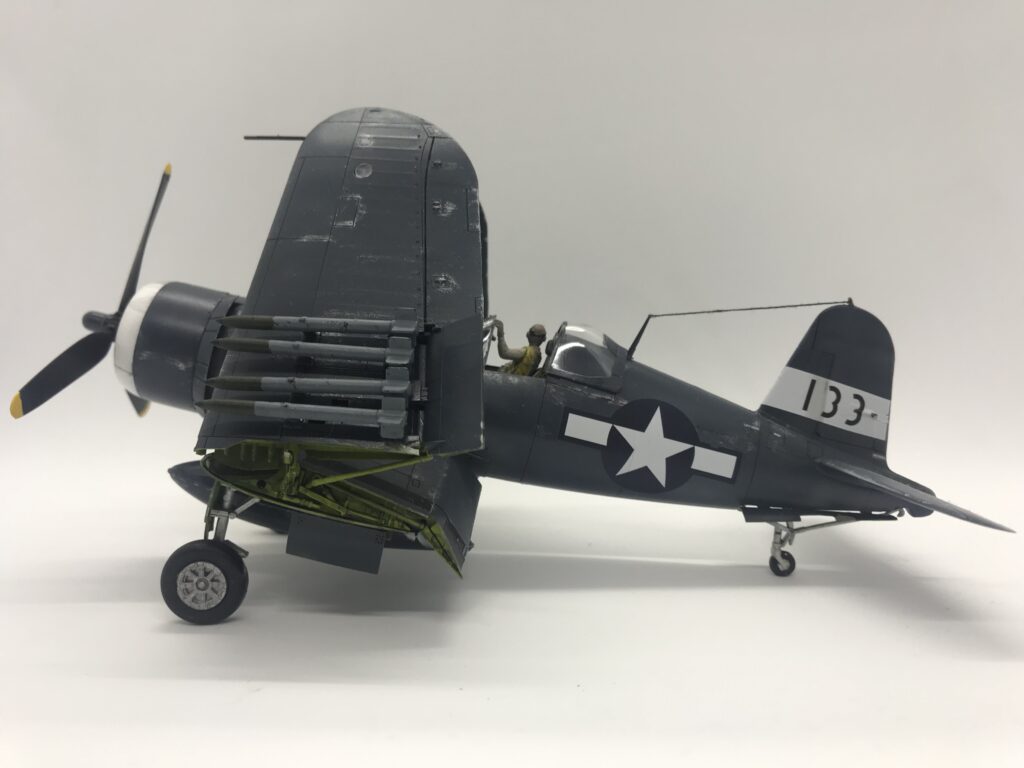
ANA 623 is a historical US Navy colour designation. A modern hobby-paint swatch or a recipe mixed from Tamiya acrylics can approximate its appearance, but should not automatically be described as an exact reproduction of the 1944 pigment formula. The actual paint mixture used on the author’s 1/48 Tamiya build is recorded separately in the Scale Model Dossier.
What the wartime record really shows
Postwar US figures repeated in historical summaries attribute 64,051 operational sorties to the combined Corsair F4U and Goodyear FG family, of which 9,581 were flown from carrier decks. The same compilations compare 2,140 aerial victory claims with 189 Corsairs lost to enemy aircraft, yielding the often-quoted ratio of more than 11:1. These figures describe a broad family and changing circumstances, however—not one specific F4U-1D aircraft, not a constant advantage in every engagement, and not independent verification of every victory claim. [5][6]
The Corsair also proved its worth as an attack aircraft. Its ability to carry bombs and rockets meant that, as the campaign progressed, it increasingly helped shape events on the ground and at sea rather than merely contesting the air. That shift explains much of the importance of the F4U-1D in the final phase of the Pacific War.
Beyond 1945
Corsair production continued until 1953 and the aircraft family remained in service after the Second World War, including attack operations in Korea. Its long career owed as much to adaptability and structural strength as to the formidable top speed that had drawn attention to the prototype in 1940. [2][5]
Related build: Tamiya 61085, 1/48 F4U-1D Corsair, completed with folded wings — see the model build.