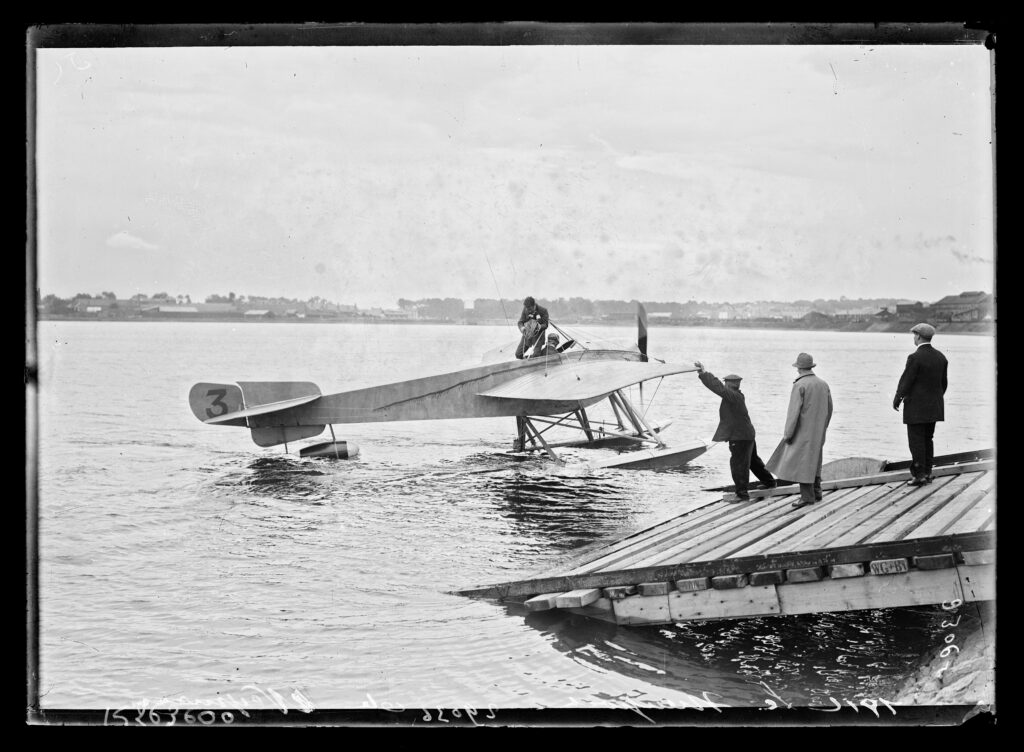
A naval air arm takes shape
In the summer of 1914, Ottoman military aviation was still a small and developing enterprise. Aircraft had to be purchased abroad, pilots and mechanics trained, and facilities built from limited resources. Yet the geography of the straits created a particular need: a flying machine able to rise from water could watch ships approaching the Dardanelles without relying on a large prepared land airfield. French-built Nieuport floatplanes became part of this first attempt to establish a naval flying service. [R1][R2]
The designation requires care. “Hydravion” means seaplane and was often used as a convenient general description of early float-equipped monoplanes. It does not, by itself, identify a specific production variant. An older record labels the Ottoman aircraft “Nieuport IV Hydravion,” but detailed inventories of Turkish naval aircraft instead distinguish a single-seat Type VI from a two-seat Type VII. Those two documented machines form the subject of this article. [R1][R3]
From early French monoplanes to floatplanes
The French firm Établissements Nieuport was among the pioneer manufacturers experimenting with efficient monoplanes. Adapting a light aeroplane to operate on water involved attaching floats and supporting struts, while maintaining sufficient performance and stability for take-off, landing and flight. Photographs from French seaplane meetings in 1912–1913 show the challenges of an unfamiliar technology: slender fuselages, exposed bracing and long wooden floats had to cope with both air and water. [R3][R4]
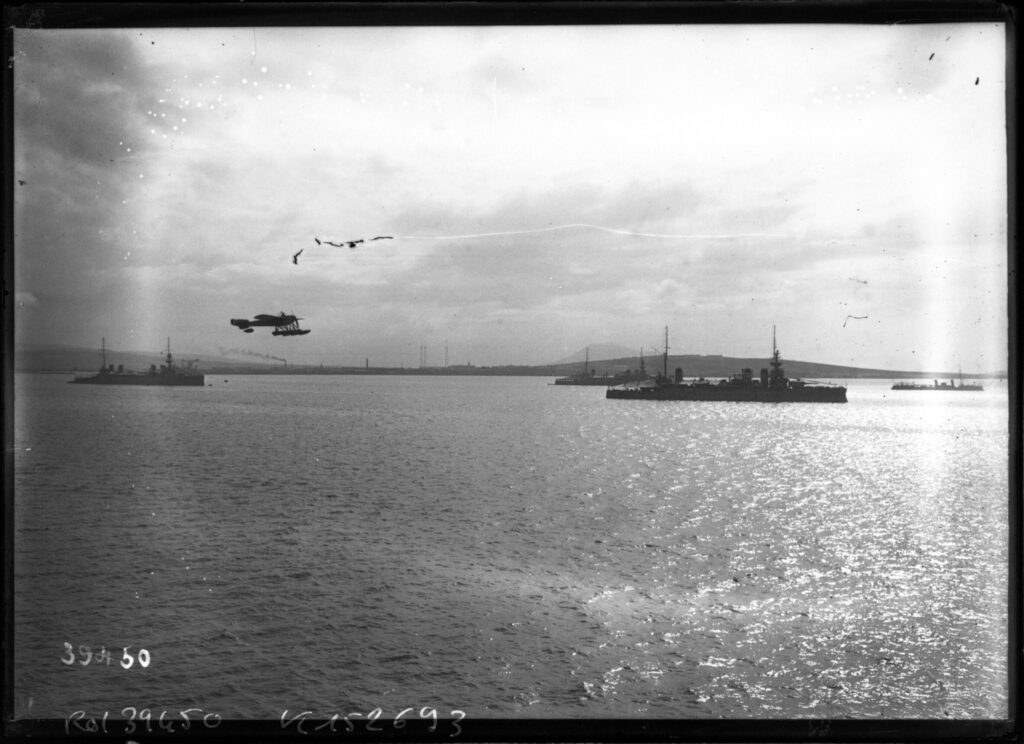
It would be misleading to describe the Ottoman VI and VII as merely identical versions with different numbers of seats. Historical inventories catalogue them under separate designations. Both are recorded in the Turkish naval aircraft inventory with 100-horsepower Gnome engines, but the available records do not verify a single, shared set of span, length, mass and top-speed figures for the two Ottoman aircraft. In particular, the familiar figures from an older Type IV summary should not be silently transferred to VI or VII. Contemporary Jane’s tables distinguish several Nieuport models with differing measurements. [R1][R4]
Yeşilköy Naval Flying School and the unfulfilled order
Ottoman naval aviation advanced organisationally in 1914. The Naval Flying School at Yeşilköy opened on 27 June 1914, alongside plans to train pilots for a larger seaplane force. An American-built Curtiss F flying boat, purchased from John Cooper, was an early school aircraft. France was also expected to supply 15 Nieuport Hydroavions, according to the specialist Turkish naval aircraft inventory. The outbreak of war interrupted deliveries; an order for fifteen is not the same as fifteen aircraft actually received. [R1][R2]
The single-seat Nieuport Type VI reached Istanbul during the summer as a training aircraft. The two-seat Type VII was brought to Istanbul in July 1914 by the French pilot Levavasseur. It was named “Mahmud Şevket Paşa,” and the detailed inventory also records the number 204. Spellings of the name vary between Turkish-language sources. For the purposes of this Dossier, the inventory form is used. The Ottoman navy thus had a small number of real aircraft, not the substantial French-built seaplane force that its procurement plans envisaged. [R1][R5]
Reconnaissance at the Dardanelles: 5 September 1914
As war spread across Europe, watching naval movements around the Dardanelles became increasingly important. Lieutenant Fazıl Bey brought a single-seat Nieuport Type VI to the straits in August 1914. Accounts give 17 or 25 August for its arrival or successful deployment. Because a landplane had initially been expected, the personnel had to improvise a waterside operating point and hangar arrangements near Nara. The resulting detachment is remembered among the earliest Ottoman naval flying units outside Istanbul. [R2][R5][R6]
On 5 September 1914, Fazıl Bey completed an approximately 70-minute reconnaissance flight. The mission produced information on foreign warships near the approaches to the straits. Further sorties followed, though the aircraft’s mechanical condition and the severe limitations of the base restricted their frequency. These early observations should not be confused with the well-known reconnaissance flights on 18 March 1915, which took place after the original two Nieuports had left service. The 1914 Nieuport flights nevertheless demonstrated how naval aviation could contribute to the defence of the approaches to the Dardanelles. [R2][R6][R7]
“Mahmud Şevket Paşa” and the forced landing
By the autumn, the single-seat aircraft had become increasingly difficult to keep operational. A two-seat Nieuport was therefore sent towards the front. On 19 October 1914, Navy Captain Savmi (Uçan) Bey departed for the Dardanelles in the aircraft named “Mahmud Şevket Paşa.” Approaching Şarköy, he found that the engine was running out of oil and was forced to put down in the Sea of Marmara. Contemporary-history accounts describe the pilot and aircraft subsequently being taken in tow by a motorboat towards Nara. [R1][R2][R5]
The precise sequence of final accidents and withdrawal dates is not entirely consistent across sources. One specialist inventory gives 20 October 1914 for the Type VII and 5 November 1914 for the Type VI. A recent scholarly account instead describes the two-seat aircraft being damaged during a flight on 5 November. These references should not be compressed into a single confidently dated event. What is well supported is that the early Ottoman service of both aircraft ended in 1914. The older online claim that these exact machines remained in service until 1916 is not corroborated by the detailed aircraft records consulted here. [R1][R5][R6]
Why two short-lived aircraft matter
The Ottoman Type VI and Type VII were not a large fleet, and they did not establish an unbroken series of operational successes. Both machines demanded skills and facilities that were still being assembled: trained pilots, dependable engines, sheltered moorings, mechanics and suitable routes for recovering aircraft from water. Their very short careers reveal the organisational challenges of making aviation useful rather than merely possessing aircraft. [R1][R2]
At the same time, the Nara detachment and the reconnaissance of 5 September 1914 were early proofs of the naval air arm’s potential. The value of these Nieuports in a historical archive is therefore not an exaggerated service record. It is the documented beginning of an operational capability that Ottoman naval aviators would develop under much more demanding circumstances later in the war. Presenting the single-seat VI and two-seat VII separately, within a shared account of the first seaplane force, honours that history more faithfully than treating everything as one undifferentiated “Nieuport IV.” [R1][R2]