
Why I recommend this kit
If someone who was new to scale modelling—or still thinking of trying it—asked me where to start, Tamiya’s 1/35 Willys MB Jeep would be near the top of my list. It avoids many of the frustrations that can discourage a first-time builder: there are relatively few parts, the fit is excellent, assembly is straightforward and the body is painted in almost a single colour. Yet the finished result looks far more interesting than the kit’s simplicity might suggest.
The tooling dates from 1997, but this remains a thoroughly enjoyable model. I found the fit so good that there was no real need to reach for filler or spend ages sanding joints. The box contains two main sprues, the body, clear parts and decals, as well as a driver figure in a relaxed pose, assembled from seven parts. The simplicity is a strength, not a lack of character. With careful paintwork and weathering, this little Jeep really comes alive.
I recommend it just as strongly to experienced modellers. It is the sort of project you can finish relatively quickly and use to experiment with different weathering effects. After a demanding, highly detailed build, there is something refreshing about a model that just goes together without a fight.
My choice: Belgium, January 1945
Tamiya provides five marking options. I built option C, the third choice, representing a Willys MB in US 7th Armored Division markings in Belgium, January 1945. Two details give this version its distinctive appearance: a tall wire cutter on the front bumper and a machine gun fitted at the rear.
Some jeeps in Europe carried wire cutters as local field modifications, so the detail gives the model a connection to the realities of wartime service. The markings here are the kit’s portrayal of a particular unit and period, not a claim that every detail has been matched to a photograph of one individual vehicle.
Assembly: Simple and satisfying
For me, the best part was how easily everything came together. The characteristic body shape, seats, windscreen and chassis take form without a huge number of components, and the parts fit cleanly. A beginner can concentrate on enjoying the process instead of correcting poorly fitting joints. A more experienced builder gains something different: extra time to concentrate on the finish.
The kit offers useful interior and engine-area details, but I particularly enjoyed what came after the uncomplicated assembly: bringing the surfaces to life with paint and weathering. An almost single-colour vehicle can easily look flat, and this Jeep provides a particularly good opportunity to avoid that.
Painting: Following Tamiya’s XF instructions
I used the Tamiya XF colours specified in the kit’s own instructions for this build. The mostly single-colour body keeps the painting process manageable, while the seats, tyres, metal fittings and small equipment parts give you enough variety to make the finished vehicle convincing.
I have deliberately not added a speculative list of XF paint codes. Although XF-62 Olive Drab was the main body colour on my GMC truck model, that is not automatically proof of which specific XF code I used on this Willys. For the Jeep, what I can confirm is that I followed Tamiya’s instruction-sheet XF colours.
Weathering: Mud and panel lines
I used the same mud texture as on my GMC 6×6 cargo truck: Vallejo Weathering Effects — European Thick Mud. The texture helps give the tyres and lower areas the feeling of a vehicle that has been used on rough, muddy roads. On such a compact model, a little difference in surface texture can make a big visual difference.
I also used Tamiya Panel Line Accent Color on the Jeep, including the black and brown tones I had used on the GMC. Bringing out the edges, seams and interior details breaks up the broad painted surfaces and gives them depth.
One of my favourite effects is on the windscreen. With brown pigments, I created the impression that mud had been partially cleared by the windscreen wipers, leaving a contrast between the dirtier glass and the wiped area. I like this sort of small, familiar detail: it helps tell the story of a vehicle in use without needing a complicated diorama. I have not described a specific masking, scraping or solvent technique because that was not recorded as part of the build.
Who is this kit for?
Beginners: Absolutely recommended. Few parts, dependable fit and a mostly one-colour paint scheme make it easy to finish a model you can be pleased with.
Experienced modellers: Equally worthwhile as a quick, relaxing project. You can keep the finish restrained or use the Jeep as a testbed for mud, pigments, panel line washes and other weathering techniques.
That is what made the Tamiya Willys MB so enjoyable for me: a straightforward, trouble-free build with a very satisfying result. Small, recognisable and full of character, it is one of those kits that reminds me why I enjoy scale modelling.
Gallery


The jeep family
Four generations of the US Army’s light utility vehicle, all built in 1/35.
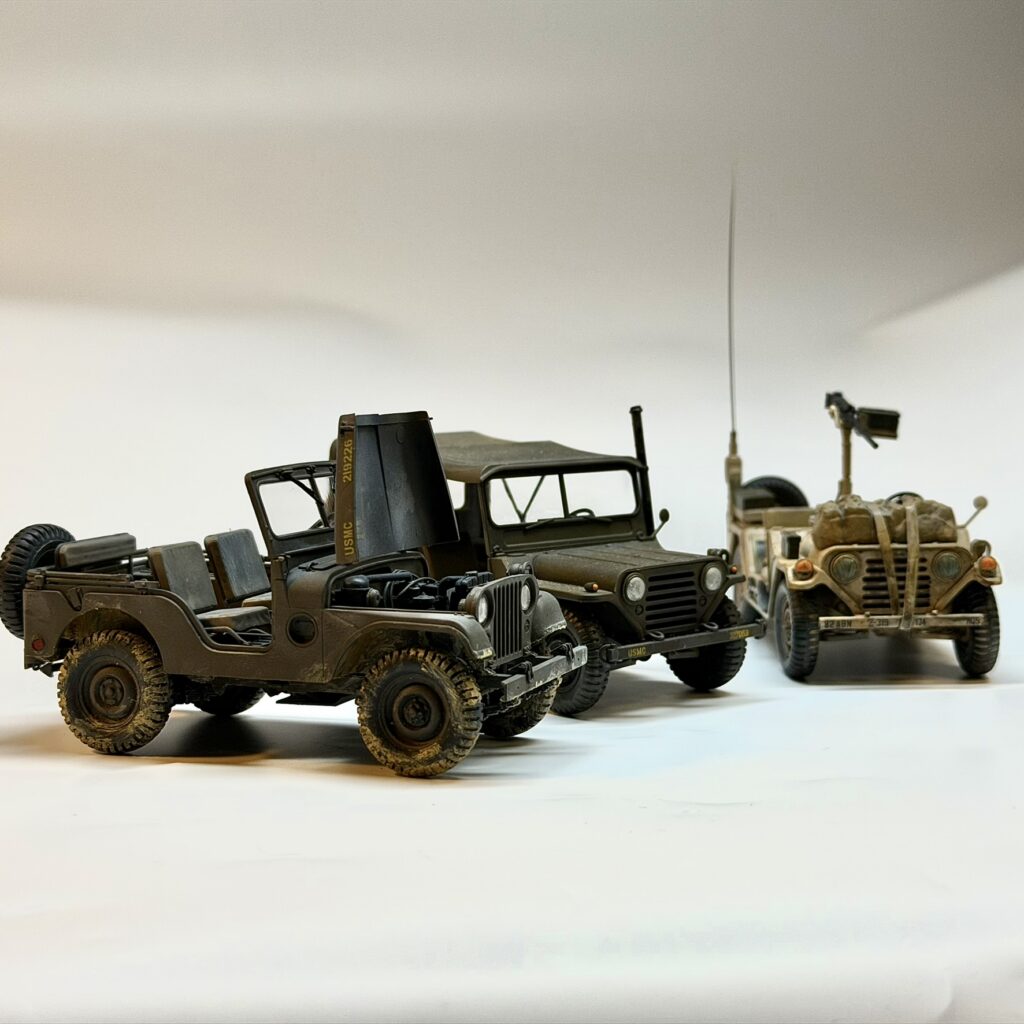
- Willys MB, 1941 to 1945 (this dossier)
- Willys M38A1, the 1950s
- M151A1, Vietnam
- M151A2, Grenada 1983
- Planned: Willys MB ambulance jeep, Normandy 1944
- Planned: Wasp flamethrower jeep, Popski’s Private Army
Related history
The 1940 requirement, Bantam’s prototype, the Willys MB / Ford GPW production programme and wartime service: Read the history →
Sources
- Tamiya kit 35219 official instructions: https://cdn.simba-dickie-group.de/downloads/300035219/300035219_Jeep_Willys_MB.pdf
Leave a Reply