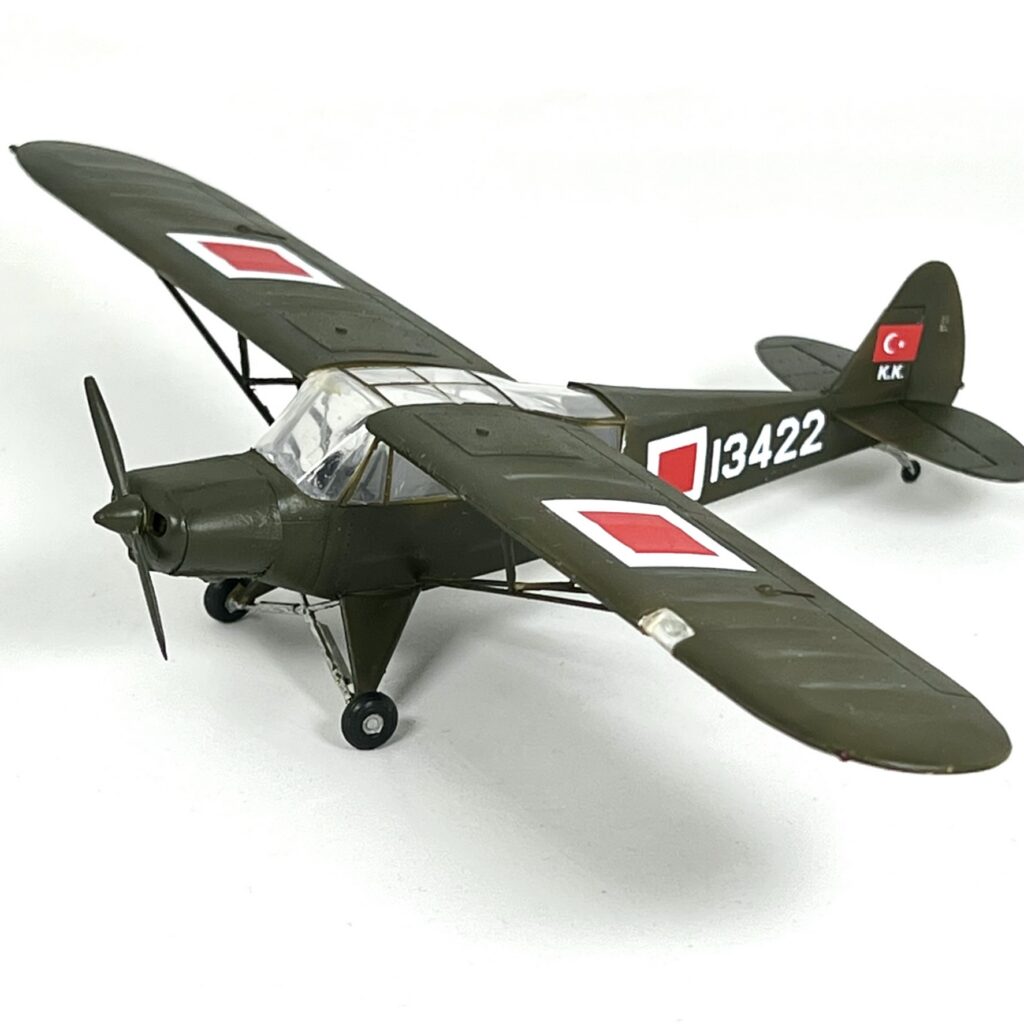
Overshadowed by powerful engines, high speeds and heavy weapons, some aircraft served a very different purpose in military aviation: observing the ground, carrying information and operating from relatively small airfields. The Piper L-21B Super Cub was one such aircraft in the post-war period. This dossier explores its development, its place in Turkish Army service and my 1/48-scale build of the PM Model kit.
The Important Work of Unassuming Aircraft
The history of military aviation is not solely the history of fighters and bombers. Light aircraft also played an important supporting role: observing ground forces, spotting artillery fire, maintaining contact between commanders and providing flight training. Often unarmed, they depended less on speed than on visibility, simplicity and their ability to operate when and where they were needed.
The Piper L-21B Super Cub was a characteristic example. With its high wing, supporting struts, fixed landing gear and straightforward fuselage, it could easily be mistaken for an aircraft at a civilian flying school. Yet those same uncomplicated features were part of what made it useful for military liaison and observation duties.
From the Piper Cub to the Super Cub
The Piper Cub family grew out of the light-aircraft design philosophy of the 1930s. Wartime aircraft such as the L-4 demonstrated how valuable a small, relatively slow aeroplane could be when assigned the right task. Developed after the Second World War, the PA-18 Super Cub carried that philosophy forward with more powerful engine options.
According to the Smithsonian National Air and Space Museum, the PA-18 was introduced in late 1949. It retained the accessible, practical flying characteristics of the earlier Cub family while offering a platform adaptable to different power and operational requirements.
Its high-mounted wing helped provide the outward and downward visibility useful for observation. Large wheels, conventional tailwheel landing gear and relatively light construction also supported operations from airfields without extensive facilities. These qualities did not, of course, make the Super Cub capable of operating effortlessly from any terrain: surface conditions, aircraft loading, weather and pilot skill still mattered.
L-21B: A Civilian Design Adapted for Military Service
Several military variants were developed from the PA-18 family. The L-21B was the military counterpart of the PA-18-135 Super Cub. In the US Federal Aviation Administration’s type-certificate documentation, the L-21B is associated with the PA-18-135 powered by the Lycoming O-290-D2 engine; the military configuration included differences such as its cockpit enclosure.
The 135-horsepower engine offered performance suited to a two-seat light aircraft of its time. The L-21B’s value lay less in outright speed than in its ability to carry out observation, liaison and training duties with a small flight crew.
Passenger and cargo capacity were necessarily limited. In return, its comparatively simple mechanical layout, ability to fly at low speeds and suitability for short-distance assignments offered practical advantages. Various military operators used aircraft from the Super Cub family for training, reconnaissance and artillery observation.
The Piper L-21B in Turkish Army Aviation
In Turkey, the use of light military aircraft was closely connected with the ground forces’ need for observation and communication. Watching artillery fire from the air and maintaining contact between units were among the tasks for which these aircraft were well suited.
Historical aircraft records concerning the Turkish Land Forces place the Piper L-21B Super Cub in service over a period extending from the 1950s into the 1970s. This suggests that the type was more than a short-lived experiment: it served during a substantial period of Turkish military aviation history.
Those years also overlapped with the organisation and development of Turkish Army Aviation and changes in its aircraft fleet. Before helicopters became widespread, light fixed-wing aircraft provided ground forces with valuable observation and transport capabilities. Over time, newer fixed-wing types and helicopters assumed some of those tasks.
The model featured in this dossier carries the letters “K.K.” on its tail. PM Model’s original PM-502 painting and marking guide explicitly labels this option “Turkish Army Air Corps” and illustrates the fuselage number 13422, the tail insignia and the wing markings. That provides direct documentary evidence for the kit manufacturer’s Turkish Army scheme.
The same marking guide specifies “Khaki — FS 34087” for the Turkish option. A kit instruction sheet is not, however, an official aircraft register. I have not independently linked 13422 to an airframe construction number, unit, airfield or service date. I therefore present my build as an L-21B finished according to PM Model’s Turkish Army Aviation scheme—not an exact reconstruction of a documented operational event.
The Advantages and Limits of a Light Aircraft
An aircraft such as the L-21B was never meant to replace larger military aeroplanes. It carried few people and limited cargo, and it was more exposed to adverse weather. Nor could it be compared with a combat aircraft in terms of armament or armour protection.
Its relatively large wing area, modest flying speeds and straightforward layout, however, made it adaptable to observation and liaison duties. In artillery-spotting missions, the purpose was not to deliver firepower but to help troops on the ground understand what was happening and adjust their actions accordingly.
That distinction matters when considering the L-21B’s place in history. A small, unassuming aircraft could still be an important military asset when used for the work it was designed to perform.
Scale Model: PM Model PM-502, 1/48
For this build I chose the Turkish-made PM Model PM-502 Piper L-21B “Super Cub” in 1/48 scale. Both the box artwork and the kit’s original painting guide show the aircraft marked 13422. The guide also offers US and Japanese marking schemes, but I chose the Turkish Army Aviation option.
The completed model is immediately recognisable by its broad high wing, slender supporting struts, narrow fuselage and conventional tailwheel landing gear. Instead of the dense detail found on some larger and more complex military aircraft, the Super Cub has a relatively simple geometry. That simplicity can make individual construction details even more noticeable: the way the wing sits above the fuselage, the alignment of the struts and the fit of the clear cockpit parts all affect the silhouette.
Building Experience: A Simple Kit with a Troublesome Engine Cowling
The parts in PM Model’s L-21B generally fitted together reasonably well. This is not, however, a highly detailed kit. With relatively few parts and limited surface and interior detail, it makes for a short build rather than a long, intricate project.
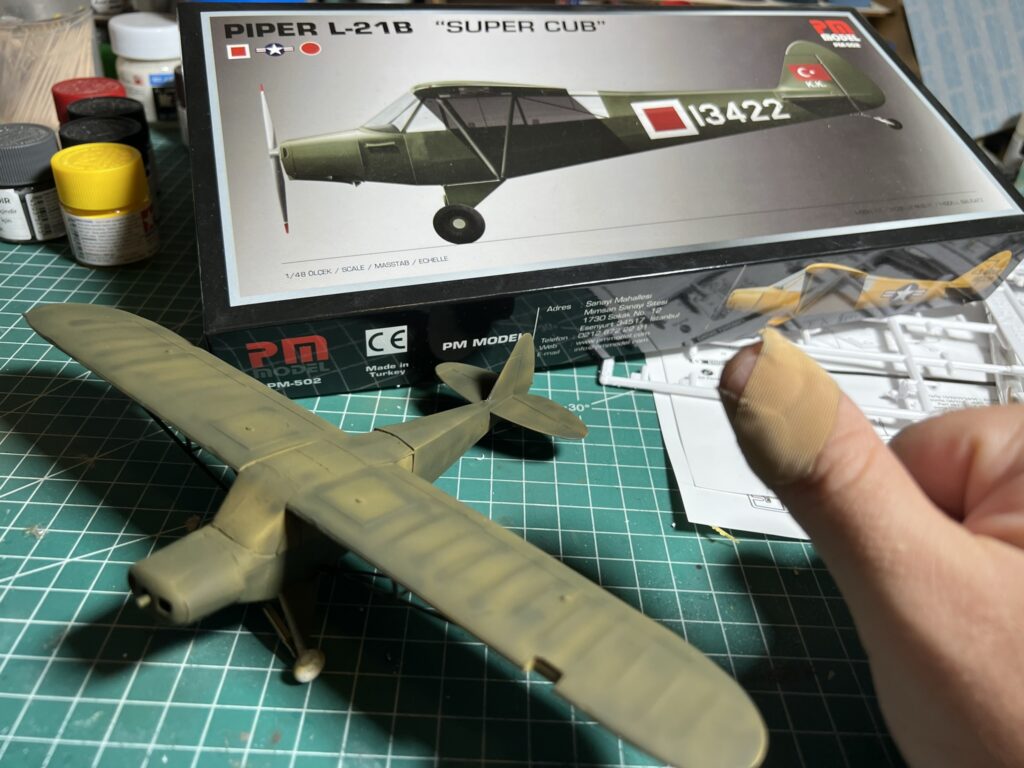
The engine compartment was easily the most frustrating part. The manufacturer included an engine, which sounds promising on paper. Once the cowling is fitted, though, almost none of that detail remains visible. Worse still, getting the cowling to close properly proved unexpectedly difficult. I had to use fine sandpaper and modelling putty repeatedly to address the poor fit around the cover.
In other words, the kit includes engine detail that can barely be seen in the finished model, yet the surrounding parts do not come together as neatly as they should. That is a disappointing compromise.
Apart from the cowling, assembly was generally straightforward. The wing struts, traditional landing gear and generous glazed cockpit area create the Super Cub’s distinctive appearance. I was able to complete most of the build fairly quickly; the engine cowling accounted for the extra work.
Painting and Markings
I kept the paint scheme simple. The kit’s Turkish marking guide calls for Khaki — FS 34087; I interpreted that appearance using Tamiya XF-62 Olive Drab on the fuselage and wings. These are different colour-reference systems, and I do not claim a measured one-to-one match. I used XF-85 Rubber Black for the tyres and XF-1 Flat Black on the engine and a few other components.
For metallic details, including parts of the engine, I used X-11 Chrome Silver. The engine also received X-18 Semi-Gloss Black. Altogether, the recorded paint list consists of five Tamiya acrylic colours.
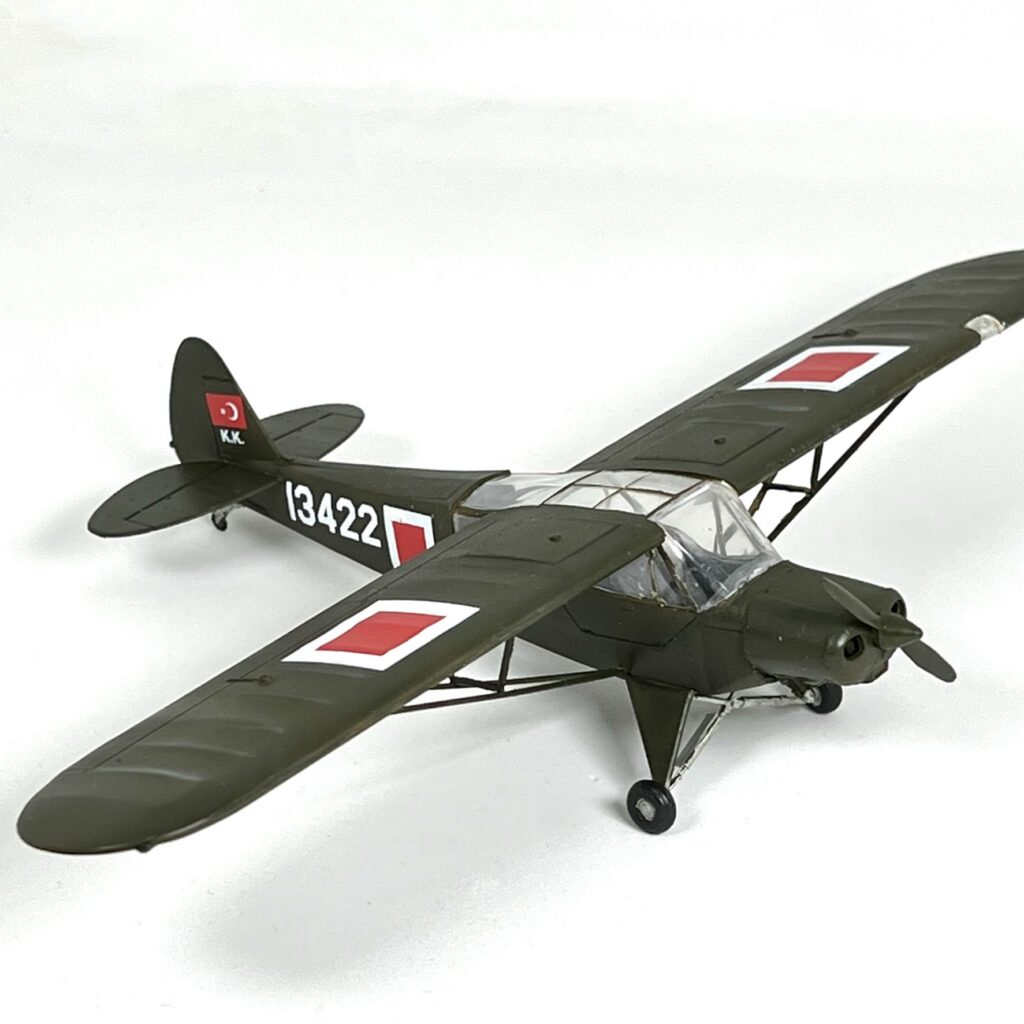
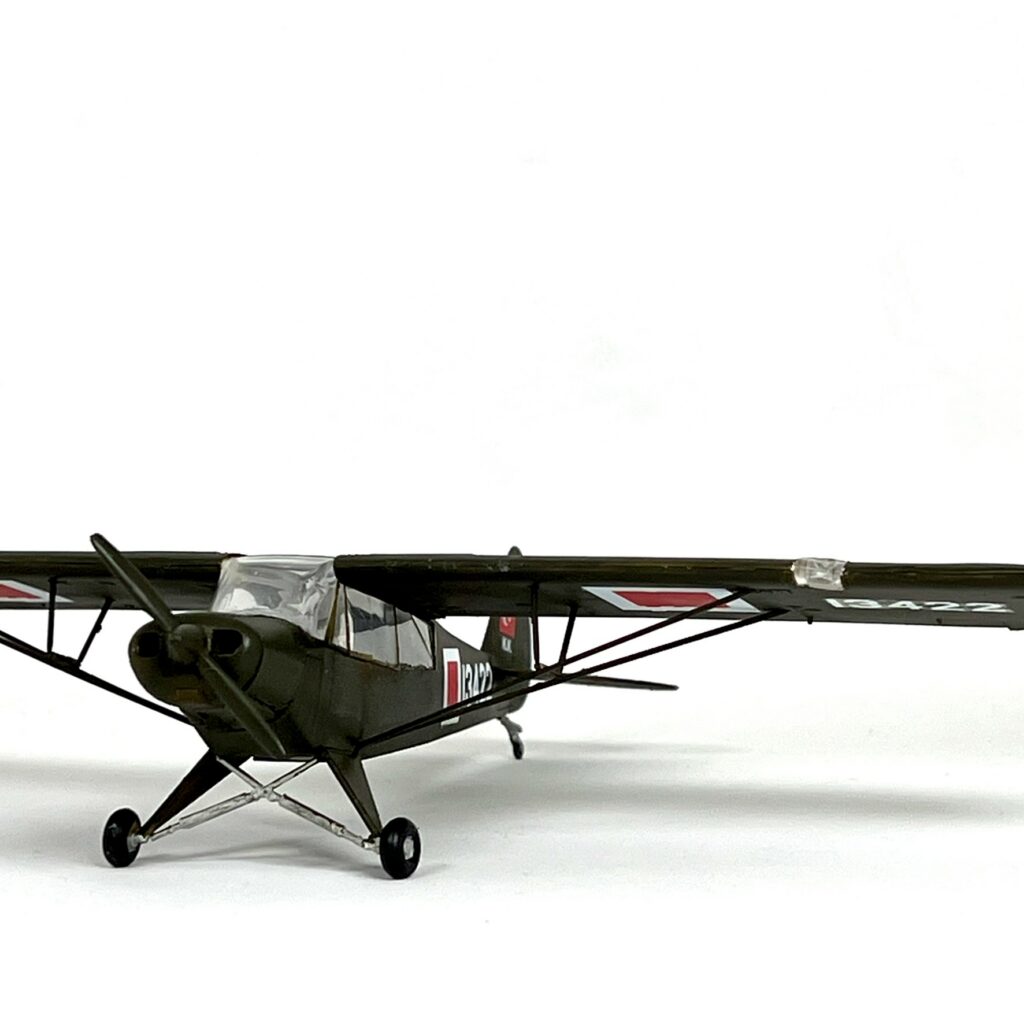
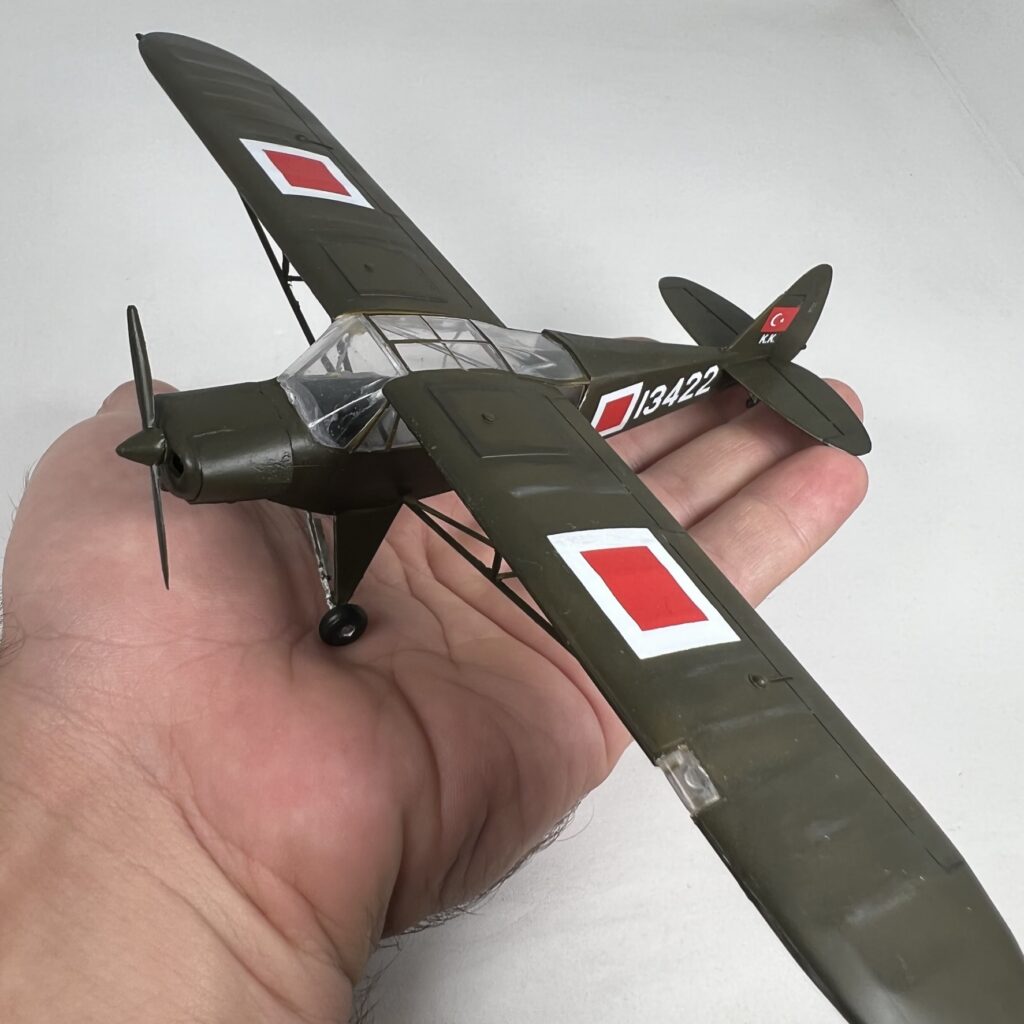
The restrained palette was enough to reproduce the model’s military appearance. On the finished aircraft, the red-and-white wing markings, fuselage number 13422, Turkish flag and K.K. lettering on the vertical tail stand out against the olive-drab finish.
The Finished Model
After completing the aircraft, I photographed it from several angles against a white background. The front and rear three-quarter views show the relationship between the high wing, cockpit and supporting struts, while the side views better reveal the long, narrow fuselage and tail arrangement.
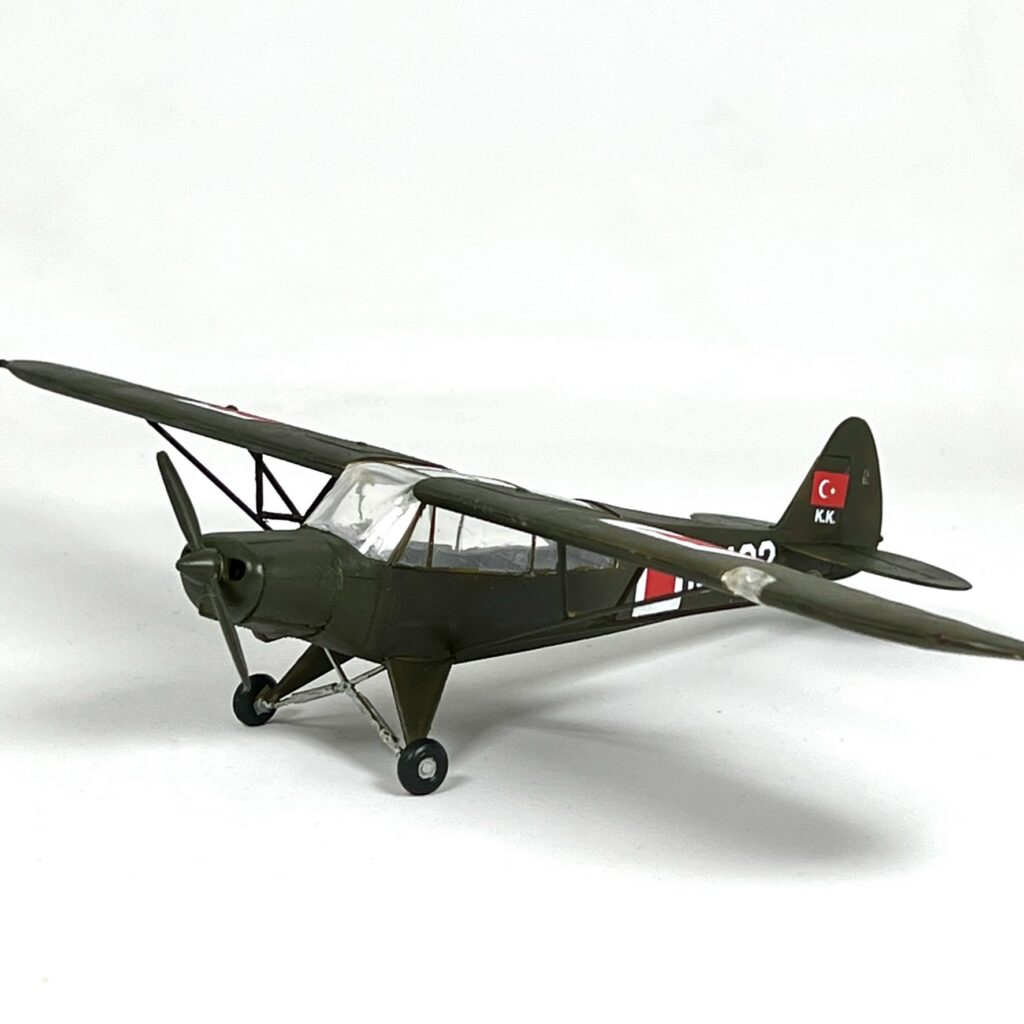
The kit’s main strength is not its wealth of detail. Rather, it offers a fairly quick way to add a distinctive aircraft associated with Turkish Army Aviation to a collection. Despite the trouble I had with the engine cowling, the finished model captures the Super Cub’s straightforward and recognisable lines.
Conclusion
The Piper L-21B Super Cub represents a category of aircraft that rarely receives the attention given to fighters and bombers, yet played an important role in the everyday operation of military aviation. Derived from the civilian PA-18 family, it was adapted for duties such as observation and liaison and served with the Turkish Land Forces over a period of many years.
PM Model’s 1/48-scale kit provides an opportunity to recreate that history in Turkish markings. It is a simple, relatively quick build with limited detail, although the poorly fitting engine cowling required extra work with fine sandpaper and putty. In the end, it allowed me to add another modest but historically interesting aircraft to my Turkish Army Aviation collection.