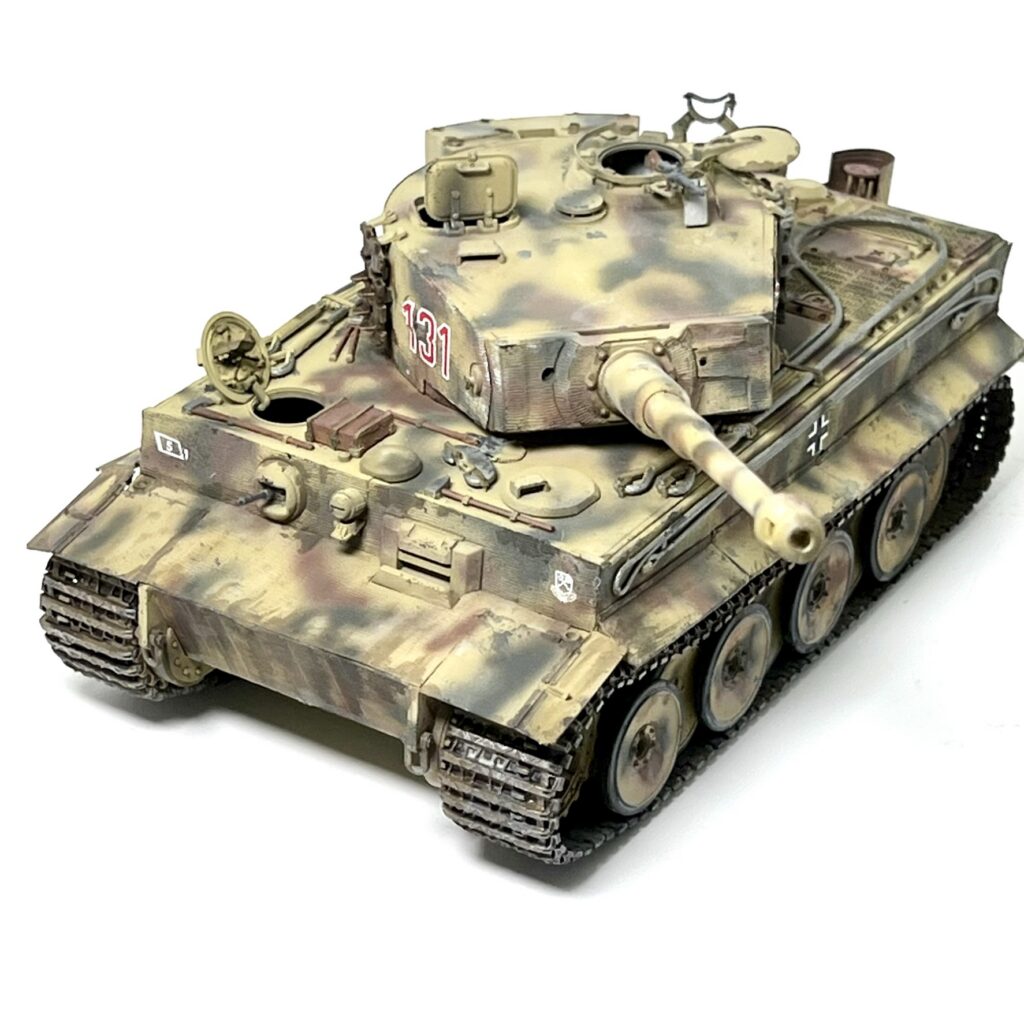
Tracing a Tiger photographed beside a village church: the journey of turret number 131 in 1944, a Tamiya 35194 build, and the intricate details of an Eduard Big Ed upgrade.
One Photograph, One Tank, One Number: 131
A small village in France. Beside the road stands a church with a distinctive roof. A heavy German tank is passing in front of it, with members of its crew riding on top. The long 88 mm gun points to the left of the photograph. Spare track links hang from the turret, while the road wheels and military markings remain visible beneath the dust and shadows.
At the centre of the photograph is a Tiger I bearing turret number 131.
Preserved by the German Federal Archives (Bundesarchiv) as Bild 101I-299-1804-04, the image captures something smaller and more personal than the great battles usually associated with the Tiger: the passage of one identifiable vehicle through a French settlement. The photographer is credited as Scheck, and the archive’s description identifies both the number 131 and the church-side setting. [1]
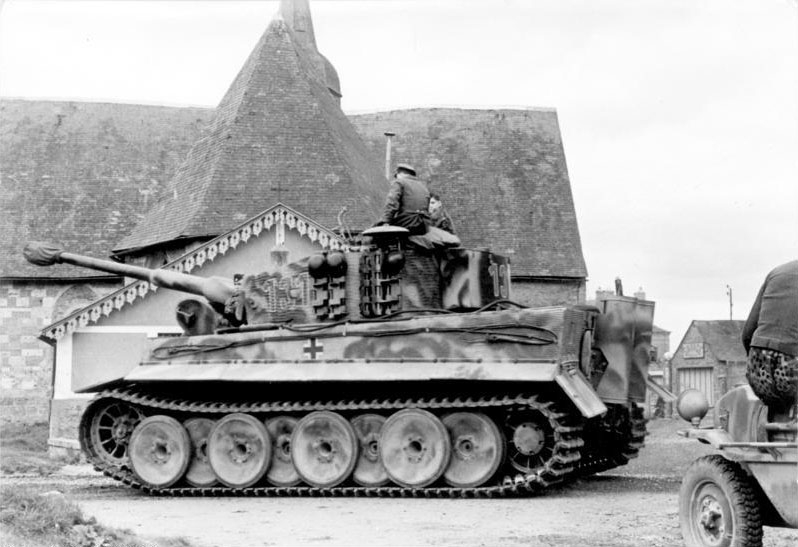
Later historical-photo research places the scene in Morgny, in the Eure department of France, and identifies the officer on the turret as Walther Hahn. These identifications should be distinguished from the original archive caption: they come in part from subsequent investigations into the location, photograph and unit. [2][3]
Even the date is not entirely settled. The Bundesarchiv catalogue gives 21 March 1944, while researchers associating the photograph with the movement through Morgny suggest 7 or 8 June 1944. Without a primary source that resolves the discrepancy, it would be misleading to present one of those days as certain. What we do have is a documented photograph of a Tiger numbered 131; its precise dating remains an open question.
My model follows the 101st SS Heavy Panzer Battalion, Normandy, July 1944 marking option in Tamiya’s German Tiger I Mid Production kit. This is therefore not simply a generic Tiger I build: it is a model linked to an identifiable vehicle from the Normandy campaign.
There is also an important distinction to make. This is not the famous Tiger 131 at The Tank Museum in Bovington, England, which was captured in Tunisia in April 1943. Different units could use the same tactical turret number at different times. [4]
What Made the Tiger I Different?
Entering service in 1942, the Panzerkampfwagen VI Tiger Ausf. E (Sd.Kfz. 181) became one of the best-known heavy tanks of the Second World War. Its 8.8 cm KwK 36 L/56 gun and substantial frontal armour made it a formidable opponent for many Allied armoured vehicles.
The Tiger weighed approximately 57 tonnes. Mid-production and later vehicles were powered by the Maybach HL230 P45, a V12 petrol engine. Its crew of five comprised a commander, gunner, loader, driver, and radio operator/bow machine-gunner. [5][6]
Firepower and protection, however, came at a price. The tank’s weight, maintenance demands, fuel consumption and complicated running gear could make long road movements particularly difficult. Getting a Tiger to the battlefield was sometimes an operation in itself.
As production evolved through 1943, the design received numerous changes. A revised commander’s cupola, alterations to external fittings and the application of Zimmerit became characteristic features of mid-production Tigers.
Zimmerit was a textured coating intended to make it harder for magnetic anti-tank mines to attach directly to the steel armour. It was not an additional armour plate and did not increase armour thickness.
Tiger 131 and the 101st SS Heavy Panzer Battalion
The Normandy Tiger numbered 131 is identified with schwere SS-Panzer-Abteilung 101 (101st SS Heavy Panzer Battalion), specifically the first vehicle of the third platoon of the first company. In that numbering convention, the first 1 indicated the company, the 3 the platoon, and the final 1 the vehicle within it. [3][4]
Following the Allied landings on 6 June 1944, the battalion was ordered towards the Normandy front. Moving west from the Beauvais area, its heavy tanks faced the mechanical and logistical difficulties of a long journey, while Allied air activity added another threat.
Accounts reconstructing the unit’s movements describe its departure on 7 June and its arrival in the Caen area around 12 June. The photograph of 131 at Morgny is commonly interpreted within the context of that journey. [2][3]
This is what gives the image much of its significance. It does not portray a dramatic exchange of fire; instead, it captures the effort of getting a heavy tank to the fighting. The church, village street and another military vehicle at the edge of the frame place the armoured unit in an ordinary, recognisable setting.
The battalion is strongly associated with the Battle of Villers-Bocage on 13 June 1944. Yet the best-documented Tigers involved in that action belonged to its second company. The sources used here do not establish that turret number 131 destroyed a particular target or took part in a specific engagement that day. The battalion’s wider combat history should not be presented as the proven service record of this individual tank.
By early July, the battalion’s first company had suffered serious losses. Even so, I have not been able to verify where, when or how Tiger 131 was ultimately lost or withdrawn from service. Leaving that part of the story unresolved is more accurate than inventing a dramatic ending.
From an Archival Photograph to the Workbench
Tamiya’s 1/35 German Tiger I Mid Production, kit 35194, captures the distinctive appearance of the mid-production Tiger. One of the instruction-sheet options is explicitly identified as “Tank No. 131, sPzAbt 101, Normandy, July 1944.” [7]
I chose that option specifically because I wanted to represent a Tiger from the Normandy campaign.
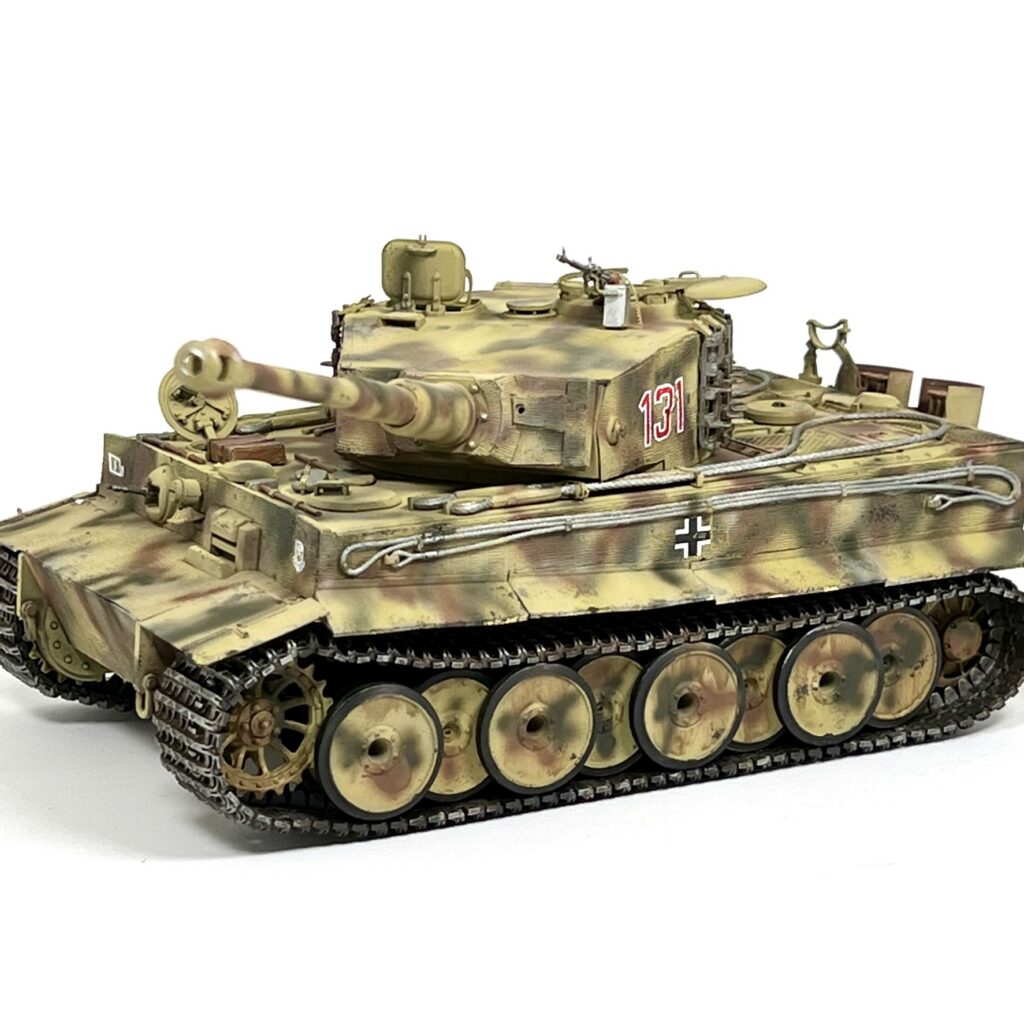
The red turret numerals with white outlines, the three-colour camouflage and the external equipment give the model its identity. The instruction sheet’s reference to July 1944 describes the proposed marking scheme; it does not establish the date of the Bundesarchiv photograph or independently prove every colour and detail in the wartime image.
I regard this build as a scale-modelling interpretation based on the real Tiger 131 and Tamiya’s Normandy marking option.
The rubber-rimmed road wheels, spare track links on the turret and Zimmerit-covered surfaces are among the details that make a visual comparison between the historical photograph and my model particularly interesting.
Tamiya 35194: A Pleasure to Build
I completed the Tiger in June 2022.
The first thing I would say about Tamiya’s kit is that the fit was excellent. I encountered no significant problems during basic assembly, which gave me more time to concentrate on the details.
For me, working with photo-etched metal parts has always been one of the most enjoyable sides of scale modelling. The more small details I can add to a model, the richer the finished result feels. A component that seems almost insignificant on its own can make a striking difference when combined with dozens of others.
That is why I enhanced this kit with an Eduard Big Ed detail set.
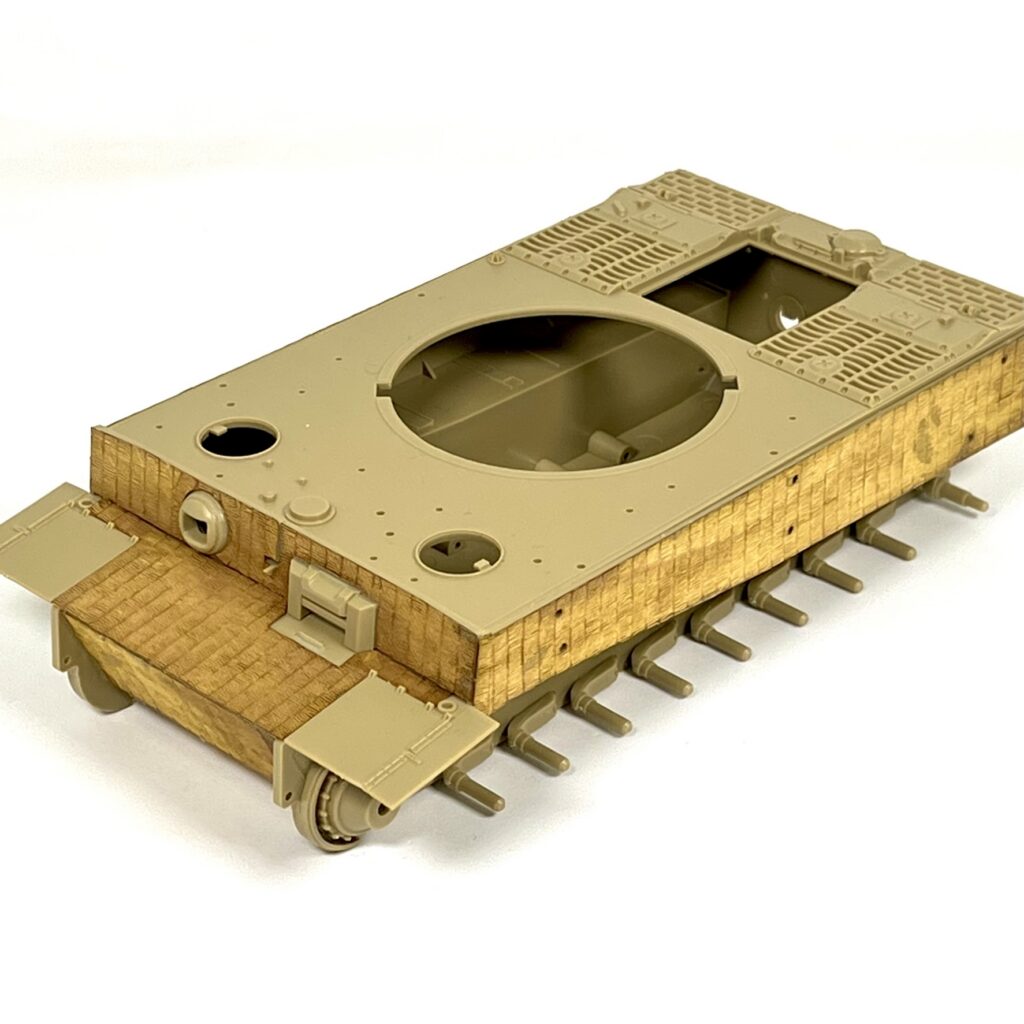
The set I used was not limited to small metal fittings. The Zimmerit pieces were also included in the Big Ed set. I did not sculpt the Zimmerit with putty; I applied Eduard’s pre-textured parts to the appropriate surfaces of the tank. Eduard’s Big Ed range for Tamiya’s mid-production Tiger includes a separate Zimmerit component. [8]
The Hardest Part: Zimmerit on the Turret
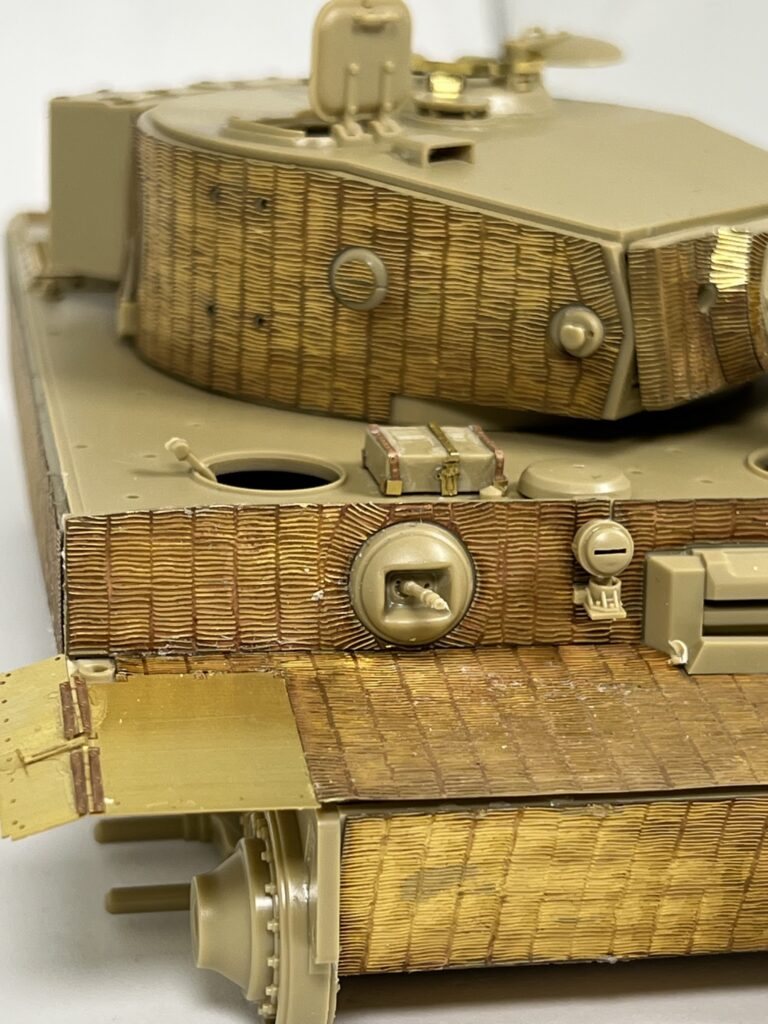
Applying the Zimmerit was most demanding on the turret.
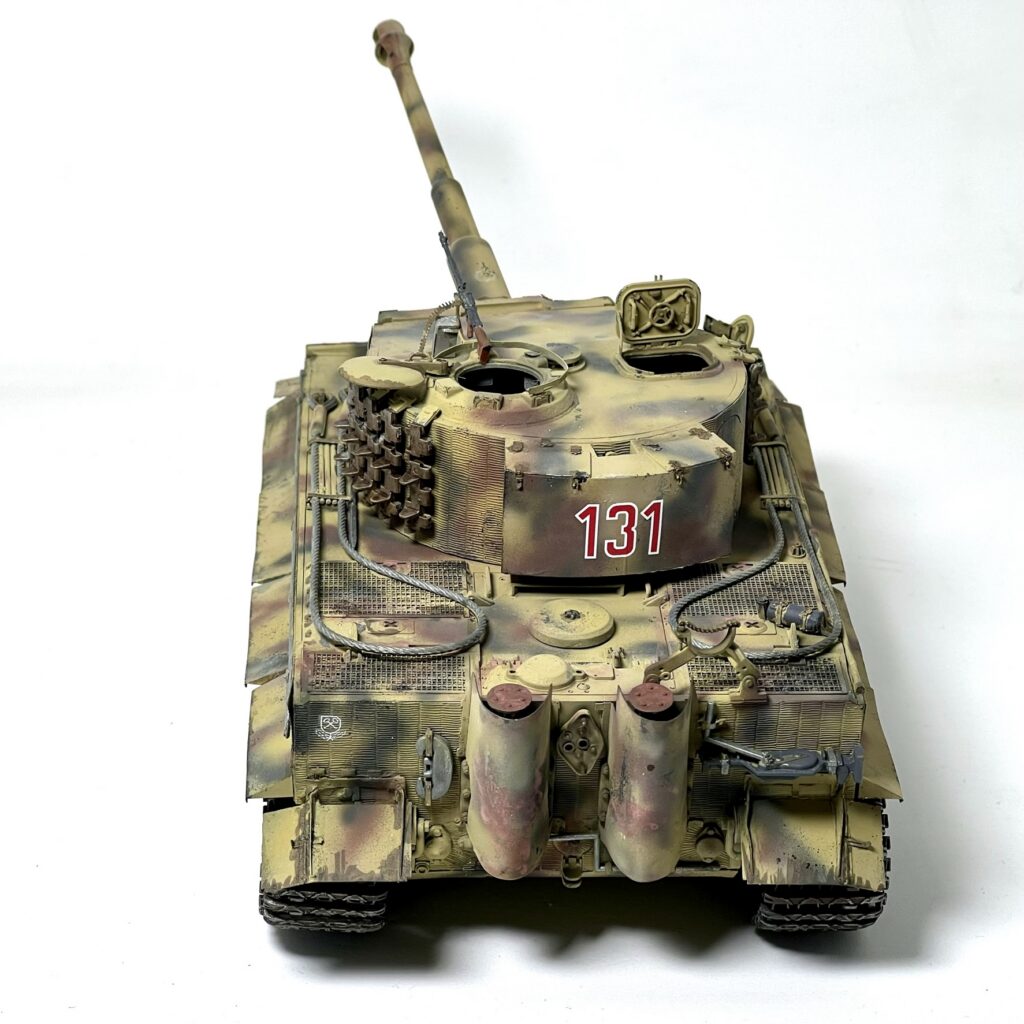
Fitting the textured pieces around angled surfaces, corners and raised details required much more care than working on the flatter sections of the hull. The aim was to keep the surface pattern convincing without losing the fit around the turret’s features.
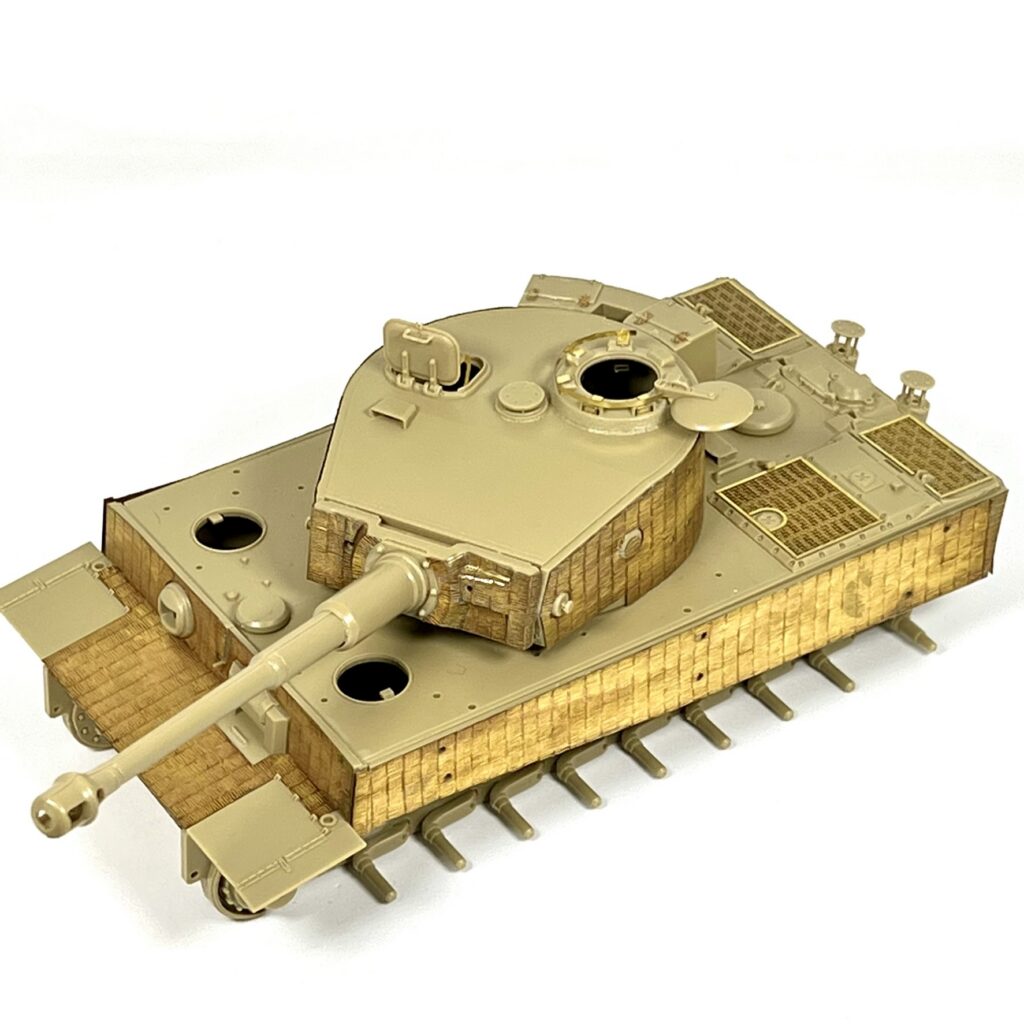
The photographs taken before painting show this stage particularly well. Without camouflage obscuring the surfaces, the Zimmerit pattern and additional metal details stand out, revealing just how much work went into the exterior.
The Rear Hull and Cylindrical Exhaust Components
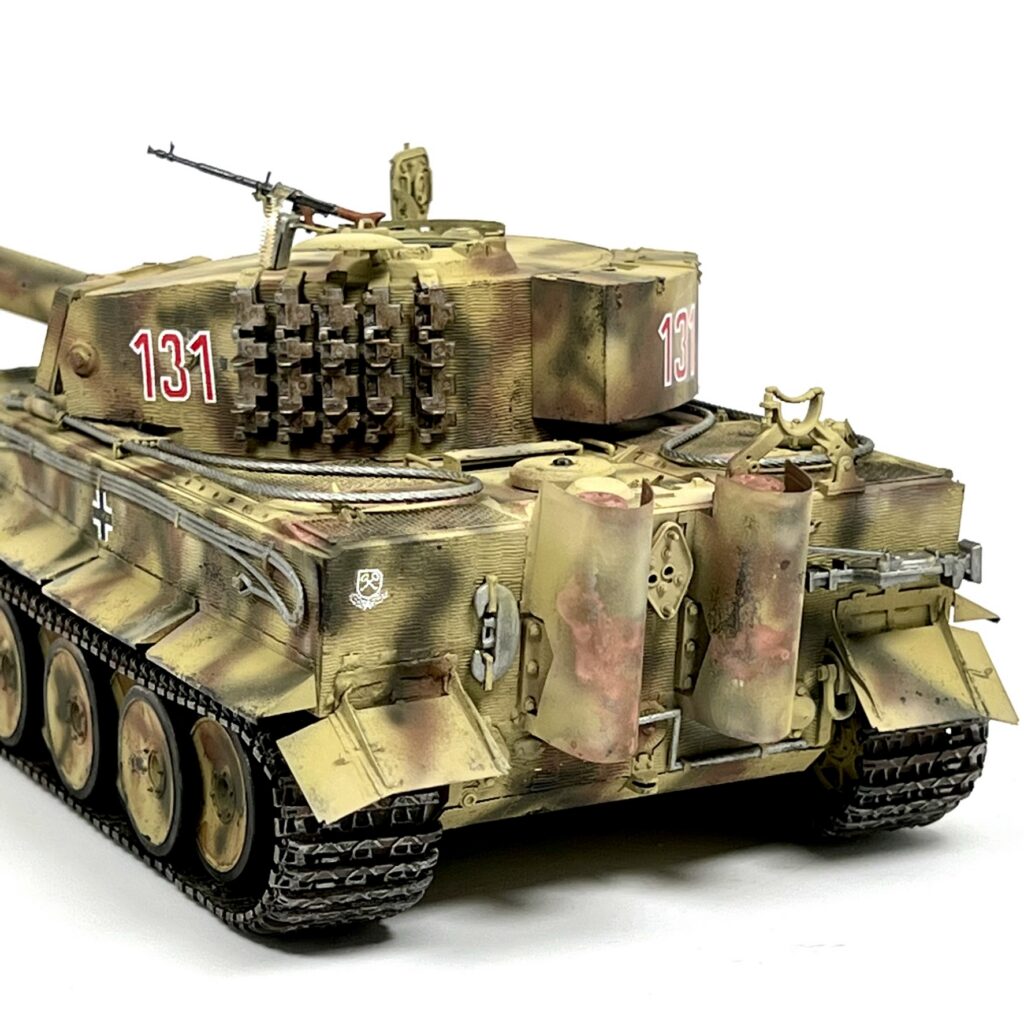
Another demanding part of the project was building and detailing the cylindrical exhaust assemblies at the rear of the tank. That section almost felt like a small project in its own right.
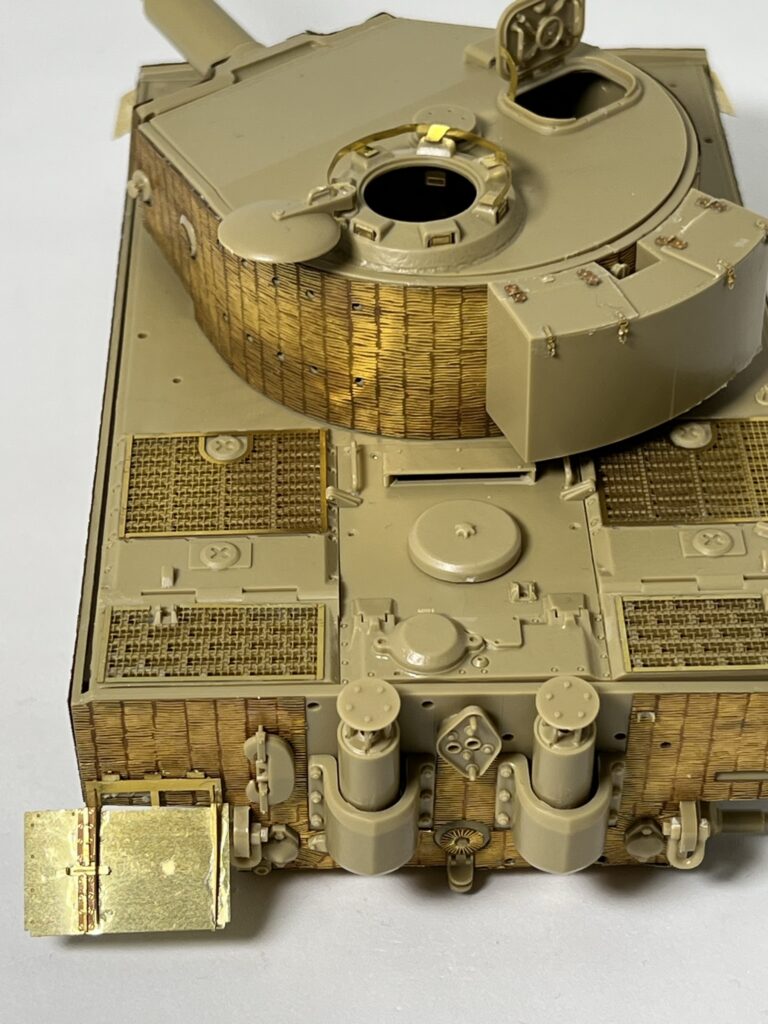
The finished photographs show the exhausts, engine-deck grilles and surrounding fittings more clearly. The rear of the Tiger became one of the best examples of how much character a collection of small details can add to a model.
Despite the more difficult stages, I thoroughly enjoyed the build. Tamiya’s excellent engineering kept the underlying assembly straightforward, while Eduard’s details transformed the overall impression.
I genuinely believe the finished Tiger would not have looked nearly as impressive without the Big Ed set.
Camouflage and Colours: Following Tamiya’s Instructions
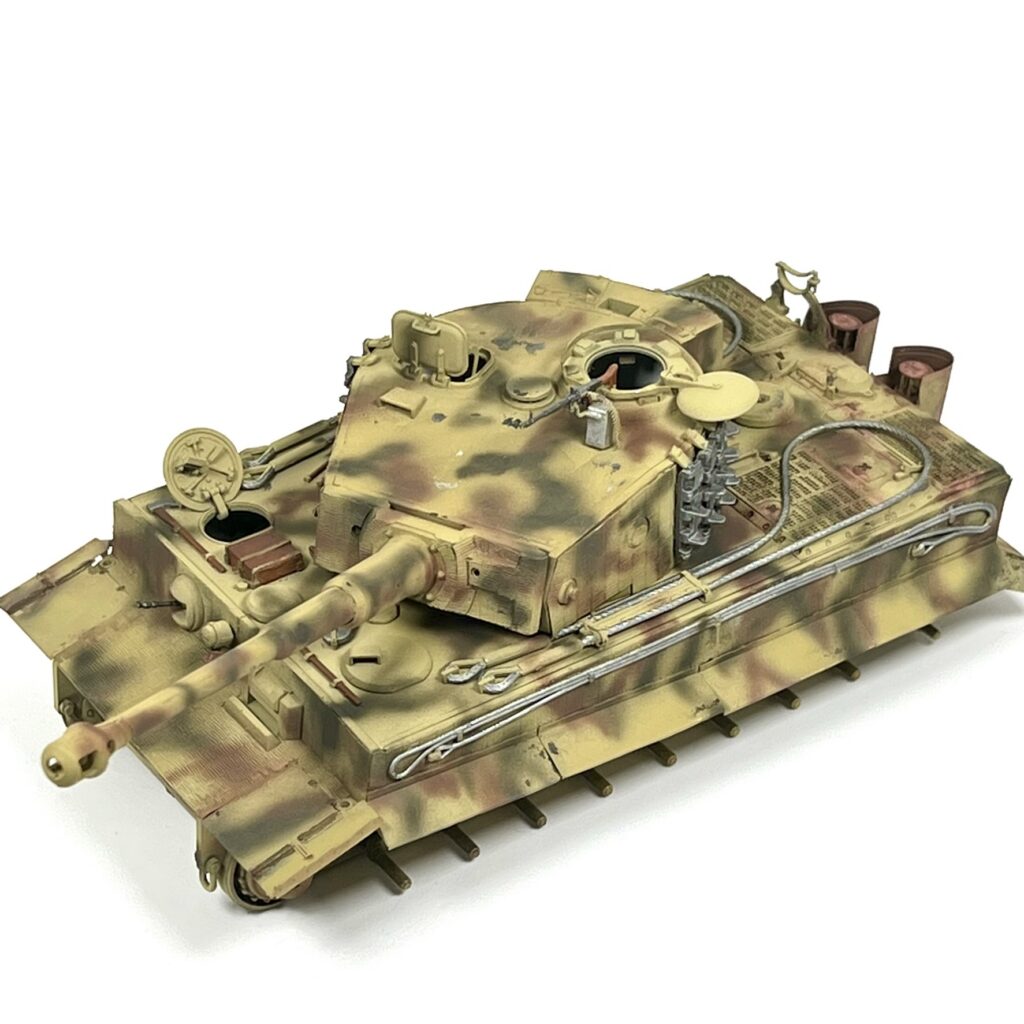
For this build, I used the Tamiya XF/X paint references printed in the kit instructions for the Normandy 131 scheme.
The main three-colour camouflage used:
- XF-60 Dark Yellow — the base colour of the hull and turret.
- XF-61 Dark Green — the green camouflage areas.
- XF-64 Red Brown — the brown camouflage areas.
Together, these colours produced the green and reddish-brown pattern over a dark-yellow base that gives the model its Normandy appearance.
I also used the other paints listed in the instructions: X-10 Gun Metal, X-11 Chrome Silver, X-18 Semi-Gloss Black, XF-1 Flat Black, XF-2 Flat White, XF-15 Flat Flesh, XF-56 Metallic Grey and XF-65 Field Grey.
I can confirm that I used all these colours, but I no longer have a precise record of which tiny component received every secondary shade. For that reason, the structured paint records distinguish confirmed paints from confirmed application areas; I will not turn a plausible guess into a documented fact.
The finished-model photographs show wear on the tracks, dirt on the road wheels, rust tones around the exhausts and scuffing along the armour edges. However, I do not have a verified list of the washes, pigments or other weathering products used to achieve those effects.
One of the results I particularly liked was the way the Zimmerit texture remained visible beneath the camouflage. The work put into the metal detailing can still be seen clearly in the final photographs.
From Tank to Diorama: The Next Chapter
After finishing the Tiger in June 2022, I decided not to leave it as a standalone model. The following month, July 2022, I completed a separate diorama depicting the tank in a Normandy countryside setting, with trees, a grassy track and infantry moving alongside it.
The scene is not a literal recreation of the historical photograph outside the church at Morgny. It is my own composition, inspired by the military movements of the period.
The terrain, figures, composition and historical interpretation will be covered in a separate Diorama Dossier. Here, the diorama marks the next stage in the life of this particular model.
Related dossier: On the Road to Normandy: The Tiger 131 Diorama
Final Thoughts
When people think of the Tiger I, its gun, armour and weight tend to come first. What interested me most about this particular build, however, was the chance to start from a photograph of an actual tank numbered 131.
There is a tangible visual link between the Tiger photographed beside the church at Morgny and the 1/35-scale vehicle I gradually assembled at my workbench. Tamiya’s excellent fit, Eduard Big Ed’s intricate details—including the Zimmerit—and the Normandy camouflage based on the kit instructions made it an especially satisfying project.
One photograph can never tell the whole story of a tank. But it can lead us to better questions, closer research and a greater appreciation of the smallest details.
At ModofWar, that is where real machines meet scale stories.
_in_Ortschaft.jpg)