Introduced in 1935, the BMW R12 left its mark on motorcycle engineering with a hydraulically damped telescopic front fork. Later employed by the German armed forces for dispatch, reconnaissance and transport duties, the R12 is explored here through its history, Zvezda’s 1/35 scale kit and my own modelling experience.
The small vehicles behind a vast war
When we think of Second World War vehicles, tanks, armoured carriers and heavy trucks tend to come first. Yet a large formation could not function on those machines alone. Orders had to reach forward units, information had to travel between distant positions, reconnaissance had to be carried out, and people and equipment had to move during the course of an ordinary day.
Motorcycles helped with some of those tasks. They took up less space than trucks and could travel quickly on suitable roads while carrying relatively light loads. Fitting a sidecar made it possible to take an additional passenger or extra equipment, though the added weight also changed how the machine handled.
The BMW R12 became one of the best-known German motorcycles of the period. Its story, however, began well before the war. Its origins lay in the road motorcycles BMW was developing during the 1930s.
1935: From the R11 to the R12
BMW introduced the R12 in 1935, alongside the R17. The R12 succeeded the earlier R11 and retained several features associated with BMW motorcycles of the time: a horizontally opposed boxer engine, shaft drive to the rear wheel and a pressed-steel frame.
But it was more than a modest revision. The principal innovation was at the front. BMW brought a hydraulically damped telescopic fork into series production. The R12 and the more sporting R17 are recognised among the earliest production motorcycles to use this arrangement.
According to BMW’s historical model record, R12 production continued from 1935 until 1942, with approximately 36,000 machines built. A substantial proportion went to military authorities and other public institutions. That figure is a total production estimate, not a count of motorcycles delivered exclusively to the German army. [1]
The R12 illustrates how a motorcycle designed for the road could also find a substantial place in official and military service.
The telescopic fork: What made the R12 special
When a motorcycle’s front wheel meets a hole or a bump, the suspension compresses and then rebounds. Springs alone do not always control that movement adequately; the front end can continue to oscillate after the initial impact. Hydraulic damping uses the controlled movement of oil to reduce those oscillations.
Today, such a system is familiar. In 1935, its application to a production motorcycle was a significant engineering step. The R12’s telescopic fork helped BMW improve the control of front-wheel movement and the comfort of the ride. [1, 2]
That does not mean the R12 had fully modern suspension. The front fork was relatively advanced, but the rear wheel remained mounted in a rigid frame. Springs beneath the rider’s saddle provided a measure of comfort. A sidecar could also have its own leaf-spring suspension. These details are documented on the military R12 preserved by the Australian War Memorial. [2]
The presence of newer and more traditional solutions on the same motorcycle is one of the things I find interesting when studying it as a scale model.
Boxer engine, four-speed gearbox and shaft drive
The R12 used a 745 cc, air-cooled, four-stroke, side-valve flat-twin boxer engine. Its cylinders projected horizontally from either side of the motorcycle, creating one of the most recognisable features of the BMW silhouette.
There were single- and twin-carburettor versions. BMW’s model record quotes 18 hp at 3,400 rpm for the single-carburettor machine and 20 hp at 4,000 rpm for the twin-carburettor version. It also gives respective maximum speeds of 110 and 120 km/h. These are model-specific catalogue figures. They should not be taken as the performance of a fully loaded military motorcycle fitted with a sidecar. [1]
The four-speed gearbox was hand-shifted, and power reached the rear wheel through a driveshaft rather than a chain. The pressed-steel frame, substantial mudguards, large round headlamp and sprung saddle gave the machine much of its distinctive appearance. Vintage BMW’s technical records also document the 78 × 78 mm bore and stroke, 14-litre fuel tank and drum brakes at the front and rear. [3]
On a model this small, details such as the projecting engine cylinders, frame connections and final-drive arrangement provide an unexpectedly good way to appreciate the engineering of the real motorcycle.
What the sidecar added — and what it took away
The R12 could be ridden on its own, but the sidecar outfit became especially recognisable in wartime photographs and in scale modelling. In this article, “sidecar outfit” simply refers to a motorcycle with a sidecar attached.
Its main advantage was extra carrying space. A passenger or light supplies could travel in the sidecar; with a rear pillion seat, certain configurations could accommodate additional personnel. Bags, a spare wheel and other equipment might also be carried. The Australian War Memorial’s collection record describes the luggage compartment at the rear of the sidecar and its leaf-spring arrangement in useful detail. [2]
There were trade-offs. A three-wheeled outfit is asymmetrical, and the distribution of its weight affects left- and right-hand turns differently. More importantly, the sidecar wheel of a standard R12 outfit was not driven by the engine. Power went to the motorcycle’s rear wheel. Adding a third wheel did not turn the machine into a high-traction, purpose-built off-road vehicle. [3]
The R12’s strengths and limitations belong in the same story. It could be an effective communications and transport machine on suitable roads, but deep mud, loose sand and heavy loads were quite another matter.
In Wehrmacht service: Useful rather than glamorous
The German armed forces employed motorcycles for dispatch riding, liaison, reconnaissance and light transport, and the BMW R12 served in these roles. The German term Kradmelder refers to a motorcycle dispatch rider. When telephone lines could not be established or were out of action, written orders, reports or maps might still have to be delivered in person.
Sidecar outfits could also be adapted for patrol duties or the carriage of light weapons. Some military R12 configurations could carry an MG34 machine gun on the sidecar. That does not mean every R12 was permanently armed or operated as a fighting vehicle. Reducing its service history to a machine-gun mount would overlook much of its everyday work. [4]
Motorcycles served across different theatres of the Second World War, and their usefulness depended on roads, weather and the availability of supplies. As ground conditions worsened, narrow tyres, single-wheel drive and the additional weight of a sidecar could restrict movement. It is more accurate to understand the R12 as one of the machines that helped an army perform its routine tasks than as an unstoppable battlefield vehicle.
Why the BMW R12, BMW R75 and Zündapp KS 750 get confused
The R12, R75 and Zündapp KS 750 are often mentioned together in discussions of German military motorcycles. They were not the same model, however, and they did not share exactly the same mechanical approach.
The R12 began as a road motorcycle later employed in military service. The BMW R75 and Zündapp KS 750 were heavy sidecar outfits developed with demanding military terrain requirements in mind. One important distinction was their drive systems: on the R75 and KS 750, power could be transmitted to the sidecar wheel as well as the motorcycle’s rear wheel, improving traction under suitable conditions. [5]
The arrival of those machines was therefore more than the introduction of larger motorcycles. It reflected the need for off-road capability beyond what adapted civilian designs could reliably provide. The R12 nevertheless remained part of wartime transport and communications history, even after its production run ended.
The scale model: Zvezda 3607 in 1/35
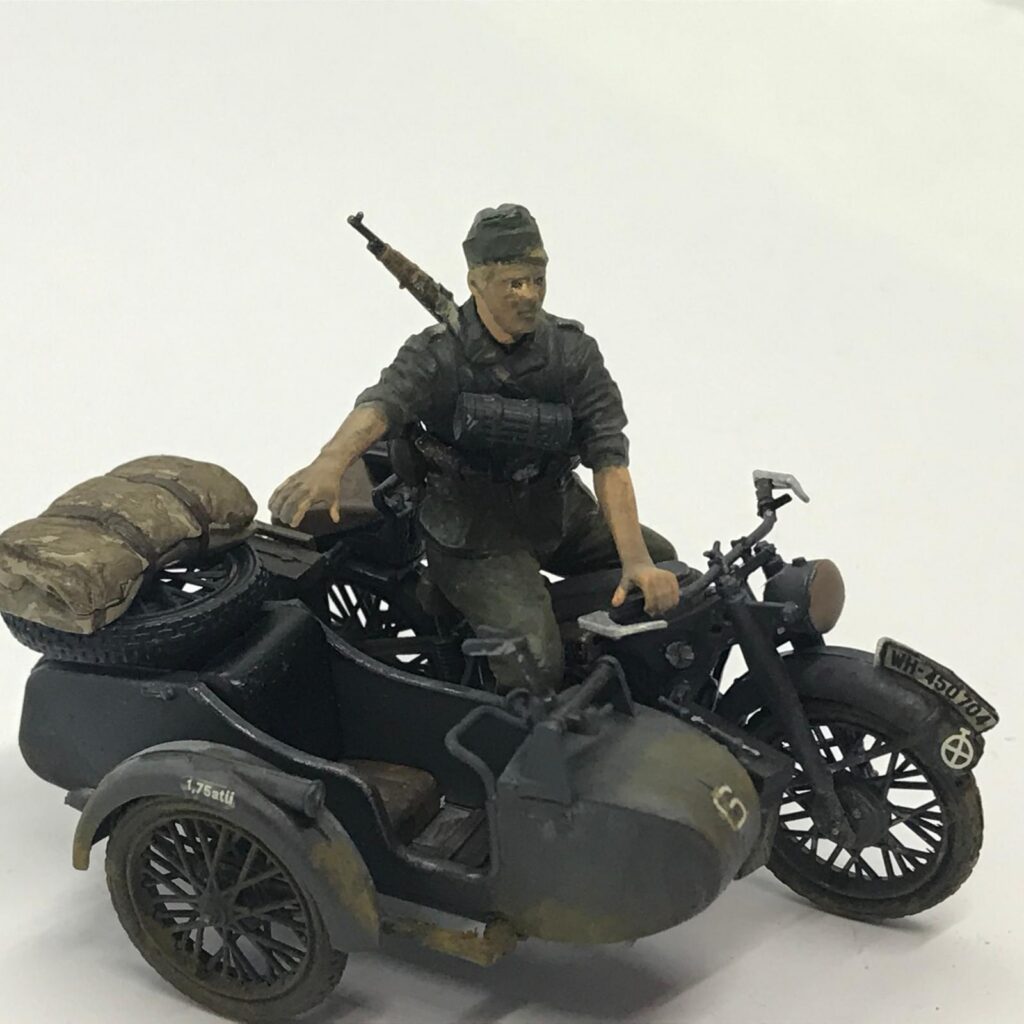
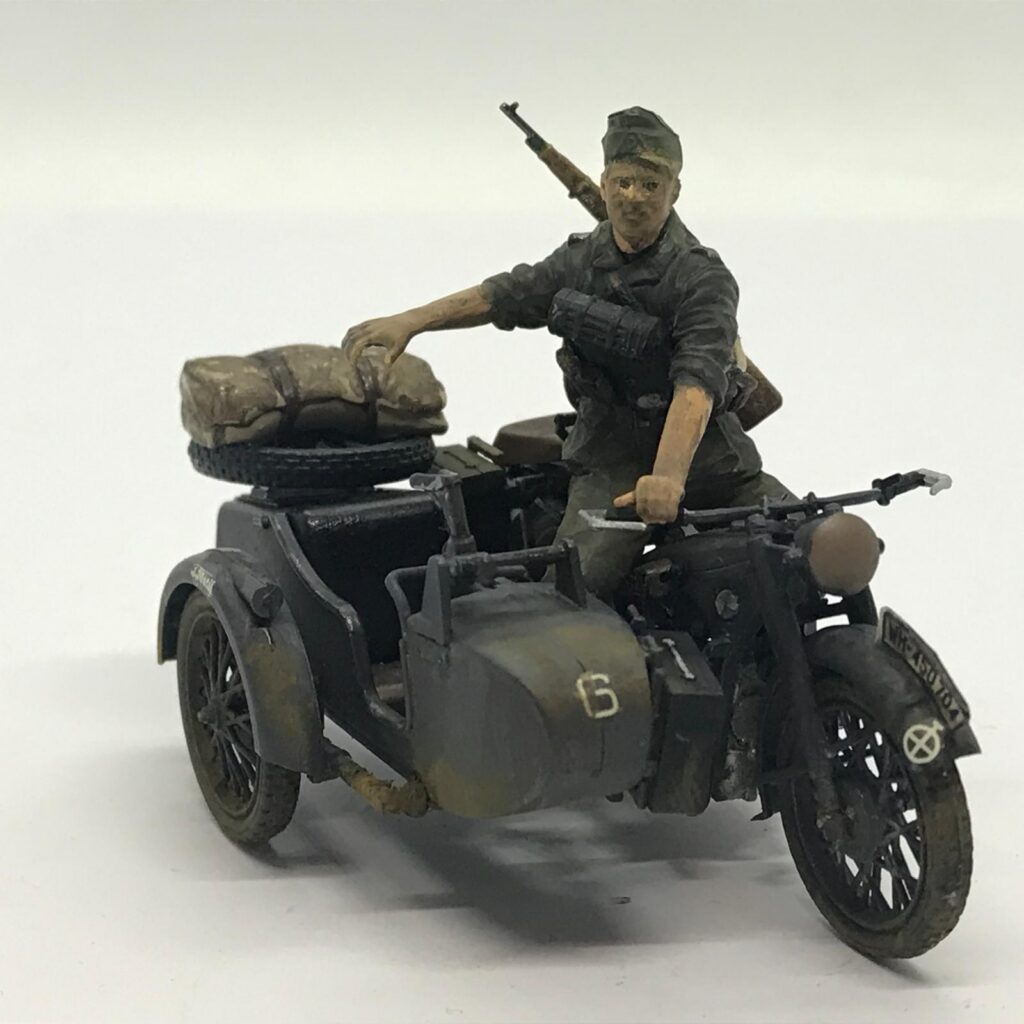
I built the BMW R12 from Zvezda kit No. 3607, German Motorcycle R-12 with Sidecar and Crew, in 1/35 scale. The motorcycle, sidecar, figures and baggage options allow for more than one way to present the finished model.
My overall impression of the kit was positive. The surfaces were clean and the mechanical detail was satisfying for such a small subject. The rider figure also fitted the motorcycle without any significant problems. I would rate the build as moderately difficult: assembly is not excessively complex, but the small components and sidecar arrangement require care.
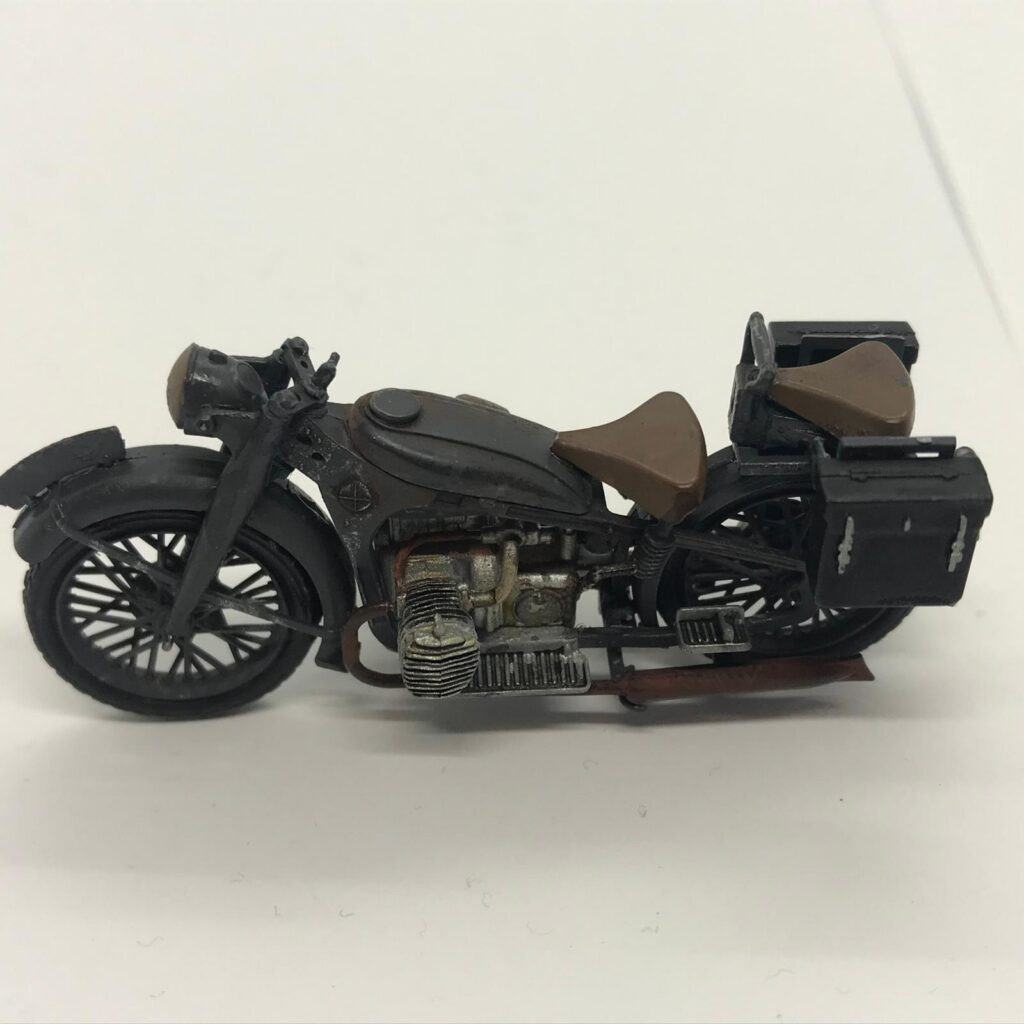
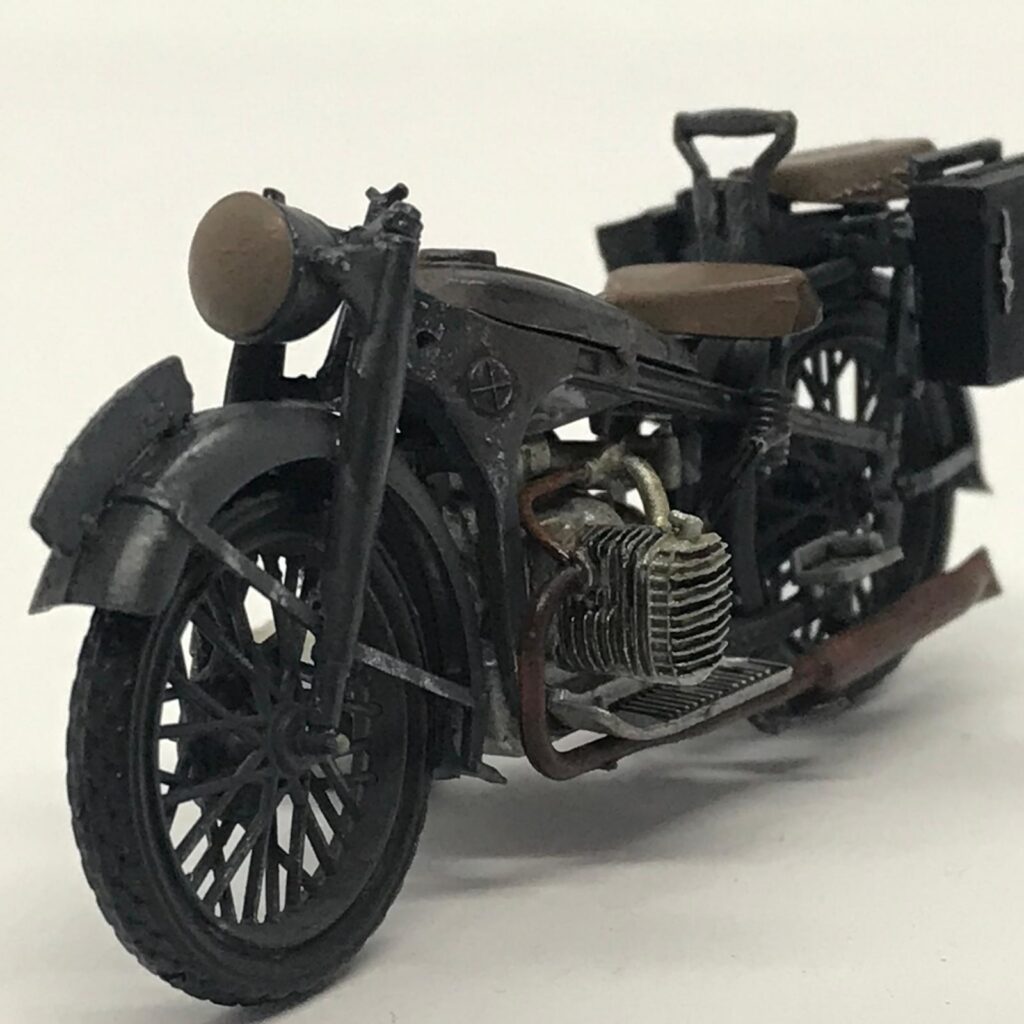
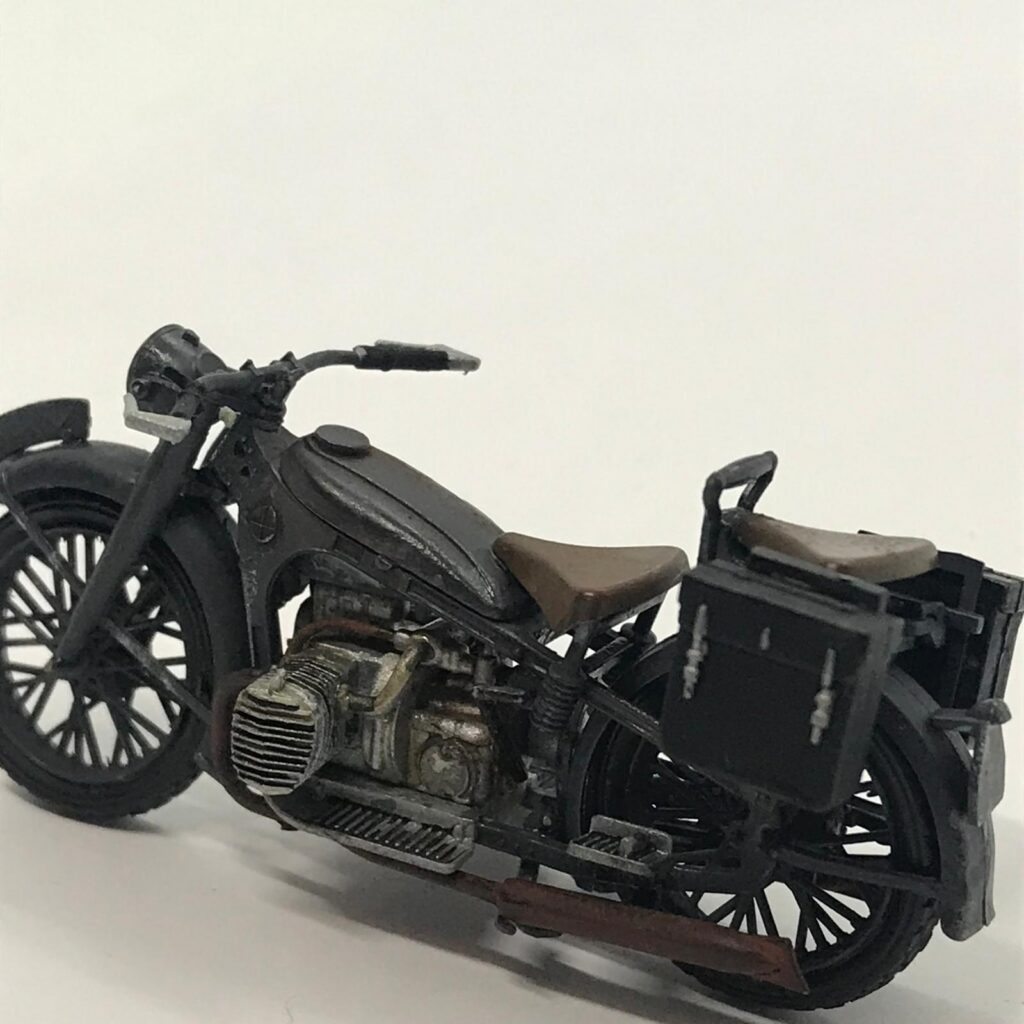
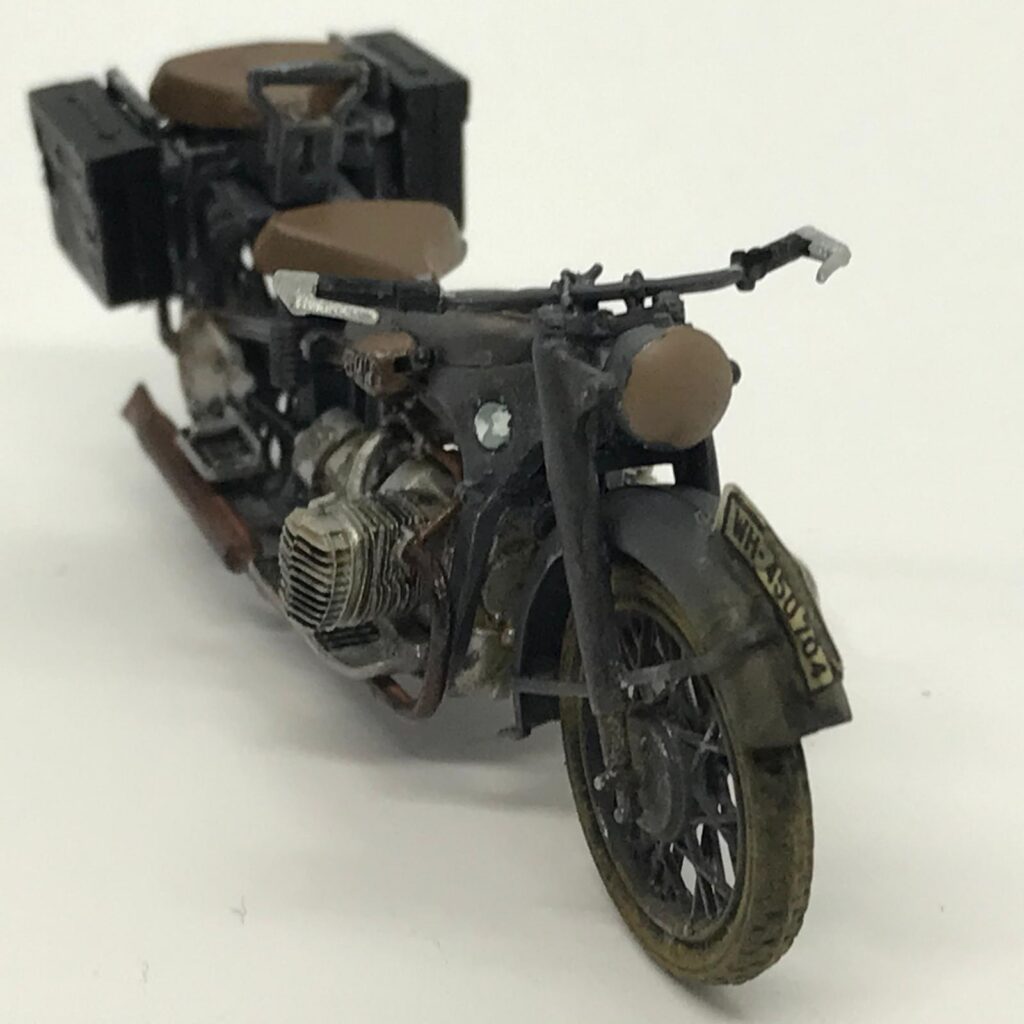
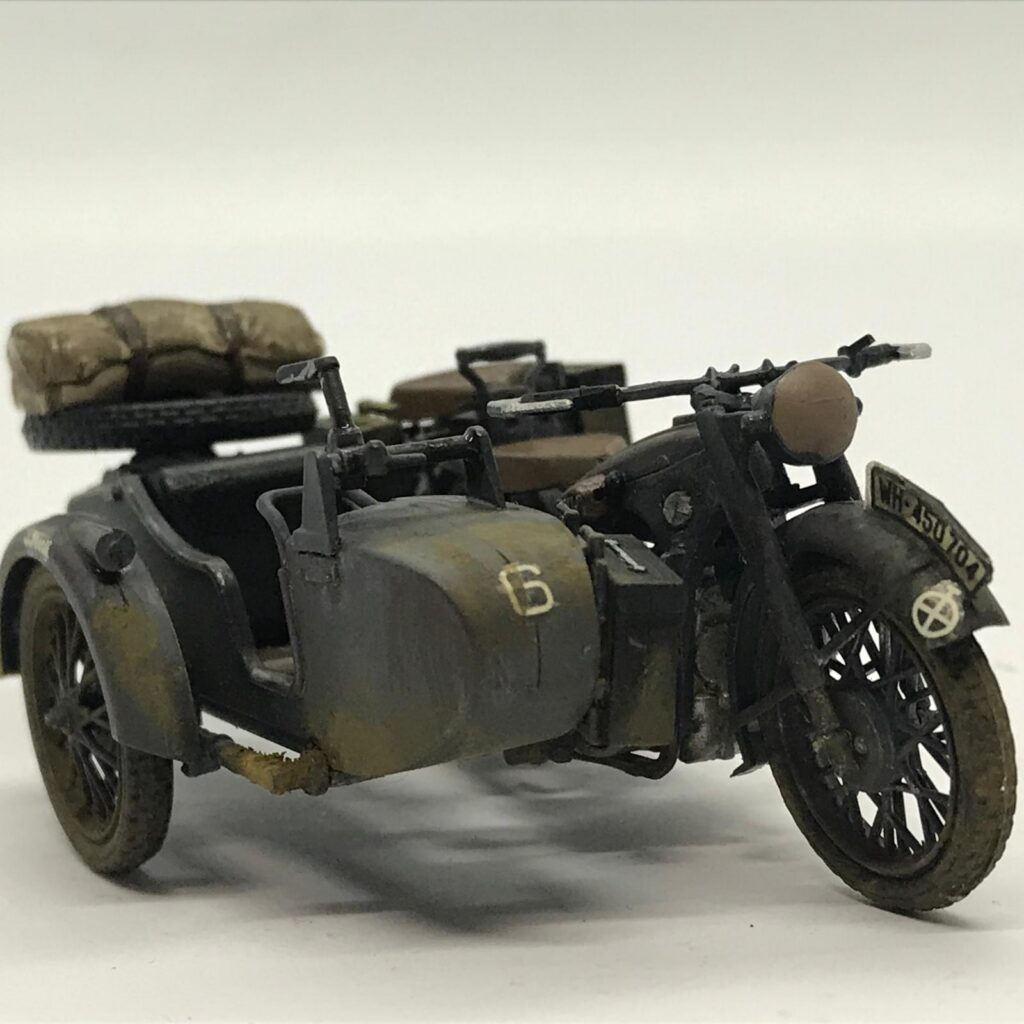
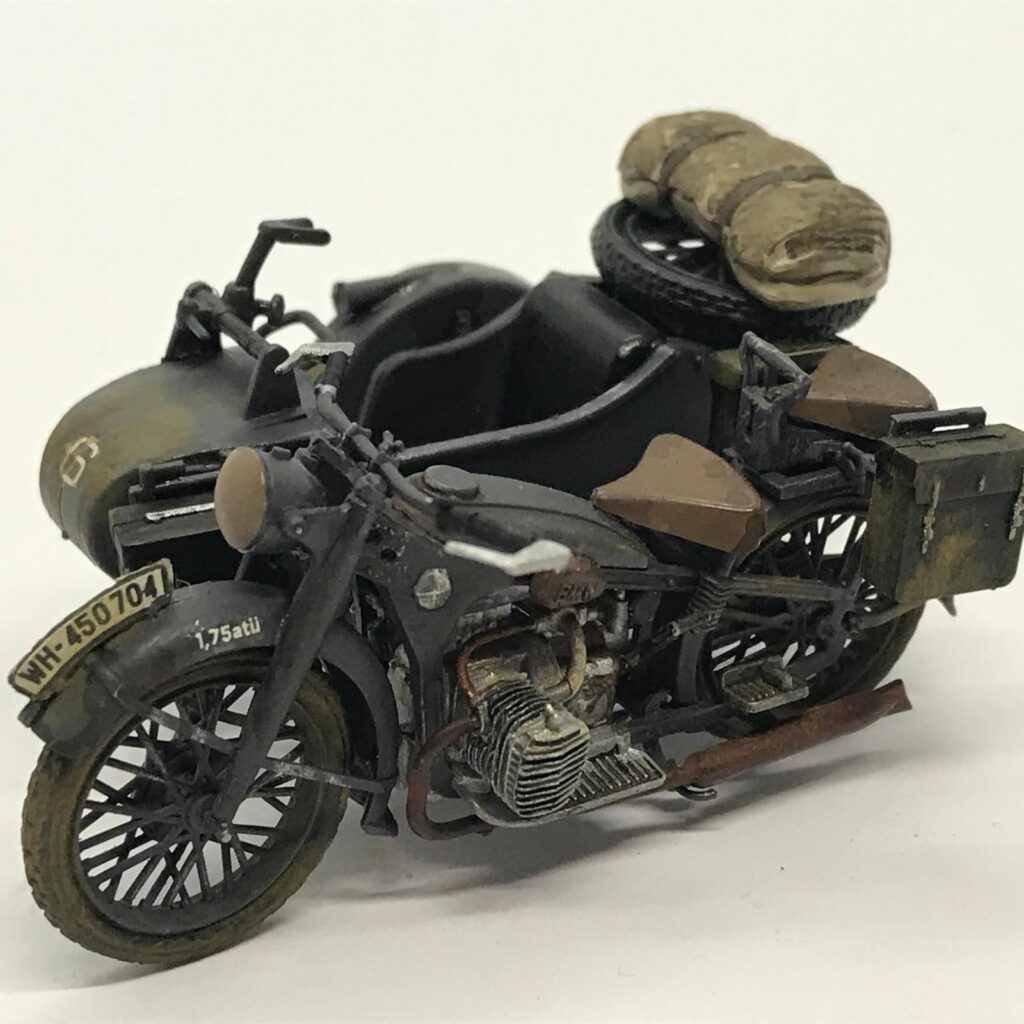
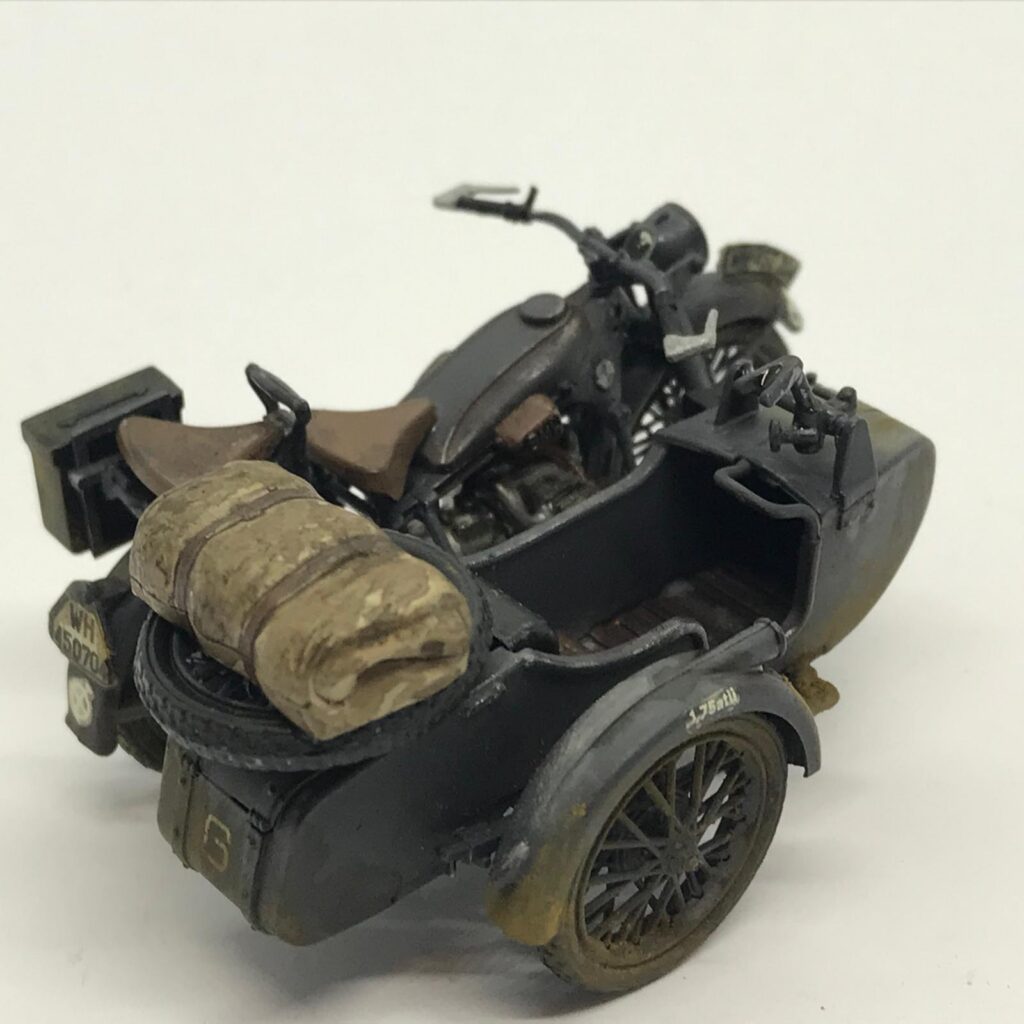
My photographs show the motorcycle without the sidecar, then with the sidecar fitted, and finally with its figures. I am using these views to compare the model’s different configurations, not as a definitive, day-by-day record of the assembly sequence.
Mechanical details and a restrained paint palette
For this model I worked mainly with Tamiya acrylic paints. The principal body colour was XF-63 German Grey. Rather than attempting a complex multicolour camouflage scheme, I focused on bringing out the mechanical parts and the contrasts between different materials.
I used X-10 Gun Metal and X-11 Chrome Silver for metallic details, along with XF-1 Flat Black and XF-85 Rubber Black for black and rubber components. XF-2 Flat White was also among the colours used. I no longer have a complete step-by-step log identifying every part and application order, so I have avoided inventing one.
Leather, rust and weathering
For the saddle, leather elements and areas of wear, I used XF-9 Hull Red and XF-10 Flat Brown. I also applied XF-57 Buff to the rear section. My aim was to give the exhaust, the engine area and the metal fittings the appearance of different materials and degrees of use, rather than leaving everything in one uniform grey.
For rusty areas I went beyond paint alone, using pigments and AK Rust Deposit. These helped create dusty, oxidised and weathered effects. I did not retain the exact pigment product numbers or the specific AK Rust Deposit variant, so I have left those details unspecified.
The sidecar changes the silhouette
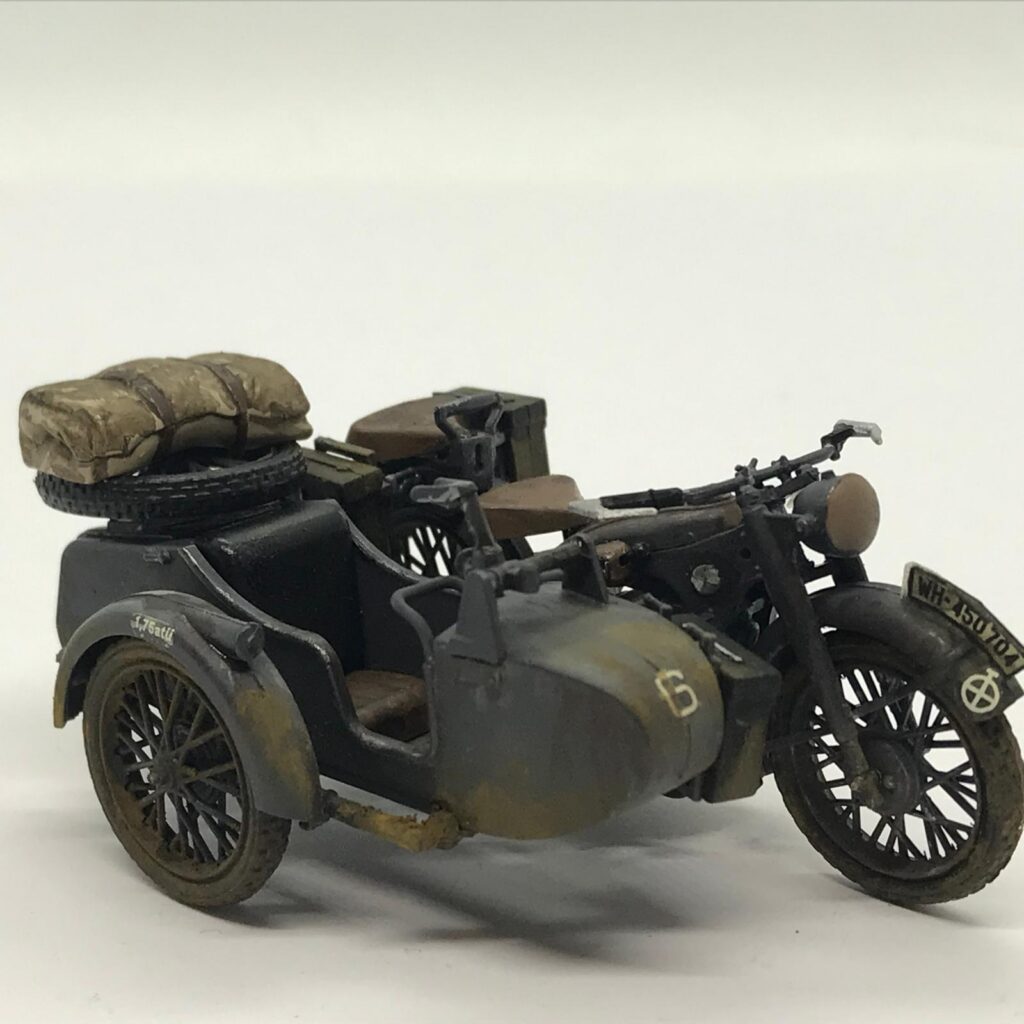
Attaching the sidecar changes the appearance of the entire model. The horizontally opposed cylinders and slim motorcycle wheels are no longer the only points of interest: the sidecar body, rear luggage compartment and the equipment loaded around it become just as important to the composition.
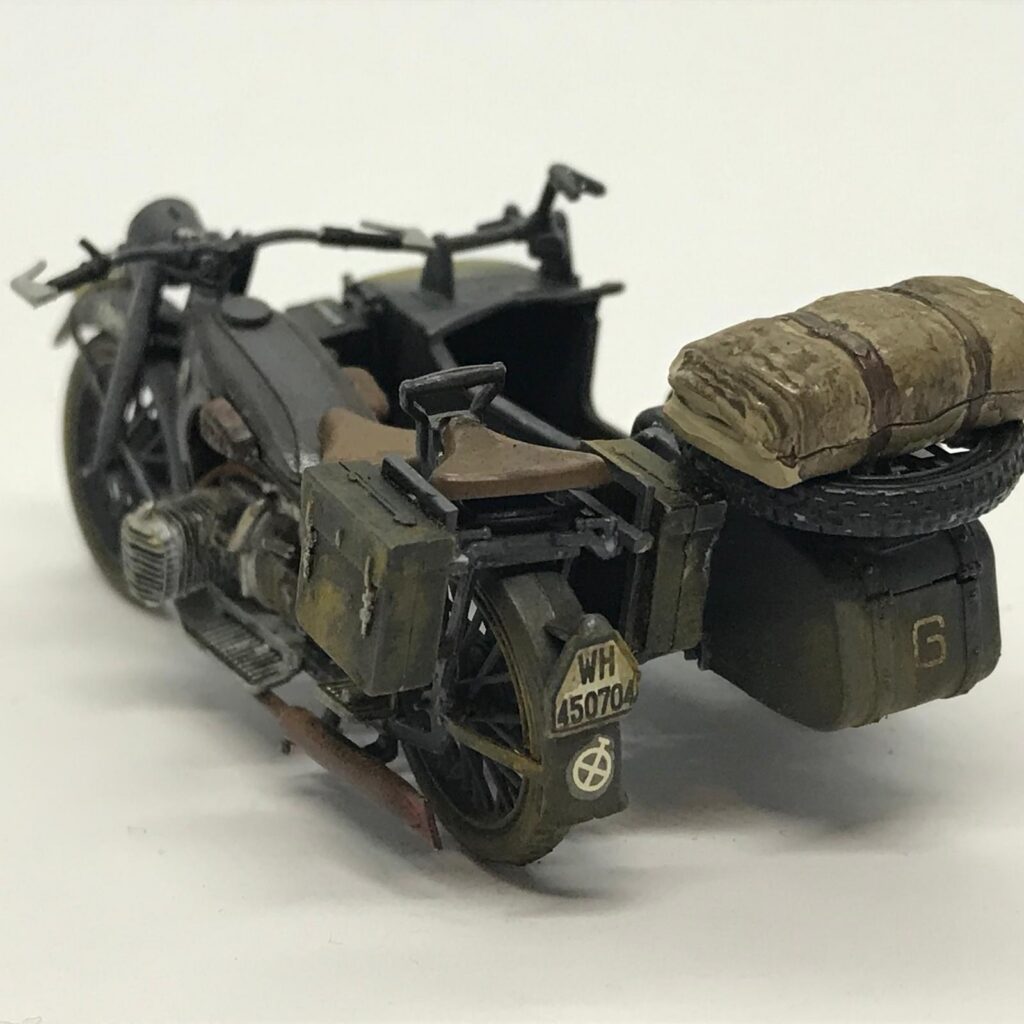
These details help explain why the R12 could serve as more than a means of getting one rider from one location to another. The markings and equipment arrangement on my model have not been independently matched to a specific wartime unit, however, and I do not present them as evidence for a particular formation.
Painting the rider figure
I also included the rider in the sidecar configuration. Tamiya XF-15 Flat Flesh was among the colours I used to paint this figure. I do not have a complete record of the other figure paints or the exact sequence in which they were applied, so I have not attempted to reconstruct that process from memory.
The kit’s most unexpected detail: A pig in the sidecar
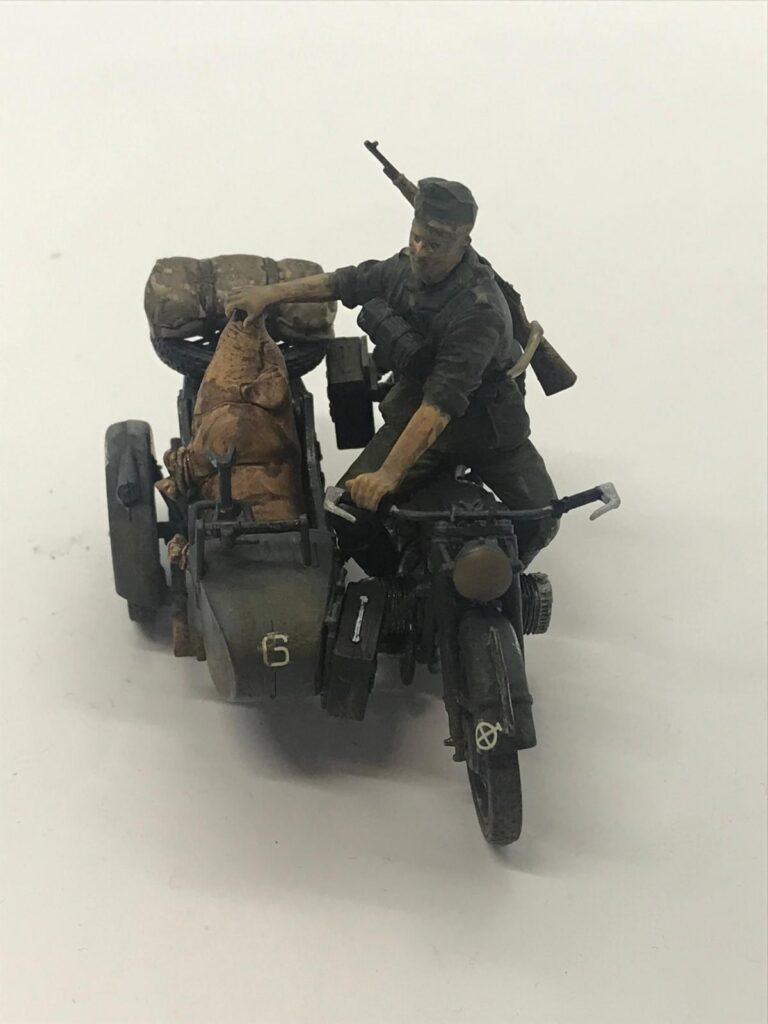
One of the details I remember most vividly about this kit is the pig carried in the sidecar. It is not an accessory you would normally expect to find in a military motorcycle box.
Yet Zvezda’s instruction sheet includes a wartime black-and-white photograph alongside the parts for “Assembling Version 2.” The photograph shows a military motorcycle carrying an animal in its sidecar. The instructions credit the image to J. Piekalkiewicz’s book Die BMW Kräder R12/R75 im Zweiten Weltkrieg. This suggests that the animal was included as a reference to a historical photograph, rather than simply as an imaginary addition. [6]
For me, this small scene is a reminder that wartime vehicles did not carry only soldiers and weapons. They also belonged to the practical, sometimes surprising routines of everyday life and supply. The instruction-sheet excerpt does not establish a reliable date, location or unit for the photograph, so I have not assigned it to a particular operation.
The reproduction rights to that historical image have not been confirmed. Accordingly, I am showing only my own scale-model photographs here.

From the BMW R12 to the Dinner at War diorama
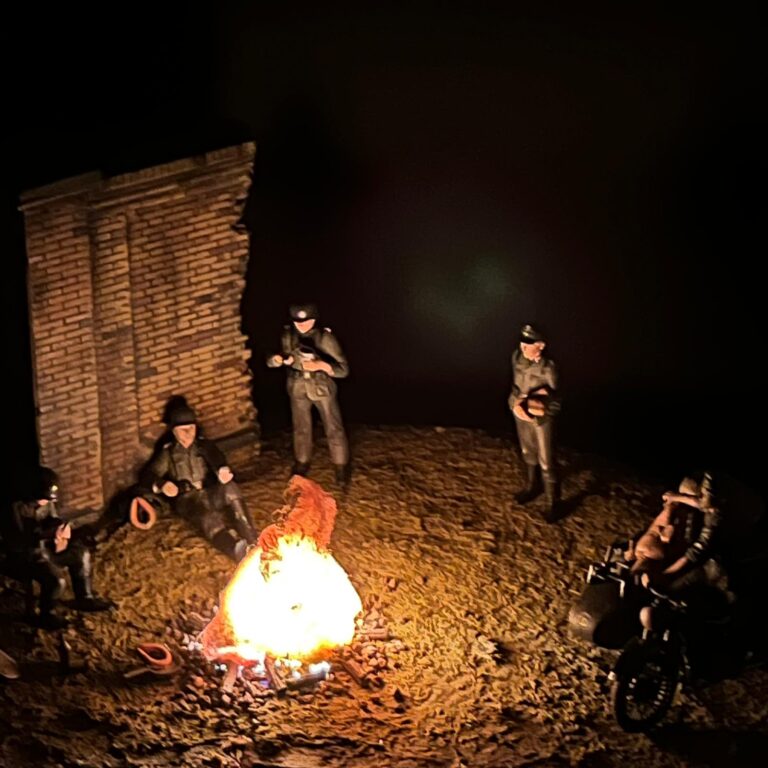
I later used this motorcycle in my Dinner at War diorama. For that scene, the Zvezda R12 was combined with Tamiya 35129 German Soldiers at Rest figures and MiniArt 35547 Brick Wall.
Rather than depicting combat, the diorama focuses on a brief moment of rest. Different shades of paint on the brick wall, pigments and a small lighting arrangement used to simulate fire helped set the atmosphere.
In this dossier I have concentrated on the motorcycle’s history and the details of its scale model. The construction of the diorama, its figures and the lighting effect deserve a separate account in Dinner at War. That allows the two articles to complement each other rather than repeat the same gallery.
Related dossier: Dinner at War
Conclusion
The BMW R12 represents a point where 1930s motorcycle engineering met the everyday demands of wartime transport and communications. Its hydraulically damped telescopic fork, boxer engine and shaft drive speak to its technical origins, while its sidecar configuration shows how a road machine could be adapted to different tasks.
Building Zvezda’s 1/35 scale kit gave me a chance to focus on the smaller mechanical details, the contrasts between materials and a relatively limited palette of colours. By the time the rider, sidecar and unusual cargo had been added, the finished model had become more than a miniature motorcycle: it was a small story in its own right.