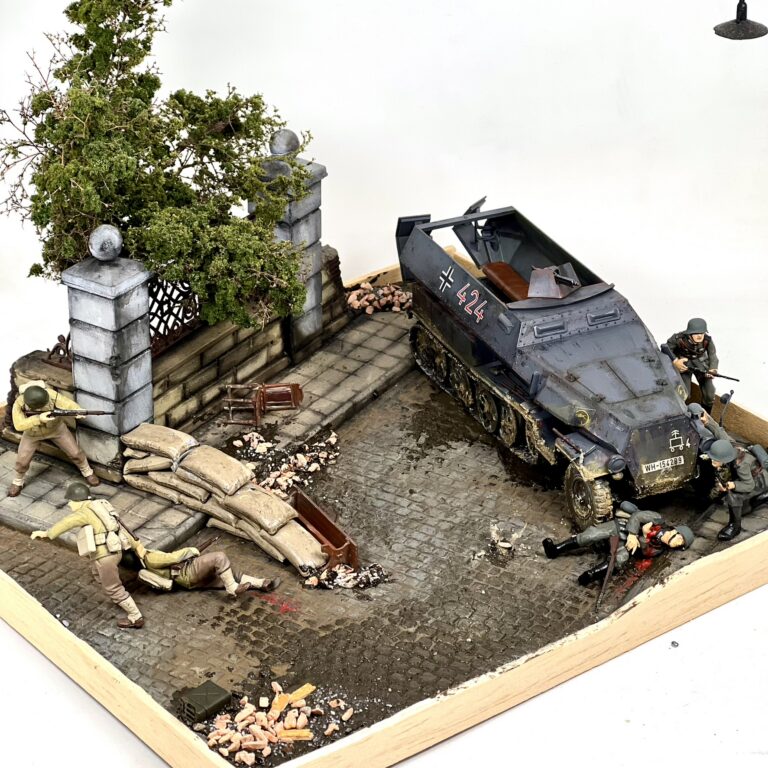
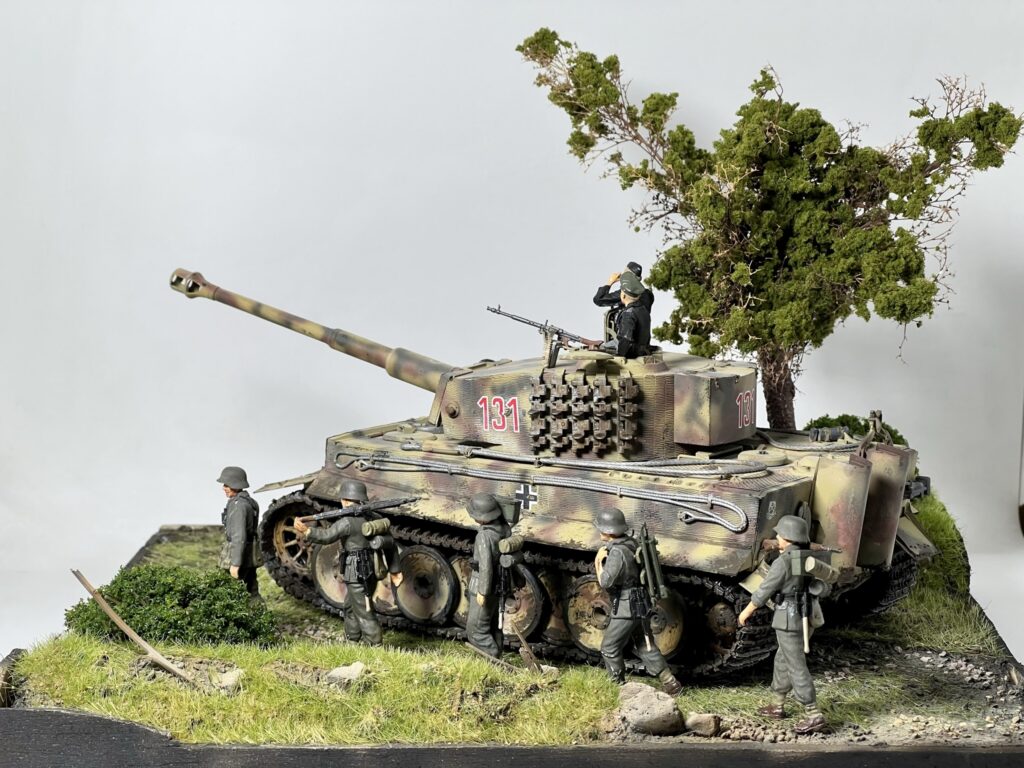
A Normandy-inspired scene completed in July 2022, bringing my Tamiya 1/35 Tiger I Mid Production together with marching infantry and a rural landscape.
Giving the Tiger a Setting
Finishing a tank model and telling a story around it are two different things. In June 2022, I completed my Tamiya 1/35 Tiger I Mid Production bearing turret number 131. The Eduard Big Ed details and Zimmerit had made it a particularly enjoyable project. A month later, the same model became the centre of a new scene: a Tiger moving through the Normandy countryside with infantry alongside it.
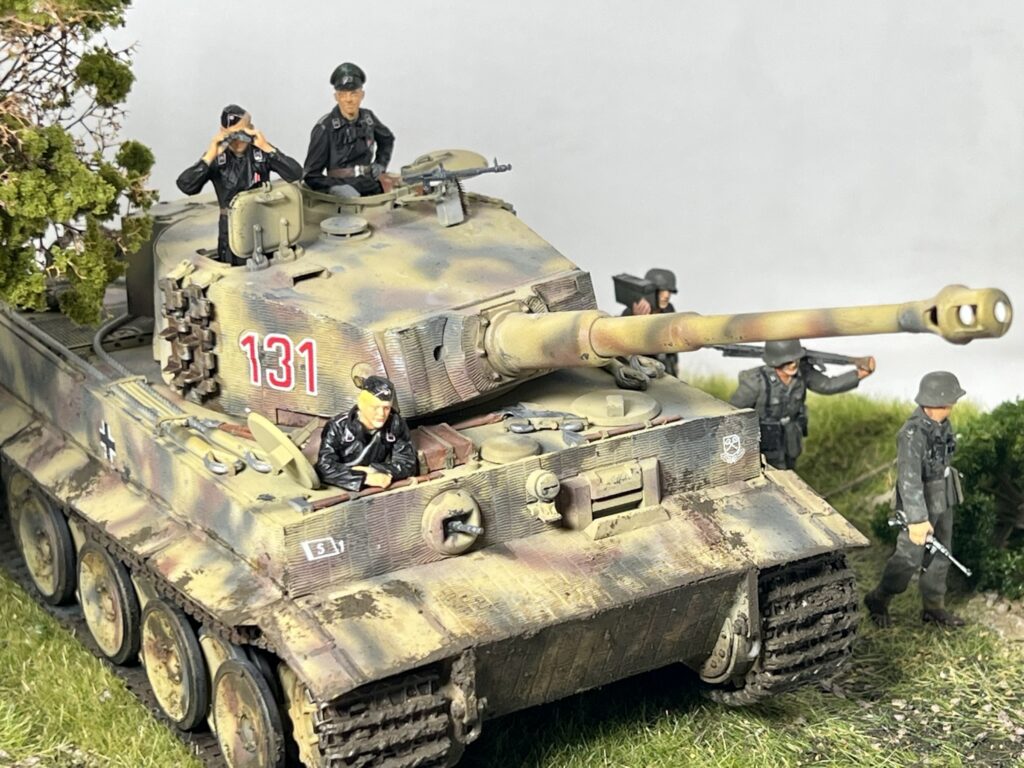
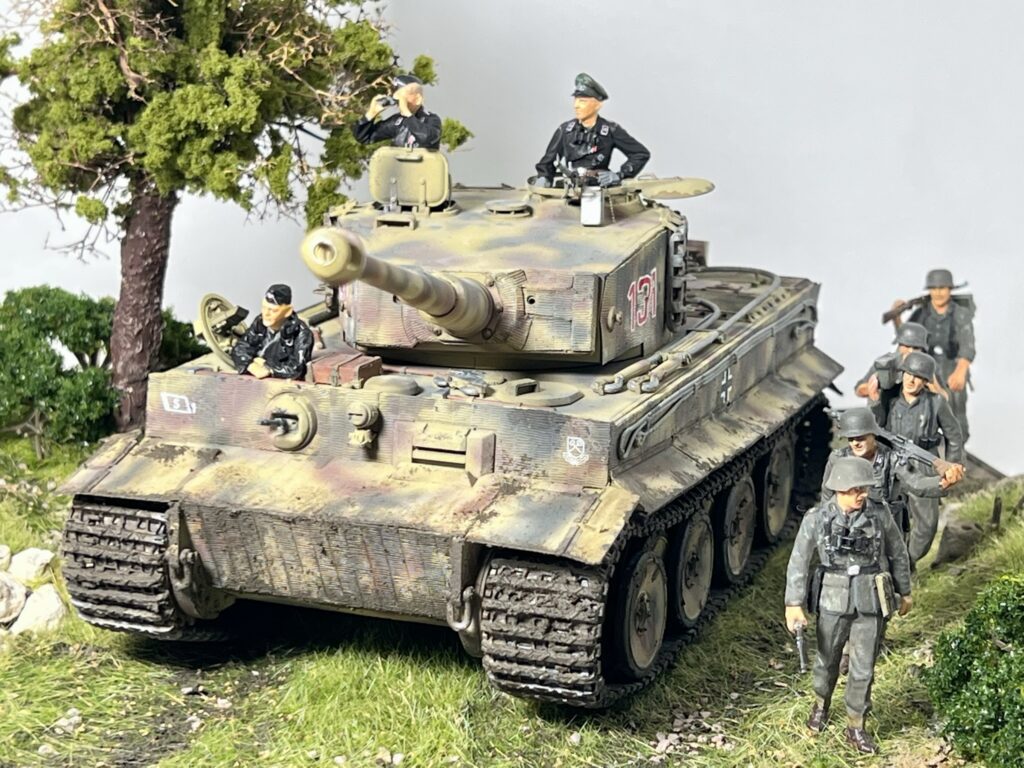
I finished the diorama in July 2022. Rather than depict the most dramatic moment of a battle, I wanted to suggest a unit on the move. The infantry walking beside the tank, the crew observing their surroundings from open hatches, and the rural track all make movement itself the subject of the scene.
The Historical Connection
The starting point was the marking option in Tamiya’s instructions identifying Tiger 131 with the 101st SS Heavy Panzer Battalion in Normandy, July 1944. An actual Tiger carrying that tactical number appears in a wartime Bundesarchiv photograph taken in a French settlement. Its identification, the unit’s history, and the competing dates assigned to that photograph are discussed in my companion article, Tiger I 131: On the Road to Normandy — History and a Tamiya 1/35 Build.
This diorama is not a frame-by-frame reconstruction of that photograph. There is no village church or identical accompanying vehicle here. Instead, the tank occupies a tree-lined, grassy country track with soldiers moving beside it. It is an original scene inspired by the Normandy campaign, not evidence that these specific soldiers accompanied the historical tank on a particular day.
Related dossier: Tiger I 131: On the Road to Normandy — History and a Tamiya 1/35 Build
The Groundwork: A Road Through the Countryside
The photographs show the display base before the tank and figures were added. A dark-edged base supports gently uneven ground, a route with exposed earth and small stones, grass in varying lengths, and patches of low vegetation.
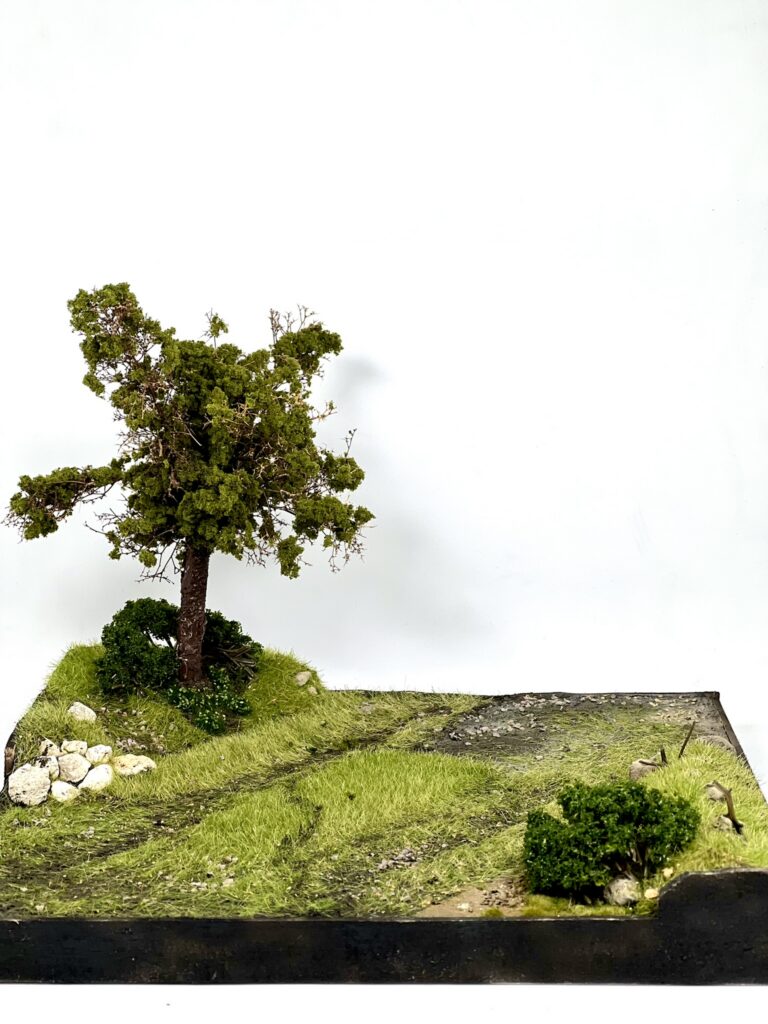
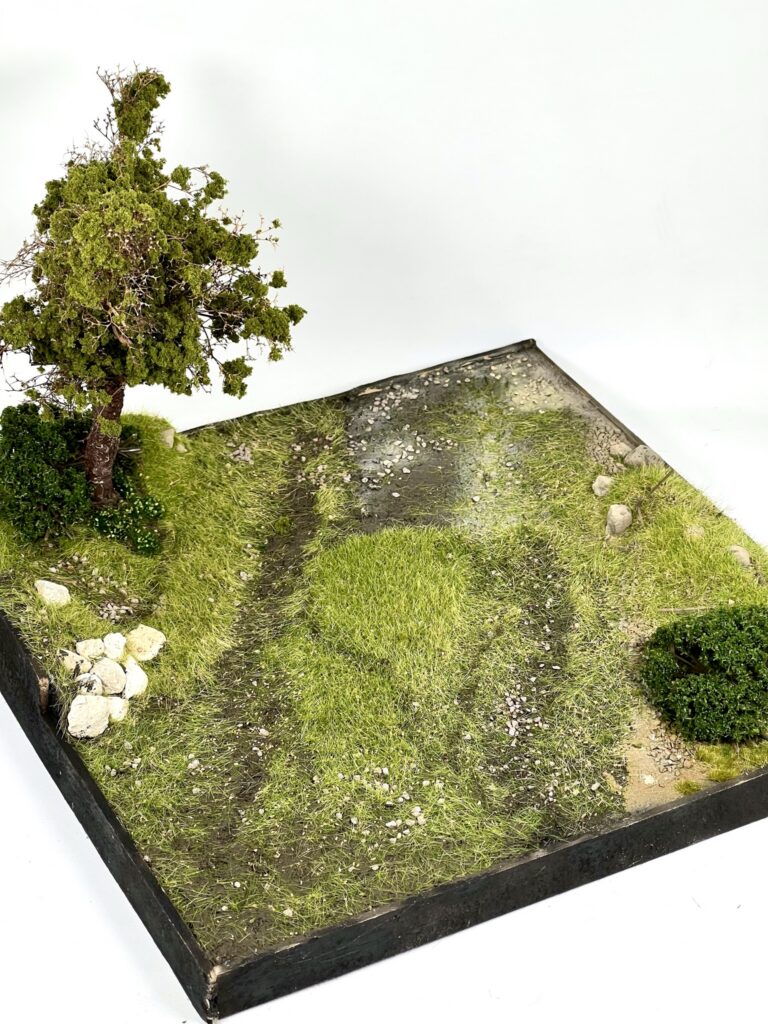
The tall tree rising from one side of the scene is its most distinctive landscape element. The textured trunk, delicate branches and uneven clumps of foliage bring height and a sense of scale. Stones, shrubs and small changes in ground colour help break up the grassy surface.
I placed the Tiger at a slight diagonal. This allows the front armour, a row of road wheels and tracks, and the 131 turret markings to remain visible from the main viewing angle. Even within a compact base, the positioning suggests direction and motion.
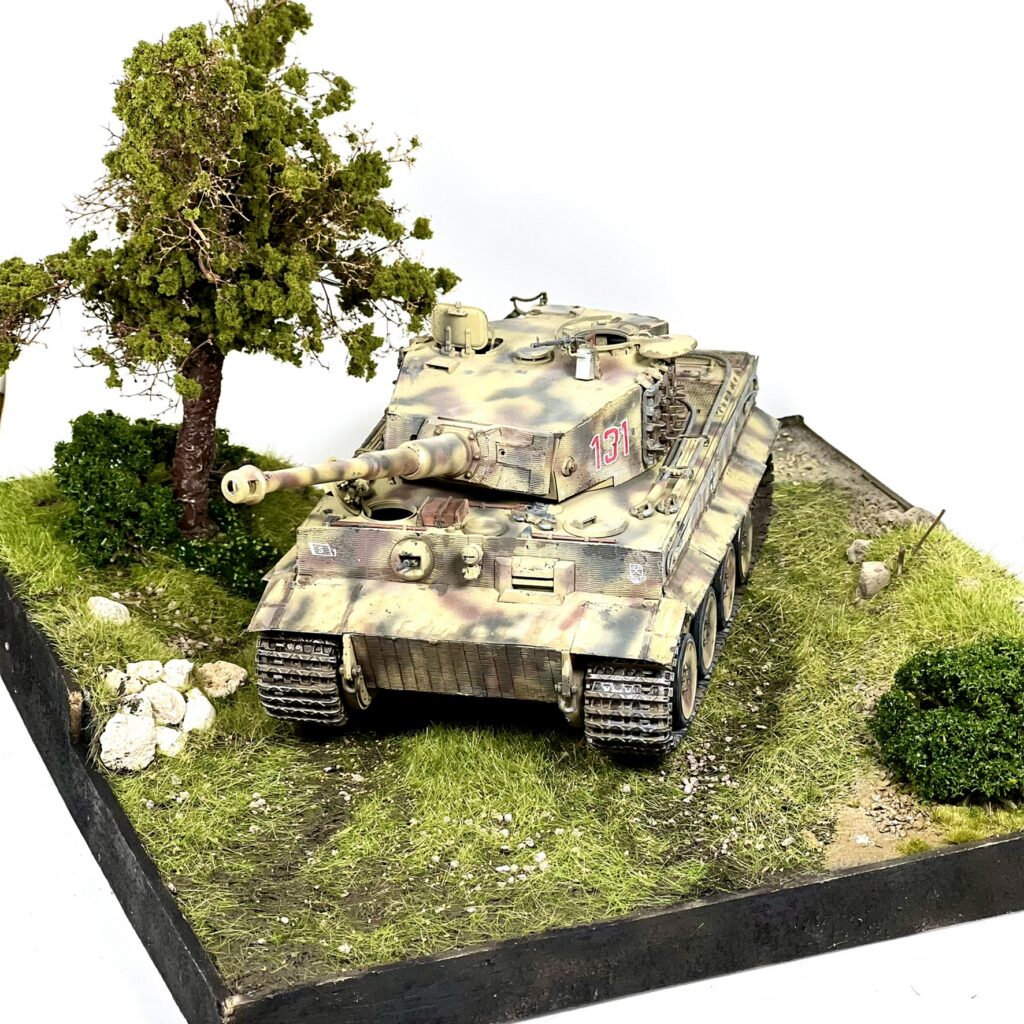
I cannot reliably identify the brands or product numbers of the ground and foliage materials today. The photographs support a description of the visible work, but I would rather leave a material field open than assign a manufacturer from guesswork.
The Figures Tell the Story
The scene comes to life through the infantry beside the tank and the crew on board.
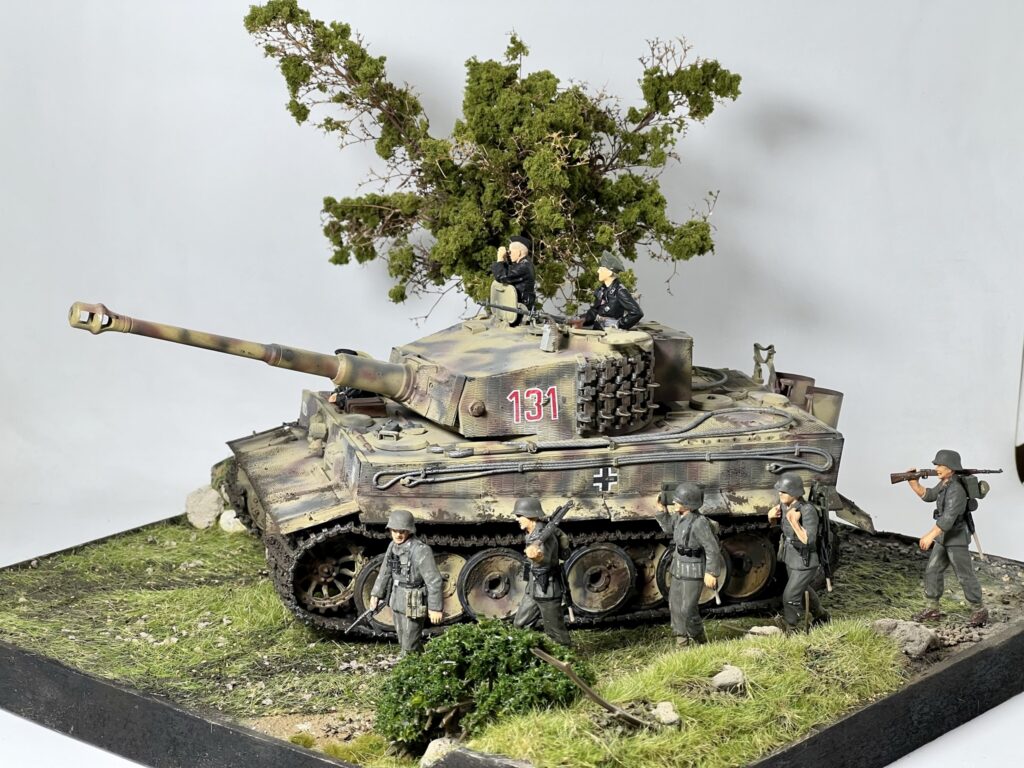
The soldiers move along one side of the vehicle, but they do not all stand in the same pose. Some carry weapons in their hands, others over their shoulders; packs and equipment add variation. Their different gestures avoid the stiffness of a parade-ground formation.
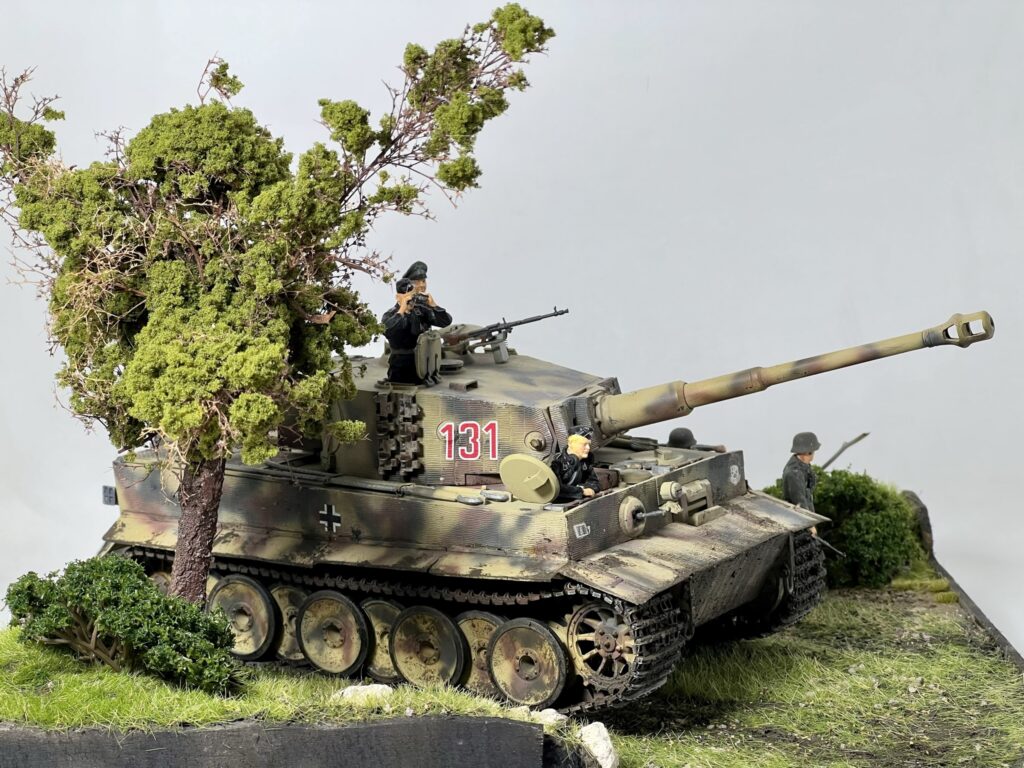
Figures in the open hatches offer a second focal point. A crewman using binoculars draws the viewer’s eye above the marching infantry, while another figure stands in an open hatch. Some photographs also show a crew figure in the open forward hull position.
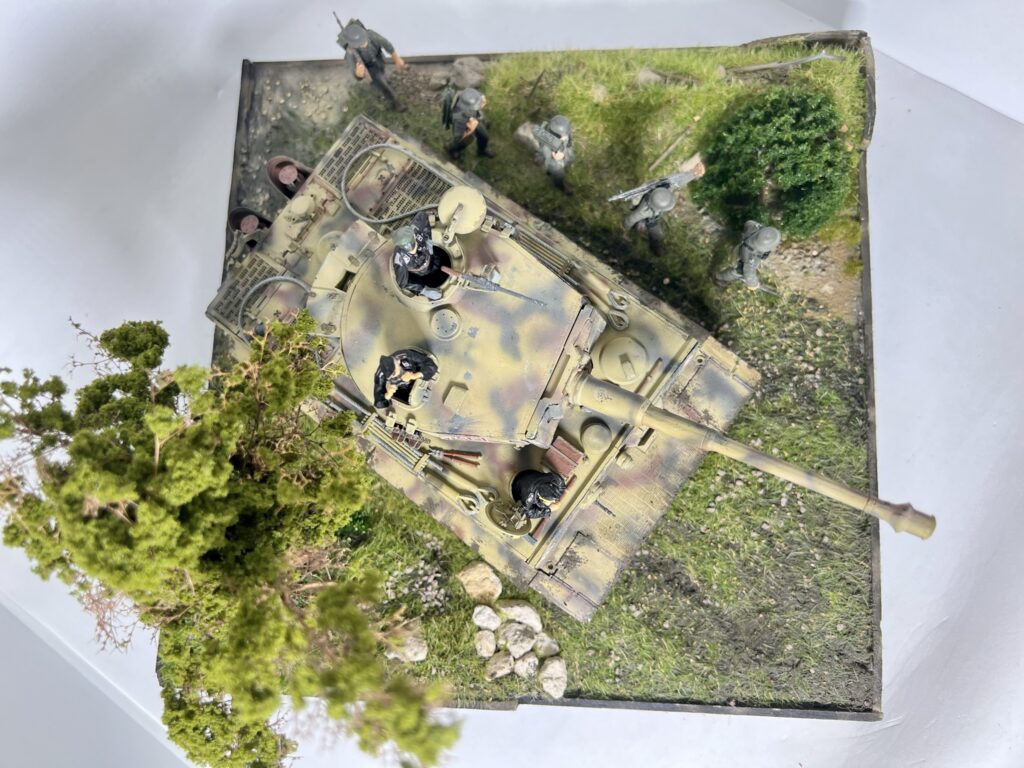
The five infantry figures walking alongside the tank come from Tamiya 35184 — German Machine Gun Crew on Maneuver (1/35). The kit portrays five members of a machine-gun team on the move, with weapons and field equipment that give the marching group a purposeful rhythm. Tamiya describes their uniforms as M43-style field dress worn from 1943 onwards. This makes the set plausible for a Normandy 1944 setting, but does not establish that those specific soldiers accompanied the historical Tiger 131.
The kit source for the tank crew figures in and around the open hatches has not yet been confirmed. I am keeping those figures separate from the five-man infantry set in the project records. Exact uniform and insignia accuracy can be assessed against historical references later.
The Same Tiger, a New Chapter
The Tiger in this diorama is the very same model I finished in June 2022. I have therefore kept the full kit-build story, Eduard Big Ed upgrades, Zimmerit application and Tamiya XF/X paint records in the main Tiger I 131 History + Model Dossier, rather than repeat them here.
Nevertheless, those details take on a different character in the landscape. The Zimmerit texture, spare track links on the turret, fine engine-deck fittings, weathered exhausts and three-colour camouflage stand out against the green surroundings. Parts that appear as individual technical achievements in standalone photographs now help tell the story of a vehicle in use.
Historical Accuracy and Artistic Interpretation
The presence of German armour and infantry in Normandy fits the wider historical setting. However, the scene should not be described as a literal recreation of the photograph of 131 outside the church in Morgny. The environment differs, and no evidence has been established that the infantry figures depicted here marched alongside the actual Tiger 131.
The historical claim is deliberately limited: this is a scale modeller’s interpretation of troop movements in rural France in 1944, built around Tamiya’s Normandy 131 markings. The documented history of the real tank and my imagined composition remain distinct.
Final Thoughts
What I like most about this diorama is how the Tiger changes from a model on display into part of a moving group. The tree, track, grass and infantry do more than fill the empty space around the vehicle; they broaden the story it can tell.
The tank was finished in June 2022. By July, it had gained a completely different presence. I could keep all the small details I enjoyed adding to the Tiger and place them within a single landscape.
A project that began with the history of a real machine continues as a story in scale.