I did not choose the Miles Magister because it was an impressive combat aircraft. I wanted to add a modest training aeroplane in Turkish markings to my collection. Special Hobby’s 1/48 Hi-Tech kit offered exactly that.
The kit: Special Hobby SH48149
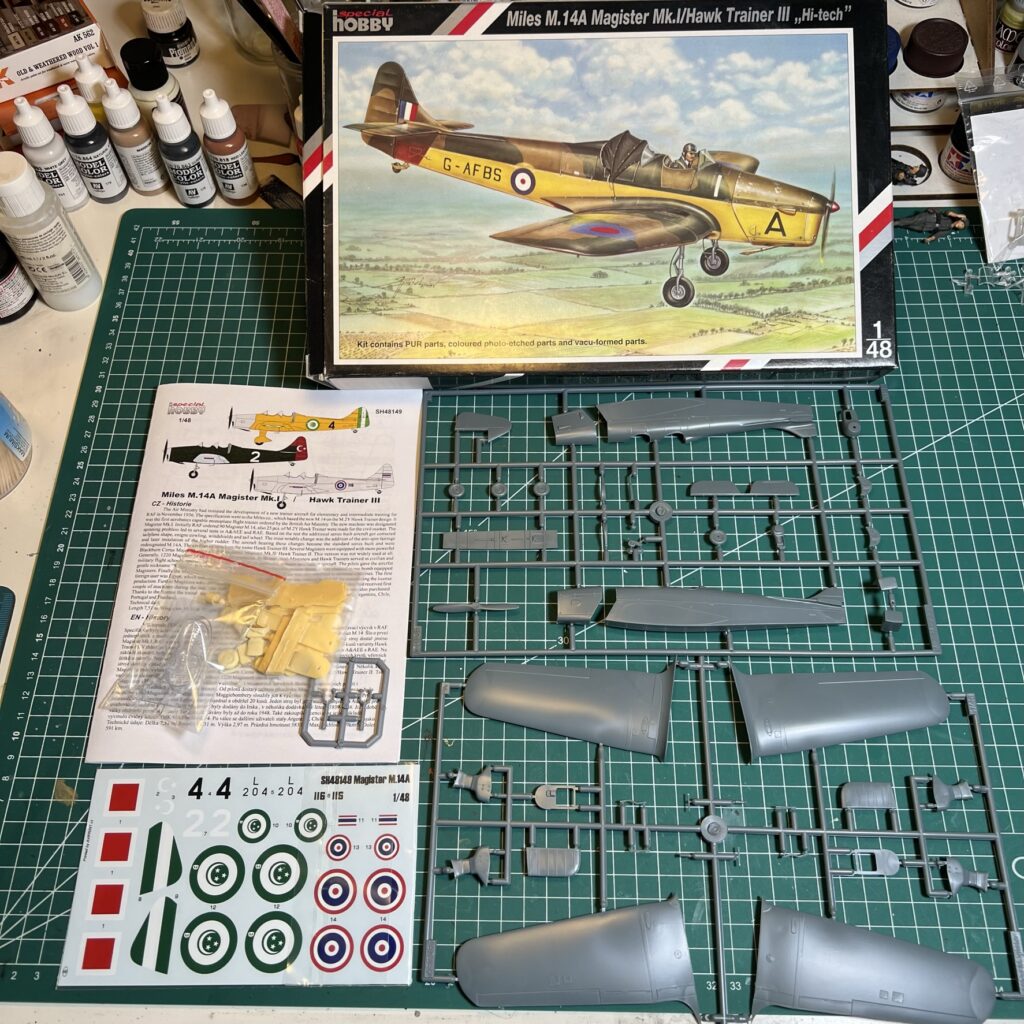
The boxing I used was Special Hobby SH48149 – Miles M.14 / M.14A Hawk III / Magister Mk.I in 1/48 scale. Alongside the plastic airframe parts, the Hi-Tech package supplied cast-resin and photo-etched metal details. Its marking options included aircraft in Turkish, Egyptian and Thai service.
The Hi-Tech label might suggest a complicated project, but the Magister itself was a remarkably simple aircraft. There were relatively few major components, and the straightforward airframe made the general assembly enjoyable rather than demanding.
Working with resin and photo-etch
I used the resin and photo-etched parts included in the kit. They improved areas such as the cockpit without fundamentally changing the character of the aircraft. The one part of the build I found genuinely awkward was joining the resin components to the plastic ones. Getting different materials to fit together was less straightforward than assembling the ordinary styrene parts.
Otherwise, the fit was quite manageable. I did not need extensive filler or sanding. This was not one of my builds dominated by seam repairs; it was a fairly easy little model with a modest mixed-media challenge.
Painting the Turkish aircraft
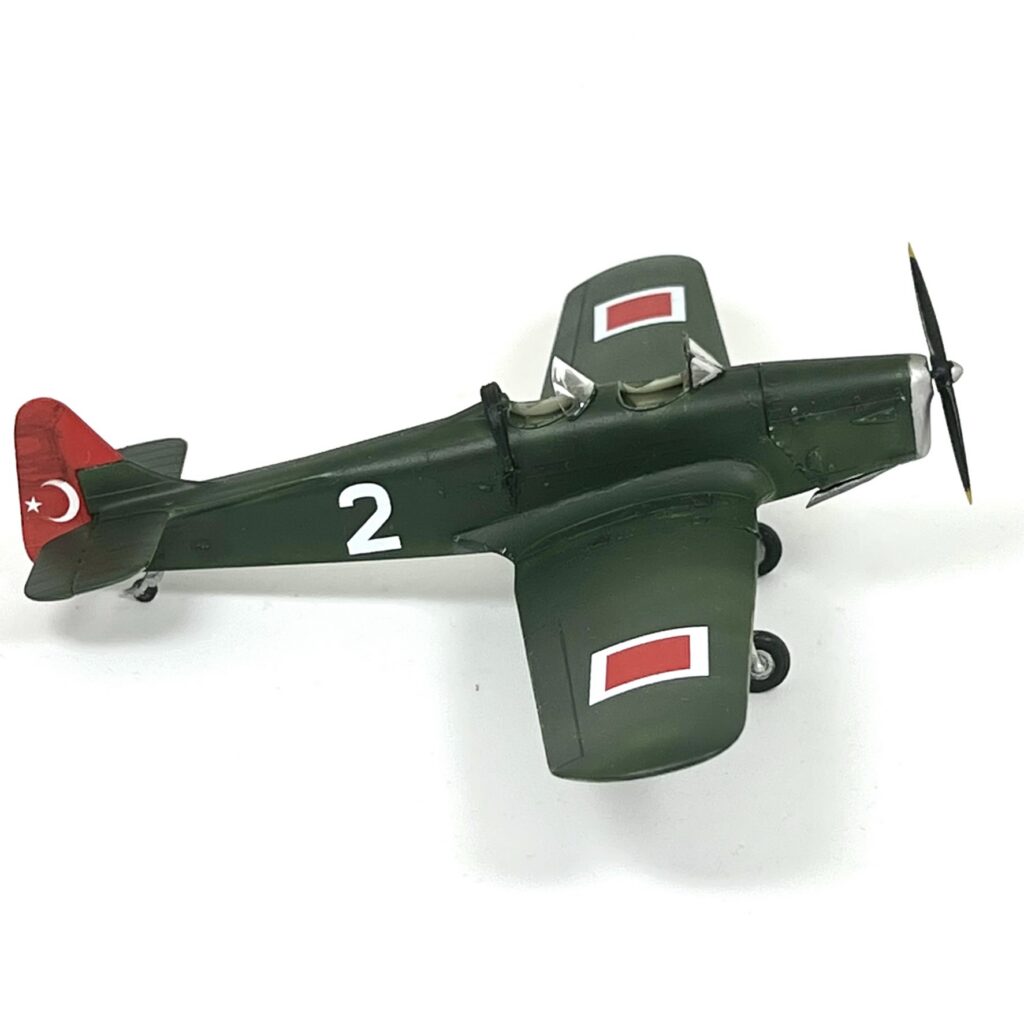
I selected the Turkish aircraft provided in the box. My completed model has a dark-green airframe, red-and-white national markings, a crescent and star on the rudder, and a large white “2” on the fuselage. I followed the kit’s painting and decal instructions throughout, without inventing an alternative colour scheme or undertaking a separate historical repaint.
There is an important distinction between following the kit scheme and establishing absolute historical accuracy. The precise “2” marking is not beyond dispute; the companion history dossier explains why “02” is sometimes discussed in relation to Turkish Magister photographs.
The finished model
I completed the Magister in February 2022. It was a simple, satisfying project, with the resin-to-plastic joints providing most of the challenge. The dark-green finish and strong contrast of the Turkish markings give the finished model a distinctive appearance despite its understated design.
For me, it is another small piece of Turkish aviation history represented on the model shelf.
The real aircraft in Turkish service
The Miles Magister joined the Turkish inventory in 1941 and was also manufactured locally under licence. Its use in flying schools and the story of production at Kayseri and Etimesgut are covered in the separate historical dossier.